Mar 29, 2025 | লেখালেখি
ভূমিকা:
বাংলাদেশ দক্ষিণ-পূর্ব এশিয়ার একটি ক্ষুদ্র কৃষিপ্রধান দেশ। হিমালয়ের পাদদেশে নদীবিধৌত পলিমাটি দিয়ে গঠিত কৃষি উপযোগী উর্বর জমি ও জলবায়ু নিয়ে এই ভূখন্ড গঠিত। একসময় এ দেশের কৃষকের ঘরে ঘরে ছিল গোলাভরা ধান, পুকুরভরা মাছ আর গোয়ালভরা গরু। “মাছে-ভাতে বাঙালী” একটি সর্বজনবিদিত প্রবাদ। এ দেশের ইতিহাস স্বনির্ভর কৃষি ও জুম চাষের এক সফল ইতিহাস। স্বাধীন ও স্বয়ংসম্পূর্ণ অর্থনীতির উপর নির্ভরশীল ছিল এ দেশের গ্রামীণ সমাজ ব্যবস্থা। কৃষক ছিল স্বনির্ভর। কেবলমাত্র কেরোসিন ও লবণ জাতীয় দ্রব্য ছাড়া জীবন ধারণের জন্য প্রয়োজনীয় কোন দ্রব্যের জন্য তাঁদেরকে পরমুখাপেক্ষি হতে হত না। খাঁটি সোনার চেয়েও খাটি ছিল এ দেশের মাটি। সহজে ও অল্প পরিশ্রমেই জমিতে ফসল ফলাতো এ দেশের কৃষক।
পদ্মা-মেঘনা-যমুনা বাহিত পলিমাটিতে কৃষি উৎপাদন সহজ ছিল বিধায় ভারতবর্ষের বিভিন্ন অঞ্চলের মানুষ জীবনধারণের জন্য বাংলায় এসে স্থায়িভাবে বসবাস করতে আরম্ভ করে। যার ফলে, ভারতের অন্যান্য অংশের চেয়ে এ অঞ্চলের জনসংখ্যার ঘনত্ব ছিল সব সময় বেশি। বাংলার সমৃদ্ধির যুগে কৃষকরা শুধু খাদ্যই উৎপাদন করত না, তারা নিজেদের ও স্থানীয় চাহিদা পূরণের জন্য কৃষি উপকরণাদি, কৃষি ভিত্তিক শিল্পজাত দ্রব্য এবং ভোগ্যপণ্যও উৎপাদন করত। এ দেশের বস্ত্র শিল্প ও মসলিন ছিল পৃথিবীবিখ্যাত। তা ছাড়া, কামার, কুমার, তাতী, ছুতারসহ নানা পেশার মানুষ মিলে গ্রামে-গঞ্জে গড়ে তুলেছিল নানা ধরণের ক্ষুদ্র ও কুটির শিল্প। এই ভূখন্ডের অঢেল সম্পদের লোভে এবং এ দেশের মানুষের সরলতা, বিভিন্ন ধর্ম-বর্ণ-গোত্রে বিভক্তি এবং অসংগঠিত অবস্থার সুযোগকে কাজে লাগিয়ে তুর্কী, মোঘল, পাঠান, পর্তুগীজ, মারাঠী, ওলন্দাজ, ফরাসী এবং ব্রিটিশ বেনিয়ারা এ দেশে এসে কায়েম করে জুলুম, নির্যাতন, শোষণ ও লুটপাটের রাজত্ব। আর তখন থেকেই এ দেশের কৃষকের ভাগ্যে নেমে আসে সীমাহীন দুর্ভোগ। এর পর থেকে এ দেশের কৃষকের ইতিহাস শোষণ ও বঞ্চণার এক করুণ ইতিহাস।
আজও এ দেশের সংখ্যাগরিষ্ঠ কৃষক জনগোষ্ঠী নানাবিধ সংকটে আকন্ঠ নিমজ্জিত। দেশের বিশাল জনসংখ্যার খাদ্য চাহিদা মিটানোর দায়ভার কৃষকের কাধে চাপিয়ে দিয়ে উৎপাদন বাড়ানোর নামে এমন এক কৃষি ব্যবস্থার বেড়াজালে কৃষককে ধীরে ধীরে জড়িয়ে ফেলা হয়েছে যেখান থেকে বেরুনোর আর কোন পথই যেন খোলা নেই। গত কয়েক দশক ধরে ফসলের প্রধানত দানাশস্যের ফলন বাড়াতে গিয়ে দেশীয় কৃষি উপকরণনির্ভর স্থায়িত্বশীল কৃষি প্রযুক্তির উদ্ভাবন এবং ব্যবহারের দিকে যথেষ্ট গুরুত্ব না দিয়ে ক্রমবর্ধমান হারে সেচ, রাসায়নিক সার, বালাইনাশক এবং অন্যান্য বাজারনির্ভর এবং আমদানিনির্ভর কৃষি উপকরণের ব্যবহারকে ঢালাওভাবে উৎসাহিত করা হয়েছে। ফলে, একদিকে যেমন ফসলের উৎপাদন ব্যয় এ দেশের সংখ্যাগরিষ্ঠ ক্ষুদ্র ও প্রান্তিক কৃষকের সাধ্যের বাইরে চলে গেছে অন্যদিকে তেমনি মাটির উর্বরতা ও উৎপাদন ক্ষমতা হ্রাস, ফসল চাষের ঝুঁকি বৃদ্ধি, সেচ সংকট, সার সংকট, বীজ সংকট, ভেজাল বীজ-সার-বালাইনাশক এবং জলবায়ুগত পরিবর্তনের ফলে প্রাকৃতিক দুর্যোগ বৃদ্ধিসহ নানাবিধ সংকট ও সমস্যায় কৃষক আজ দিশেহারা হয়ে পড়েছে। তা ছাড়া মানবস্বাস্থ্য, পরিবেশ এবং জীববৈচিত্র্যও আজ মারাত্মক হুমকির সম্মুখীন। সর্বোপরি ধ্বংস হচ্ছে এ দেশের হাজার বছরের স্বনির্ভর, সমন্বিত ও স্থায়িত্বশীল কৃষি ব্যবস্থা।
একথা সত্য যে, বর্তমান কৃষি ব্যবস্থায় দানাদার শস্যের উৎপাদন অনেকগুণ বেড়েছে কিন্তু তার সুফল কৃষকের ঘরে উঠছেনা। মুক্ত বাজারের কারসাজিতে অনেক ক্ষেত্রে উৎপাদন খরচের চেয়ে কম মূল্যে কৃষককে তার উৎপাদিত পণ্য বিক্রী করে দিতে হচ্ছে। এভাবে ভর্তুকী দিয়ে, নিজে না খেয়ে কৃষক এ জাতির মুখে অন্ন তুলে দিচ্ছে। অন্যদিকে, ক্রমবর্ধমান হারে রাসায়নিক সার ও বালাইনাশক প্রয়োগ করা সত্ত্বেও গত প্রায় দুই দশক ধরে দেশের প্রধান শস্য ধান ও অন্যান্য শস্যের ফলনে স্থবিরতা লক্ষ্য করা যাচ্ছে। অথচ, একই সময়ে সেচ, বালাইনাশক ও রাসায়নিক সারের ব্যবহার বেড়েছে বহুগুণ। ধানের উৎপাদন আমাদের চাহিদা অনেকাংশে মেটাতে সক্ষম হলেও ডাল, তেল, মশলা ও ফল উৎপাদনে যথেষ্ট ঘাটতি রয়েছে যা প্রচুর পরিমান বৈদেশিক মুদ্রা খরচ করে আমদানি করতে হচ্ছে। তা ছাড়া, অধিক ফলনের আশায় এ ধরণের চাষাবাদের ফলে আমাদের বীজের নিয়ন্ত্রণ তথা খাদ্যের নিয়ন্ত্রণ চলে যাচ্ছে দেশী-বিদেশী কোম্পানির হাতে যা আমাদের খাদ্য নিরাপত্তাকে আরও হুমকির মুখে ফেলে দিবে।
কৃষি এখনও এ দেশের গ্রামের মানুষের প্রধান পেশা। দেশের জাতীয় আয়ের প্রায় এক পঞ্চমাংশের উৎস হল কৃষি। শতকরা ৬০ ভাগেরও বেশি মানুষ সরাসরি কৃষির উপর নির্ভরশীল। কিন্ত এ দেশের কৃষির সেই সমৃদ্ধ অতীত ঐতিহ্য আজ কালের গর্ভে বিলীন হয়েছে। বদলে গেছে কৃষকের গোলা ও গোয়ালের মালিকানা। অধুনা বাণিজ্যিক বিশ্বায়ন ও বহুজাতিক কোম্পানির বাণিজ্যিক আগ্রাসনের কবলে পড়ে এ দেশের কৃষি ও কৃষক অতিক্রম করছে এক কঠিন ক্রান্তিকাল। আগামী দিনগুলো হবে আরও আধার ঘেরা, আরও ভয়ংকর। দ্বিতীয় বিশ্বযুদ্ধোত্তরকালে বৃটিশ বেনিয়া শাসকগোষ্ঠী এ দেশ থেকে বিতাড়িত হলেও নব্য ইস্ট ইন্ডিয়া কোম্পানিরূপী বহুজাতিক কোম্পানিগুলো এ দেশের প্রায় ১৭ কোটি মানুষের বিশাল বাজার দখলের লক্ষ্যে আজ এক ভয়াবহ নীল-নকশা বাস্তবায়নের পথে সাফল্যের সাথেই এগিয়ে চলেছে। প্রকৃতপ্রস্তাবে, তৃতীয় বিশ্বের দেশগুলোর বিশাল বাজার দখলের লক্ষ্যকে সামনে রেখেই গঠন করা হয়েছে বিশ্ববাণিজ্য সংস্থা। বিশ্ব বাণিজ্য সংস্থার কৃষিচুক্তি ও ট্রিপস চুক্তির সহায়তায় এ দেশের কৃষিপণ্য ও স্থানীয় প্রযুক্তির বাজারকে ধ্বংস করে দিয়ে বহুজাতিক কোম্পানিগুলো তাদের কৃষিপণ্য এবং প্রযুক্তির একচেটিয়া বাজার প্রতিষ্ঠার সবরকম ব্যবস্থা পাকাপোক্ত করছে। এতে যে শুধু এ দেশের কৃষি ও কৃষকই ক্ষতিগ্রস্থ হচ্ছে তাই নয়, দেশের স্বাধীনতা ও সার্বভৌমত্বও আজ হুমকির মুখে পড়ছে। কারণ, দেশের নীতি নির্ধারণের ক্ষেত্রে দাতা দেশ ও সংস্থাসমূহের নগ্ন হস্তক্ষেপ আজ সর্বজনবিদিত।
দুঃখজনক হলেও সত্যি যে, এ দেশের কৃষি, কৃষক এবং সর্বোপরি দেশের এরূপ সংকট মোকাবিলায় স্বাধীনতা পরবর্তী সরকারগুলোর ভূমিকা ও উদ্যোগ অত্যন্ত হতাশাব্যঞ্জক। স্বাধীনতার পূর্বে ক্ষমতাসীন শাসকগোষ্ঠী এ দেশের কৃষি ও কৃষকের উন্নয়নকে স্বাভাবিকভাবেই অবজ্ঞার চোখে দেখেছে। কিন্তু দুর্ভাগ্যজনক হলেও সত্য যে, স্বাধীনতা অর্জনের পরও আজ পর্যন্ত এ দেশের কোন সরকারই সংখ্যাগরিষ্ঠ গ্রামীণ দরিদ্র কৃষক জনগোষ্ঠীর বিশেষ করে ভূমিহীন, ক্ষুদ্র ও প্রান্তিক কৃষকের (যারা মোট কৃষক জনগোষ্ঠীর শতকরা প্রায় ৮৭ ভাগ) স্বার্থ রক্ষায় কার্যকর কোন ভূমিকা রাখে নি। যে মুক্তির স্বপ্ন নিয়ে এ দেশের আপামর গণমানুষ রক্তক্ষয়ী যুদ্ধের মধ্য দিয়ে স্বাধীন বাংলাদেশ কায়েম করেছিল, সে মুক্তি আজও সুদুর পরাহত। স্বাধীনতার পর বহুল আকাংখিত ভূমি সংস্কারে কোন সরকারই কার্যকর কোন উদ্যোগ গ্রহণ করে নি। স্বাধীনতা লাভের অব্যবহিত পরে বাংলাদেশের প্রথম পরিকল্পনা কমিশন ভুমি সংস্কারের একটি খসড়া সুপারিশমালা প্রণয়ন করে এবং তা বিবেচনার জন্য তৎকালীন মন্ত্রী পরিষদে পেশ করে যা গ্রহণ করা হয় নি। তা ছাড়া, এ সুপারিশমালায় ভূমিহীন, ক্ষুদ্র ও প্রান্তিক কৃষকের উন্নয়নের জন্য সমবায় ব্যবস্থা গড়ে তোলার প্রস্তাব রাখা হয়েছিল, তাও বিবেচনা করা হয় নি।
পক্ষান্তরে, স্বাধীনতাত্তোরকালের সরকারগুলো বিশ্বব্যাংক, আইএমএফ ও এডিবিসহ বিভিন্ন দাতা দেশ ও সংস্থার প্রত্যক্ষ ও পরোক্ষ চাপের মুখে অথবা কায়েমি স্বার্থে যে কাঠামোগত সংস্কার কর্মসূচি বাস্তবায়ন করেছে তা কার্যত ক্ষুদ্র ও প্রান্তিক কৃষককে কৃষি থেকে বিতারণের পথকেই সুগম করেছে। এরূপ কাঠামোগত সংস্কার কৃষিতে দেশী-বিদেশী কর্পোরেশনের অবাধ বাণিজ্যের দ্বার অবারিত করেছে। আর এ দেশের পিছিয়েপড়া কৃষক জনগোষ্ঠী দিন দিন বাজারের দাসে পরিণত হচ্ছে। বহুজাতিক কোম্পানিগুলোর অসম বাণিজ্যের বেড়াজালে কৃষক সমাজ আজ দিশেহারা হয়ে পড়ছে। অথচ বাণিজ্য উদারিকরণের নামে বহুজাতিক কোম্পানিগুলোর বাণিজ্যিক আগ্রাসনের নির্মম শিকারে পরিণত হলেও এ দেশের কৃষকদের মধ্যে তার স্বরূপ উপলব্ধি করার মতো প্রয়োজনীয় তথ্য ও জ্ঞানের যথেষ্ট অভাব রয়ে গেছে।
এমতাবস্থায়, এই কঠিন সংকট মোকাবিলা করতে হলে এ দেশের কৃষকদেরকেই উঠে দাঁড়াতে হবে। কারো মুখাপেক্ষি না হয়ে দলমত নির্বিশেষে কৃষকদেরকেই একমঞ্চে এসে দাঁড়াতে হবে এবং বর্তমান কৃষি ব্যবস্থা ভেঙেচুরে নতুন করে গড়ে তুলতে হবে এক স্বনির্ভর ও স্থায়িত্বশীল কৃষি ব্যবস্থা। খাদ্য ও কৃষির উপর বহুজাতিক কোম্পানির বাণিজ্যিক আগ্রাসন মোকাবিলা এবং খাদ্য নিরাপত্তা অর্জনে আমাদের নিজস্ব সংস্কৃতি ও কৃষ্টির সাথে সামঞ্জস্যপূর্ণ একটি স্থায়িত্বশীল কৃষি ব্যবস্থা গড়ে তোলার কোন বিকল্প নেই। ক্ষতিকর রাসায়নিক সার, বালাইনাশক এবং ব্যয়বহুল কৃষি প্রযুক্তির উপর নির্ভরশীলতা ক্রমশ কমিয়ে এনে স্থানীয় ও প্রাকৃতিক সম্পদের সর্বোচ্চ ব্যবহার নিশ্চিত করার মাধ্যমে এবং শস্য, মৎস্য, প্রাণিসম্পদসহ কৃষির সমস্ত খাতগুলোকে সমন্বিত করে একটি স্থায়িত্বশীল কৃষি ব্যবস্থা গড়ে তোলার জন্য আমাদের রয়েছে প্রচুর সুযোগ ও সম্ভাবনা। এই সম্ভাবনাকে কাজে লাগাতে হলে সবার আগে প্রয়োজন আমাদের সকলের সর্বোপরি নীতিনির্ধারক মহলের সুদৃঢ় রাজনৈতিক সদিচ্ছা এবং অব্যাহত প্রচেষ্টা। এই গ্রন্থে এসব সমস্যার বিশ্লেষণ ও সমাধান খুঁজে বের করার চেষ্টা করা হয়েছে যা নীতি নির্ধারক মহল, গবেষক, কৃষি উন্নয়ন কর্মী এবং সংশ্লিষ্ট সকলের কাজে লাগবে বলে আশা করি।
#বাণিজ্যিক #বিশ্বায়ন #কৃষি #ক্ষুদ্র কৃষক

Mar 29, 2025 | লেখালেখি
Introduction
Although tobacco is a cash crop, it has little importance in terms of essentiality in the context of Bangladesh, which has been facing severe food deficit for combating hunger and malnutrition of the nation. Moreover, tobacco farming has various negative impacts on health, especially women’s & children’s health, the environment, soil, biodiversity, etc. The increase in acreage of tobacco farming will essentially make the issue of food security more difficult to face. In Bangladesh, over 10.5 million people who are currently malnourished could have an adequate diet if money spent on tobacco were spent on food instead, saving the lives of 350 children under age five each day.1 The World Health Organization says that tobacco is responsible for creating a vicious circle of poverty in the world. This is especially true in developing countries. In addition to the economic burden (both on individuals and nations) of treating smoking-related illnesses and the consequent lost productivity, tobacco farmers often become trapped in a cycle of poverty and debt after being forced to sign crippling contracts with the tobacco industry.2 On the other hand, the present trend of contract farming is a great threat both for the farmer as well as the country because it will lead to limiting farmers’ freedom of choice for crop production and hampering the crop diversity as well as biodiversity.
Therefore, the fact sheet is prepared to look into the situation of the tobacco farming at present in Jhenaidah district as well as collect the opinion of the relevant people. The fact sheet is prepared based on the FGDs conducted with tobacco growers in five villages under Jhenaidah district, in-depth interview with ten tobacco growers, five non-tobacco growers, one small traders, one whole sale traders, Upazila agriculture officer and field officer of tobacco company. Some secondary data was also reviewed to prepare the fact sheet.
Tobacco farming is increasing alarmingly
The data on several tobacco growers and their land area under tobacco cultivation in sadar upazila of Jhenaidah district during last three years (2008-2010) is presented in Fig-1 beside. 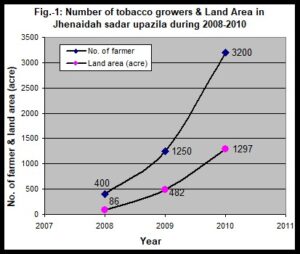 From the graph, it is observed that both the number of farmers and the land area under tobacco cultivation increased alarmingly during the last three years. The situation in the other tobacco-growing areas is quite similar. If this trend remains unchanged, it would be a serious concern for the food security of the country. It is to note that the main reasons behind such an increase are the increase of the price of tobacco in one hand and the decrease of the price of boro rice on the other. In 2009, the price of boro rice was gone down very low while the price of tobacco was very high. The tobacco grower earned a very good profit, which encouraged the other farmers to grow tobacco. In the FGDs, it was found that the farmers have plans to increase their acreage of tobacco in coming years because they have no other suitable options in hand.
Why do farmers cultivate tobacco?
In the FGDs it was asked to the farmers, why they cultivate tobacco. In reply, it was found that the main motivation for the farmers to cultivate tobacco is the marketing facilities. Apart from the profitability aspect, guaranteed market and ready cash play an important role in the farmers’ decision to grow tobacco. Although the tobacco growers, especially the non-card holders, often suffer from various problems like price instability, fraud by the middlemen & company officials in case of price and quality, illogical rejection of tobacco showing reason of low quality, etc., but compared to other crops, tobacco farmers enjoy more satisfaction in tobacco marketing. For the other crops like rice, jute, potato, cotton, sugarcane, vegetables, etc. the farmers suffer a lot in marketing. Often, they are compelled to sell their products at a price lower than their cost of production. But, in the case of tobacco, they are satisfied that tobacco cultivation is more profitable than any other crops that they presently grow, though their calculation of profit is not accurate at all. The other reasons for cultivating tobacco are-
- It is a cash crop which gives the farmer a handsome amount of cash at a time.
- The company provides inputs (in credit) and field-level technical support, which are not available for other crops.
- The farmers often suffer a lot to collect fertilizers for other crops during crisis period but for tobacco, the company supply fertilizers and pesticides to their doors.
- The company provides quality seed free of cost.
- The problems for other crops are increasing, which are also increasing for tobacco, but they get technical support from the company to solve the problems.
- The company provides some other incentives like tree saplings.
Patronisation by different tobacco companies has been an important propelling factor for the spread of tobacco. These companies have their own registered contract growers who are mostly medium and large farmers. These farmers are, then, provided with inputs such as free seeds and technical assistance as well as fertilizers & pesticides in credit. Depending on the consumers’ preferences and market demand, the farmers are informed of the exact grade and quantity of the leaf desired by the companies, which would be procured from them at a satisfactory price. In fact, the demonstration effect has an important role to play here. The non-contract grower is ‘coerced’ to take to tobacco farming by watching his neighbour (who happens to be a contract grower) suddenly earn more money.
There is also an indirect patronisation by the companies. Apart from their contract growers, these companies also have traders who supply them with tobacco leaves. These traders buy out their required tobacco from the non-card-holder farmers and also from the card-holders who are rejected by the company and sell again to the companies.
Why don’t all farmers cultivate tobacco?
Although tobacco farming is in increasing trend but it was found in the villages that the total number of tobacco growers in a village is less than 30%. So, it was also asked in the FGDs that why all farmers don’t cultivate tobacco. In response it was found that most of the farmers of the village are very poor. Tobacco farming is not suitable for the poor farmers because it needs huge amount of investment which is not affordable for them. Moreover, the company don’t make contract with the small & marginal farmers because their minimum ceiling for issuing a contract card is 2 acres of land. The other problems are-
- Tobacco cultivation is very much laborious. It is so laborious that the whole family doesn’t have time even to eat & take bath during the harvesting & processing period of tobacco leaf. So, the family that don’t have enough manpower especially women and children can’t cultivate tobacco.
- The other crops have lower profit but those are essential for food & family needs.
- Tobacco cultivation has very high risk. The risks include crop damage due to natural disasters like storm, hail storm, disease, insects etc. as well as risk of firing in curing house.
- Most of the farmers are concerned that tobacco cultivation is harmful for soil fertility & productivity, health and environment.
Tobacco cultivation is very much labour intensive
Tobacco cultivation is so laborious that the whole family doesn’t get time even to eat & take a bath during the harvesting & processing period of tobacco leaf. The farmers minimize the labour cost by using their household labour. It has been estimated that per acre of tobacco cultivation requires about 150 labours, which is equivalent to 1200 hours’ work. It is also estimated that more than 50% of the total economic cost of labour is attributable to household labour. Among the family labour, most are women and child labour. In poor families who depend on tobacco, children work on tobacco farms from a very early age. The labour inputted by the family members is, in fact, uncountable and inhumane. The farmers said that their appearance is so changed during the tobacco harvesting due to hard labour that one can easily identify a tobacco-growing family looking at the appearance of any of the family members. However, when the value of the family labour is taken into account, tobacco loses much of its profitability.
Tobacco cultivation is highly capital intensive
The comparative cost of production of tobacco with some other crops grown during the same season is presented in the figure-2 beside. It is estimated that including land lease value and family labour one acre of tobacco cultivation require as high as Tk.82609 while it is required Tk.36956, Tk.13695, Tk.8260, Tk.48043, Tk.8260, Tk.12608 and Tk.16956 for boro rice, lentil, khesari, onion, pea, mustard and sesame respectively. In terms of material inputs as well, tobacco involves higher costs than most other crops. It was estimated that the bulk of this cost arises on account of fertilizers and curing fuel. These two items also account for more than 50% of the total cost of production. Given the input-intensive nature of tobacco, substantial capital is required during its production. Although the company provides fertilizers and pesticides in credit but often the farmers have to access loans or credit from external sources for meeting up the other costs. Needless to mention, most of these farmers belong to the marginal and small farm size categories. Since the majority of these loans is tied to tobacco, it works to enhance the poor farmers’ circle of dependency. Moreover, with high transaction costs, farmers are forced to seek loans from the exorbitant village moneylender rather than approach formal financial institutions which disburse loans on easier terms.
The problems of disease & insect are increasing:
The disease infestation and insect occurrence in tobacco is in increasing trend may be due to changing climate. Tobacco mosaic virus is the major disease while aphid is the major insect that causes huge loss of tobacco. Sometimes, the damage is so severe that the farmer doesn’t get any harvest. The farmers said that if tobacco is grown more than two times in a piece of land the attack of disease and insect increase very much. So, the farmers have to change the tobacco land after every two years.
Tobacco needs excessive chemical fertilizer & pesticides:
Tobacco cultivation requires 10 times fertilizers except Potash fertilizer than other crops. Some farmers put even table salt at the rate of 40-45 kg/acre. Some farmers also use soda, sugar, boric powder etc. These materials are generally used in the leased land. The farmers don’t want to use these materials in their own land because they know that these are harmful for soil health. They also use different kind of pesticides to control disease and insects.
Is tobacco much profitable?
The profit margin of tobacco cultivation is not as high for tobacco cultivation as it seems to be to the farmers. The profit of tobacco compared to some other crops grown during the same season is presented in the Fig-3 beside. It was estimated that the profit margin for tobacco was Tk.15217/acre while the profit margin for Boro rice, Lentil, Onion, Pea, Mustard, Chilli, Cabbage and Banana were Tk.9782, Tk.28043, Tk.49783, Tk.17826, Tk.15652, Tk.32609, Tk.32609 and Tk.86957 per acre respectively. The profit seems to be very high to the farmers because they never calculate their land value and family labour cost. When the own labour and land lease value is not included to the cost of production then the profit margin per acre reach about Tk.45000. Most importantly, when farmer get an amount of about Tk.100000 for per acre of tobacco at a time then they become very much satisfied because they never see such a big amount for other crops. It is fact that for many farmers, the earnings from tobacco are barely enough to cover their cost of production. But, still the farmers continue to grow tobacco because there is often little support for the other crops in one hand and their profit is grasped by the middlemen on the other.
Problems in tobacco grading & pricing:
The farmers don’t have any control over the pricing of tobacco. The companies fix the price during the harvesting period. The farmers are often cheated by the company in case of pricing and tobacco quality determination. The farmers go to the company’s purchase centre with their tobacco. The company officials check the quality and fix the price. The card-holder farmers have no choice to sell their tobacco outside of the affiliated company even though they could get a higher price.
The farmers are usually obligated to sell all of their leaf to the company at a set price which sometimes ends up being less than their investment. The companies grade tobacco according to a number of variables, including the position of the leaf on the stalk, leaf colour and size. Tobacco growers have no influence on how their crop is graded. Since there are usually no more than a handful of purchasers, farmers are forced to accept whatever prices are offered to them.
The tobacco prices frequently fluctuate. There was stability of price before, but during last two or three years the price is very much unstable. In 2008, the price was Tk. 80-85 per kg. which was increased to Tk. 125-135 in 2009. But, in 2010, it again went down to Tk. 110-120. The card-holding farmers get better prices but the non-card-holder farmers suffer very much with their tobacco leaf. They even have to sell their leaf at half price, then the actual market price to the middlemen.
Tobacco marketing:
Mainly three marketing channels for tobacco were found.
- Farmer → Company
- Farmer → Whole sale traders → Company, and
- Farmer → Small Farmer → Whole sale trader → Company
The small traders purchase tobacco from the farmers, while the wholesale traders purchase from both farmers and small traders. In most of the cases the companies purchase tobacco from the respective contract growers. Although tobacco has a secured marketing but often the farmers face various problems in marketing their tobacco leaf. Although the card-holder tobacco growers have one kind of assurance to sell their products to the company but their tobacco is often rejected by the company due mainly to quality questions. The card-holder farmers have no choice to sell their tobacco outside of the affiliated company even though they could get a higher price. If any farmer sells their products to the other company or traders, then the company cancels the contract as punishment. When the supply of tobacco in the market is higher, then the company wants to buy only the best quality tobacco, rejecting the lower grades which cause tremendous suffering for the farmers and also increases the preservation & transportation cost. The non-card-holder farmers suffer a lot in marketing their tobacco leaves. They have to sell their tobacco to the middlemen at very lower price than that get from the card-holder farmers from the company.
In the Jhenaidah district, British American Tobacco Company (BATC), Dhaka Tobacco Company (DTC) and Abul Khair Tobacco Company (AKTC) have their own contract growers. Among the companies, BATC has a better reputation in giving better marketing facilities and price to their contract growers. The other companies often deal unfairly with the farmers. The following case will illustrate the situation better.
Mr. Habibur Rahman, a farmer of Bijoypur village under Jhenaidah district, had a card of BATC for eight years. However, last year, the company cancelled the card because he sold a little part of his tobacco at a higher price to the buyer of DTC. Then he got a card from DTC. This year, Mr. Habibur Rahman suffered a lot to sell his tobacco because DTC officials played a lot of fraud in tobacco purchases. He sold his best-quality tobacco at the rate of only Tk.65 to DTC where he had nothing to do. In fact, the company compelled the farmers to sell their tobacco to their brokers, to whom the staff had hidden contracts. The brokers purchased the tobacco from the farmers at the rate of Tk. 80-90, while they sell to the company at the rate of Tk. 120-130 or more. Then, the profit is shared among the brokers and the company officials. Generally, the local musclemen are also involved with this kind of brokery. So, the farmers can’t say anything against such types of irregularities and corruption.
Impacts of Tobacco Farming
1. Impact on Food Security
Tobacco farming has twofold negative impacts on food security. Firstly, in the case of the poorest, where food shortage is an ongoing problem, and where a significant share of income is going to purchase food, tobacco expenditures may make the difference between an adequate diet and malnutrition. The studies have found that the typical poor smoker could add over 500 calories to the diet of one or two children with his or her daily tobacco expenditure. Applied to the whole country, an estimated 10.5 million people who are currently malnourished could have an adequate diet if money spent on tobacco were spent on food instead.3 In both urban and rural areas of Bangladesh, per capita spending on tobacco is higher than on milk. What the average Bangladeshi male smoker spends on cigarettes each day would be enough to purchase almost 3,000 calories of rice. Researchers estimate that in Bangladesh 10.5 million people are going hungry and 350 children are dying each day due to diversion of money from food to tobacco.4
Secondly, the farmers are shifting to tobacco from the food crops like rice, pulses, oilseeds, vegetables and spices which are essentials for food security. In Bangladesh the population is increasing at an annual growth rate of 1.39% and the cultivable land is decreasing at the rate of 1% per year. Moreover, it is a net food importing country. Therefore, expansion of tobacco farming in the country is a great threat for the food security of the ever-growing population.
2. Impact on human health
Studies in Bangladesh have shown that tobacco consumption has a direct impact on the health of poor households, with poorer people spending less on food, resulting in malnutrition. Apart from the health hazards caused by smoking, tobacco cultivation has both direct and indirect impacts on the health of tobacco growers and their family members. Continuous inhalation of the tobacco aroma emanating from the fields often causes nausea, vomiting and weakness to headaches and dizziness and may also include abdominal cramps and difficulty breathing, as well as fluctuations in blood pressure and heart rates. Dermal absorption of nicotine while harvesting the chemical-drenched green leaves leads to an illness called ‘green tobacco sickness’.5 Curing of tobacco leaves and excessive use of chemical fertilizers contribute to environmental degradation. Interestingly, the majority of the farmers seemed aware of the health hazards caused by tobacco during cultivation, preservation, curing and transportation.
Large and frequent applications of pesticides are required to protect the plant from insects and disease. Common pesticides, include: aldicarb, a highly toxic insecticide that is suspected of causing genetic damage in humans;6 chlorpyrifos, which, like all organisphosphate insecticides, negatively affects the nervous system and is a common cause of pesticide poisonings, with symptoms encompassing nausea, muscle twitching, and convulsions; and 1,3-Dichloropropene, a highly toxic soil fumigant that causes respiratory problems in humans, as well as skin and eye irritation and kidney damage.7 The heavy and repeated use of these and other pesticides takes an enormous toll on the health of tobacco farmer, most of whom do not receive proper training on how to handle these chemicals.
“From the day the nursery is laid to the day the pay cheque is collected, the farmer inhales an assortment of chemicals. To make matters worse, the farmer has no protective gloves, gas masks, gum boots or dust-coats during his sad sentence as a tobacco farmer. Thus, at the end of the farming season, the farmer spends all he earned from the crop, sometimes more, to seek medication. The farmers said in the FGDs that the medicine cost reached as high as Tk.5000 during harvesting & processing season for a tobacco-growing family.
3. Impact on environment
Serious environmental costs are associated with tobacco production, especially deforestation, erosion and desertification. Tobacco-growing contributes to poverty by harming the environment on which people depend for sustenance. In Bangladesh, wood is used as fuel to cure tobacco leaves and to construct curing barns.
The forest area is also declining in the areas in which tobacco is grown. Research suggests that tobacco growing is a significant cause of deforestation in Bangladesh, accounting for over 30% of annual deforestation in Bangladesh-putting the country third internationally in terms of the severity of the problem. Not only is tobacco farming not a great source of income to farmers, but research indicates that it is also disastrous for the environment.5
Tobacco nurseries are situated near water masses, most times at the source. Thus, as the farmer waters his chemical-drenched seedbed, the water flows back to the river, carrying with it remnants of such chemicals. It does not take much intelligence to figure out that the same water will be used downstream by communities and their animals. The result is a proliferation of all sorts of ailments assaulting man and beast in the area. Environmental degradation is also caused by the tobacco plant, which leaches nutrients from the soil as well as pollution from pesticides and fertilizers applied to tobacco fields. Tobacco manufacturing also produces an immense amount of waste.
4. Impact on Soil Health
Tobacco farming has a negative impact on soil health. The farmers stated that tobacco can’t be grown in a land continuously for more than two years which indicates the depletion of soil fertility status. Moreover, tobacco farming needs about ten times the chemical fertilizers compared to the other crops, which is harmful for soil and environment. The farmers also said organic fertilizers can’t be used in tobacco fields because it causes harm to tobacco leaves, which is also a limitation to maintaining soil fertility. In the FGDs, the farmers said that many farmers use even table salt, sugar, soda and boric powder to get better yield, which has negative impacts on soil health. The farmers face various problems in growing other crops in the tobacco land. For example, if they grow rice in the tobacco land, then the vegetative growth becomes excessive which reduces the yield. Growing jute or sesame in tobacco land suffers from stem rot disease. According to the farmers’ experience, it takes at least two or three years to recover the fertility of tobacco land.
5. Impact on family life and education of children
It is already mentioned that tobacco farming is very much labourious. All the family members of a tobacco grower have to be involved in tobacco farming, especially during harvesting, processing and curing which affect family life and the education of the children. During the tobacco harvesting and processing period, normal family life is hampered, and the family members become exhausted due to inhumane labour. Mr. Habibur Rahman, a tobacco grower of Bijoypur village under Sadar Upazila of Jhenaidah district, has been cultivating tobacco for the last 10 years. Ms. Sheuli Parvin, the wife of Mr. Habibur Rahman, along with their children Tutul Hossain (11 years), Iti Khatun (14 years) and Ripon Mahbub (16 years) have to work hard during the harvesting and processing period of tobacco leaf. Ripon the elder son of Mr. Habibur, could not pass the SSC exam last year due mainly to his engagement with tobacco farming. The youngest son Limon is also irregular to school. Only the daughter Iti is reading in class eight in local secondary school. She is also uncertain about continuing her studies. However, all of them have to support their parents during harvesting and processing of tobacco. Iti said with a bothered mind that she doesn’t like when tobacco is brought to home. They feel various health hazards like headache, gastric, vomiting tendency etc. and loss their appetite. She often suggests her father to stop tobacco farming. Ms. Sheuli said she got a chance to sleep only 3-4 hours during that period for about 3 months, which makes her and her family members physically and mentally ill. Ms. Sheuli Parvin also often urged to her husband to stop tobacco farming when she had to work inhumanly hard during the tobacco processing period. But, Mr. Habibur Rahman doesn’t stop cultivating tobacco mainly because there is no guarantee for making profit for any other crops as it has for tobacco.
6. Tobacco benefits the wealthy, not the poor
The main beneficiaries of the tobacco business are not farmers or factory workers but the national and multinational companies. Contrary to the tobacco industry’s claims that tobacco farming brings positive economic benefits to developing countries, the “overwhelming majority of profits go to the large companies, while many tobacco farmers find themselves poor and in debt.” 8
While most people toiling in tobacco fields and factories struggle to make ends meet, tobacco industry executives are rewarded handsomely. In 2002, the chief executive officer of Philip Morris/Altria, the world’s largest multinational tobacco company, made over US$ 3.2 million in salary and bonuses,9 while a British charity calculates that it would take the average tobacco farmer in Brazil around six years to earn the equivalent of what the director of one of the biggest tobacco companies earns in a single day (and approximately 2140 years to earn his annual salary).10
Tobacco is an extremely labour-intensive crop which requires large amounts of pesticides and fertilizers. These chemicals are expensive and must be bought in advance. If the crops fail due to drought or poor weather, the farmers are still liable for these costs.
Tobacco farmers often find themselves in a cycle of debts to repay farm input loans in the event of a bad crop or low prices of tobacco. Those employed in tobacco factories or selling tobacco on the streets often earn starvation wages. Far from growing rich from their work, many of those working in tobacco are facing multi-generational poverty compounded by illiteracy and poor health.
On the other hand, among the farmers, the big and rich farmers benefit from tobacco farming. The small and marginal farmers don’t get the registration card from the company because they don’t have enough land to get the card. So, they often cultivate tobacco as non-card holders and suffer a lot during marketing, which has been described earlier. Besides, the poor farmers can’t invest as much as required, which hampers the yield, resulting in less profit.
Recommendations
In order to restrict the increasing trend of tobacco farming, the following measures should be taken-
- The farmer must be informed about the true economy of tobacco farming. They have to be capacitated to calculate the real cost of production for tobacco and other crops.
- Appropriate and feasible alternatives of tobacco should be identified through participatory action research and those should be delivered to the farmers through proper extension services.
- The marketing system for other crops needs to be reformed so that farmers get fair price of their products. For this farmers’ cooperative should be formed for collective production and marketing directly to the consumers.
- The farmers should be sensitized on the detrimental impacts of tobacco farming on food security, soil, health and the environment.
- The farmers should be patronized with input subsidy, uninterrupted supply of quality inputs like seeds & fertilizers, agricultural credit in easy terms & conditions, as well as field level technical support for other crops.
Concluding remarks
It was interestingly observed that the farmers know about the harmful impact of tobacco farming on soil fertility & productivity, health and the environment. They also noticed that the cost of production is increasing day by day, and as a result, the profitability is also decreasing. The insect occurrence & disease infestation is also increasing day by day. But, even though they cultivate tobacco mainly because they think that tobacco is more profitable than any other crop. In the FGDs it was found that the farmers have plans to increase their acreage of tobacco in coming years because they have no other suitable options in hand, mainly because the marketing system for other crops is not favourable for the farmers.
Although the farmers are interested in quitting tobacco cultivation but they are neither well-informed about plausible alternatives nor about the ways to make the transition. Farmers must be informed of the true economies of tobacco. In addition to that, they must be shown appropriate and feasible alternatives to tobacco through participatory action research and provide proper agricultural extension services. Most importantly, providing marketing facilities, introducing sustainable procurement drives at reasonable prices, and enhancing the storage facilities for other crops would also act as catalysts for farmers to quit growing tobacco.
References
- World Health Organization. The Tobacco Atlas (2002).
- Tobacco and poverty: A vicious circle. World Health Organization, 2004 pg6.
- Efroymson, D. et al. Hungry for tobacco: an analysis of the economic impact of tobacco consumption on the poor in Bangladesh.
- Debra Efroymson and Saifuddin Ahmed, Hungry for Tobacco: an analysis of the impact of tobacco on the poor in Bangladesh. Dhaka: July 2000.
- Firdousi Naher, F & Chowdhury AMR; To produce or not to produce: tackling the tobacco dilemma in Bangladesh; Tobacco and Poverty Observations from India and Bangladesh, PATH Canada, October 2002.
- Aldicarb CC. Journal of Pesticide Reform, Summer 1992.
- Cox C. 1,3—Dichloropropene. Journal of Pesticide Reform, Spring 1992.
- Philip Morris/Altria Securities and Exchange Commission Form DEF-14a, 17 March 2003.
- Christian Aid/ DESER, Hooked on Tobacco report February 2002.
- World Health Organization. http://www.who.int/tobacco/communications/events/wntd/2004/en/factsindividuals_en.pdf
A Case Study
‘We cultivate tobacco finding no alternative’ says farmer Habibur
Mr. Habibur Rahman a small farmer of Bijoypur village under Jhenaidah sadar upazila. He is now fifty years old but very strong and energetic farmer. With his wife and three children, he has a five members’ family. He has a total of 2.52 acres of his own land, including homestead. He cultivated tobacco on 2 acres of land in 2008 and on 2.76 acres of land in 2009 and 2010. He has taken 92 decimal of land lease for tobacco cultivation. Before cultivating tobacco, he cultivated paddy, wheat, lentil, mustard and jute in his lands. 
Tobacco cultivation was started around 25 years ago in Bijoypur village. But, cultivation was stopped for 10-12 years due mainly to lower price and less profitability. During that period, only very few farmers from surrounding villages cultivated tobacco by taking lease the land of the farmer of Bijorpur village. When Mr. Habibur Rahman found that tobacco farming was profitable then he started to grow tobacco about 10 years ago. The field workers of British American Tobacco Company (BATC) provoked them to cultivate tobacco by saying that it is very much profitable and the company will purchase whole products at a good price. Then Mr. Habibur Rahman came to a contract with the company and got a card of two acres of land. It is to mention here that the minimum ceiling for getting contract card is two acres of tobacco land. At present, there are 65 tobacco growers in Bijoypur village growing tobacco in almost 163 acres of land while it was only 5-6 acres at initial stage. Tobacco cultivation has increased very rapidly during the last few years.
Very interestingly, Mr. Habibur Rahman knows that tobacco cultivation is harmful for soil fertility & productivity, health and environment. He also aware that the cost of production is increasing day by day and as a result the profitability is also decreasing. The insect occurrence & disease infestation is also increasing day by day. But, he cultivates tobacco mainly because he thinks that tobacco is more profitable than any other crop.
He noted that one acre of tobacco cultivation requires about Tk.75000-80000, including land lease value and family labour and if the price is on an average Tk.100/kg then the total price would be Tk.90000-95000 if they get good yield. So, the profit margin is not so high, but it seems to be very high for him because he never calculates his land value and family labour cost. The most importantly, he gets the total cost at a time though bank cheque which is a very big amount for him. For example, in 2010 he sold his all tobacco of 2.92 acres of land at a price of Tk. 230000, which is a very big amount for him
He said that tobacco cultivation requires 10 times more fertilizer than other crops except Potash fertilizer. Some farmers put table salt at the rate of 40-45 kg/acre if the land is taken lease. The farmers don’t want to use salt in their own land because it is harmful for soil health. He also uses different kinds of pesticides to control diseases and insects.
He said that the farmers don’t have any control over the pricing of tobacco. The companies fix the price during the harvesting period. The farmers are often cheated by the company in the case of pricing and tobacco quality determination. The farmers go to the company purchase centre with their tobacco. The company officials check the quality and fix the price.
He noticed that the price was stable, but during the last two or three years, the price has become very much unstable. In 2008, the price was Tk. 80-90 per kg. which was increased to Tk. 125-135 in 2009. But, in 2010, it again went down to Tk. 110-120. The card-holding farmers get better price,s but the non-card-holder farmers suffer very much with their tobacco leaf. They even have to sell their leaf at half price then the actual market price, to the middlemen.
Mr. Habibur Rahman had a card of BATC for eight years. But, last year the company cancelled the card because he sold a little part of his tobacco at higher price to the buyer of Dhaka Tobacco Company (DTC). Then he got a card from DTC. However, DTC and its officials are very much fraud in tobacco purchases. This year, Mr. Habibur Rahman suffered a lot to sell his tobacco. He sold his best-quality tobacco at the rate of only Tk.65 to DTC where he had nothing to do. In fact, the company compelled the farmers to sell their tobacco to their brokers, to whom the staff had hidden contracts. The brokers purchased the tobacco from the farmers at the rate of Tk. 80-90, while they sell to the company at the rate of Tk. 120-130 or more. Then the profit is shared among the brokers and the company officials. Generally, the local musclemen are involved with this kind of brokery. So, the farmers can’t say anything against such types of irregularities and corruption. He also said the governance of BATC is better than the other companies.
He said that the company provides free seeds and technical support. The company also provides fertilizers & pesticides on credit, which is deducted from the price of the products. These facilities are only given to the cardholder farmers.
Ms. Sheuli Parvin, the wife of Mr. Habibur Rahman, along with their children Tutul Hossain (11 years), Iti Khatun (14 years) and Ripon Mahbub (16 years) have to work hard during the processing period of tobacco leaf. Ripon, the elder son of Mr. Habibur, could not pass the SSC exam last year due mainly to his engagement with tobacco farming. The youngest son, Limon, is irregular to school. Only the daughter Iti is reading in class eight in local secondary school. She is also uncertain about continuing her studies. However, all of them have to support their parents during harvesting and processing of tobacco. Iti said with a bothered mind that she doesn’t like tobacco when brought to home. They feel various health hazards like headache, gastric, vomiting tendency etc. She often suggests that her father to stop tobacco farming. Ms. Sheuli Parvin said she also often suggested her husband to stop tobacco farming when she had to work inhumanly hard during the tobacco processing period. Ms. Sheuli said she get the chance to sleep only 3-4 hours during that period of about 3 months. Due to hard labour, their appearances are significantly changed, which is typical for tobacco farmers.
The most important motivation to cultivate tobacco for Mr. Habibur Rahman is the assurance of marketing with fair price which is the problem for other crops. When they get a good amount of money at a time then feel enormous pleasure and forget all sufferings and hard work. But, in the context of harmfulness of tobacco farming for health, environment, soil health and overall food security as well as hard family labour Mr. Habibur Rahman & his family don’t want to cultivate tobacco if the fair price for other crops is guaranteed.