Apr 2, 2025 | লেখালেখি
Case Study on Tanu Integrated Agricultural (TIA) Farm
Brief Methodology of the Study
This document is prepared based on several visits to the farm, in-depth interviews with the Farmer, Workers, surrounding farmers, and Local NGO leaders, and media coverage. Observation, photography, and videography were also key study methods. This is just a pre-study to determine the feasibility of further study and research on the farm.
Limitations of the Study
The case study was completed quickly, based mainly on in-depth interviews and observations. This preliminary document may contain some information gaps, misinformation, misinterpretation, and mistakes.
Introduction
The present world is in a real dilemma. We are at a loss to realise what to do in combating the challenges of food security & climate change, especially in a country like Bangladesh, which is one of the four most climate-vulnerable countries in the world. Indeed, technological advancement in Bangladesh has substantially increased the availability of food grains, which is usually termed as food security by the policy makers of the country. We have almost decided that modern technological interventions based on green revolution technologies are the only way to feed the huge population of the country, which is not untrue. But, in the last four or five decades, it has been proven that the green revolution technologies neither benefit the majority of farmers nor produce safe and nutritious food for the people. We have lost our belief that our indigenous technologies could be improved for the sustainable growth of our agriculture to ensure our food security. Although lots of irrational elements of our food habits are a great hindrance to achieving food security of the country but we have a rich food culture. Fish & Rice are two major elements of our food culture, but we have almost lost our rich fish stocks due to running behind increasing rice production by using green revolution technologies. We are also losing huge amounts of our seasonal fruits along with seasonal crops like pulses, oilseeds & vegetables. Indeed, it was much needed to make our indigenous varieties high-yielding and sustainable. But, without doing the right things at the right time we have invited the alien technologies in a wholesale manner. As a result, we have lost our integrated farming system combined with fish, poultry, livestock, fruits, and varieties of crops. Such rich diversity contributed a lot not only to the food security of the country but also livelihood security of the people. We never thought that our integrated production system produced safe & nutritious food completely ecologically & organically.
The existing food production system has not only become a threat to food security but also worsened the health situation, as well as destroyed our soil, environment, and ecosystem. Moreover, the existing food production system is encouraging corporations to take full control over human food chain of Bangladesh and the world. If only the intake of carbohydrates could be reduced, our food demand could be fulfilled with our own HYVs without inviting hybrid & GM crops in such haste. By giving up our own integrated farming system, we have adopted monoculture, which is termed as commercially profitable. But the commercial viability of an integrated farming system mainly depends on diversity. We can get carbohydrates from different sources other than rice. But, in rural areas, where food security is under great threat, food is treated as nothing but an element of filling up the stomach as well as meeting the taste of the tongue. The mother teaches the children how to take more and more rice, ignoring the need for a balanced diet. But, before the green revolution diversity of food ensured our balanced nutrition in a hidden manner. Green revolution-based monoculture has emerged as a great threat to our food security within only four or five decades. In the meantime, we are going to lose our rich biodiversity source of food diversity. Our new generation only sees our own fish, fruits, birds, and animals in the pictures while they eat either junk food or foods full of poisons. As a result, they are getting ill and becoming dependent on medicines. On the other hand, our education system is making them consumers of corporate products. We are in an age where all basic human rights like food, clothing, health, education, and shelter are consumer products of corporations. Now, we have to have unlimited money to fulfil our basic human rights. Now we are conducting research with golden rice to ensure Vitamin-A intake by incorporating a gene into rice containing only 30µg of β-carotene, while almost all of our vegetables, including many wild vegetables like Kanchu Shak (aurum) contains more than 12000µg of β-carotene. But, surprisingly, we are putting almost no effort into conserving our rich biodiversity to ensure food security as part of the ecosystem-based adaptation to climate change. Now, the modern technologists are prescribing technical solutions by introducing hybrid & GM crops in order to combat the challenges of food security & climate change, inviting corporations to take over the control of agriculture from the grip of farmers. It is proven in the agriculture of America and Europe that the farmers are getting only one penny out ten pennies generated from the so-called modern agriculture. This is the right time to raise the questions, “food security for whom? And development for whom?” If we really prioritise the development needs of the farmers who are feeding the whole people of the world, we have no other way but reforming our agricultural production & marketing system.
Our agricultural production system was an integrated system for thousands of years. Fish, poultry, livestock, timber & medicinal trees, fruits cum timber trees, varieties of vegetables & other food crops, as well as cash crops were part & parcel of our integrated farming system. Our policymakers termed it unproductive subsistence farming and replaced it with monoculture-based agriculture without considering the ecosystem, environment, biodiversity, or our own culture. Nowadays, consumerism and individualism are becoming an integral part of our society. But we all know that a human being is a social being. Our family structure, which was a basic characteristic of our society, has been destroyed. We are losing our rich Bengali culture based on agriculture. We have done all these because we believed that there are no alternatives but to adapt alien technologies to feed the nation. Technological interventions are indeed necessary for increasing the productivity of our agriculture. We could do it without destroying our own production system that we could not do. We could not conduct the much-needed land reform to revise the feudal land tenure system imposed by the colonial British rule. We failed to protect the majority of people, the farmers, from the new colonialism in the name of neo-liberalism. As a result, Bangladesh is literally developing while the gap between the rich & poor is equally increasing. We are focusing more on increasing purchasing power to ensure food security, where the rich consume much more than they need, while the majority of people go hungry. However, the matter of hope is that we haven’t lost everything, but there is still an alternative. Tanu Integrated Agriculture (TIA) Farm could be a model in this regard to make the alternative visible for the decision makers of the country. The present study was only a preliminary study to investigate the matter. Further in-depth study is necessary to prove and establish it as an alternative model for replicating it throughout the country. This farm could be a model for the policy makers as well as for the farmers to decide what should be the future of our agriculture in combating the challenges of food security and climate change.
The Location and Socio-economic & Cultural Situation of the Farm Area
The farm is located in the village named Arajipalashbari at the bank of the dying river Dharala, only 2.5 km away from the centre of the Kurigram town. The area is well-known as a Manga (one kind of famine) affected area of the country where the people don’t have food & livelihood security. Very low productivity of soil, flash flood & drought are common phenomena of the soil & climatic conditions of the area. A few decades ago, the major crops of this area were Cown (one kind of grain), Jute, Mustard, Lentil, Aus & Aman rice of local varieties matching the climatic conditions of the area. For example, the farmers cultivated a mixture of Aus & Aman Rice of local varieties named Malshira, Ganjia, etc., which could grow under flood conditions. The crops were low-yielding on one hand, and the farmers didn’t get a profitable price for their major crop, jute, due to global Jute politics. Moreover, the farmers could not adapt to the new high-yielding technologies due to a lack of cash to invest. As a result, the farmers sold their land to the money holders of the township who introduced monoculture, eg, potato, maize, etc., in this area for maximising their profit. The farmers were compelled to change their profession to van & rickshaw puller as well as agricultural labourer in their own field. Due mainly to the monoculture of seasonal crops like potatoes, maize, etc., the people didn’t have work throughout the year, resulting in Manga. Massive actions were taken by the government as well as different NGOs to combat Manga in this area and have had significant success at least ensuring the availability of food and increasing the income of the people mainly through different service delivery programs, including social safety-net, but the sustainability of the programs is questionable. Still today, almost no education, very poor health & hygienic situation prevail in the area, along with a high rate of population growth, child marriage, dowry, violence against women, etc. The majority of people in the area are Muslim, having lots of prejudices and blind beliefs. But the majority of people are very simple and industrious.
Reasons behind selecting the Location
The main reason for selecting the location was the very low price of land, only 30000 Tk./acre, due to very low productivity. The lands of the area remain under water almost throughout the year, giving mainly one crop during winter. The earlier cropping patterns of the area, including the situation of the farmers, are already described. It also describes how the ownership of the lands was converted and how businessmen came into agriculture with monoculture-based technologies. Surprisingly but logically, Mamun (the founder of the farm) didn’t follow the monoculture, though he has introduced many modern technologies in the area, which are being followed by many other farmers and have increased the productivity of the area. As an agricultural technocrat, Mamun realised the associated risks of agriculture, which are intensified due to climate change. Considering all these, he decided to establish an integrated farm to increase both the productivity and the profitability of agriculture sustainably. Another reason behind selecting the location is that the area is also very close to the town, having very good marketing opportunities by developing consumer linkage.
About the Farmer
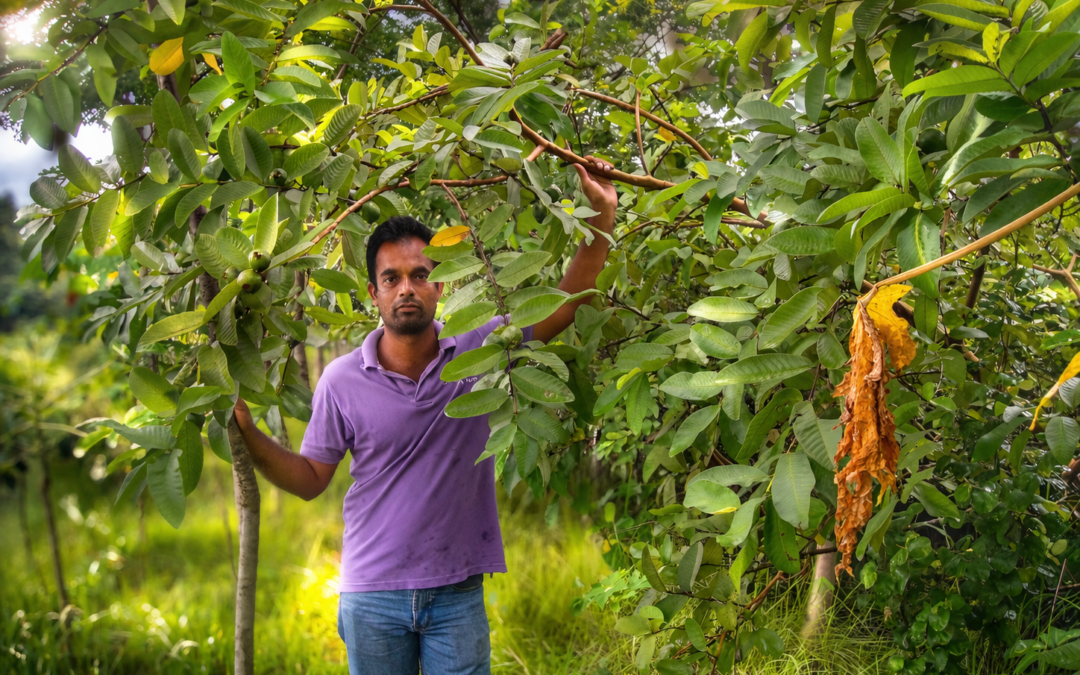
Khandakar Musaddek Al-Mamun, the founder of the farm, is the youngest son of Khandakar Mokhlesur Rarman, a retired government official, and Ms. Khodeza Begum, a retired government official. school teacher. All five of his brothers and one sister are also highly educated and serving in higher positions in different government and non-government offices, and are well-established in society. As a meritorious student of Rangpur Cadet College, Mr. Mamun was also expected to be an army officer or a higher government official by his family members. But he graduated from Bangladesh Agricultural University in 1998 and decided to become a farmer. Even in an industrialised country, an agriculture graduate is usually supposed to go into farming, but it was really very difficult for him to become a farmer in a country like Bangladesh, where farming is the most neglected profession in society, mainly because the farmers are the poorest segment of society. No educated persons, even if he is the son of a farmer, ever think of going to this profession other than if he can’t get any other job. So, his family members never allowed him to become a farmer due to logical reasons. 
Mamun became devoted to agriculture since his childhood, when he used to go to visit their lands with his father and found that his father got almost nothing from the land. He realised that educated persons should come to this profession to develop this sector. He was also inspired by his elder brother Khandakar Mosharraf Hosain, who started farming during 1978-79, but by pressure from his father & mother, he had to join a government job, giving up farming. He taught Mamun about agricultural planning and helped him grow a devotion to agriculture. Then, Mamun set his aim in life to become an agriculturist for farming in their own land when he was an age of 12 years reading in Cadet College, because he found that farming is the most honest profession in the country, like Bangladesh, which is full of corruption, especially in the service sector.
The Start of the Journey
When Mamun finished his graduation from Bangladesh Agricultural University in 1998, he started farming in their own land in Tograihat, about 5 km away from the Kurigram town. But, his family severely retarded his initiatives and compelled him to join a local college as a teacher. But, due to his strong devotion to agricultural farming, he didn’t continue the job and convinced his eldest brother, Khandakar Mosharaf Hossain, to purchase some land near the town to establish his dream farm.
When monoculture became a trend in the agriculture of the country patronised by the government policies, Mamun started his integrated farm against the mainstream. As an agricultural technocrat, he realised that integrated farming is a must for his survival & sustainability as a farmer. He had many examples in front of him of many farmers, especially the modern farmers, making huge profits out of their monoculture of fruits, fish, poultry, livestock, maize, potatoes, or other crops. But, he found that this trend is not sustainable because such farming may give huge profit for a few people for the short term, but for sustainability in the long term, integration is a must. Moreover, he observed that the consumers prefer local fish, seasonal traditional fruits, and local poultry to the alien species. He also realised that if integration is possible, the local components could be more profitable in a sustainable manner.
Chronological development
At first, the farmer Mamun purchased 2 acres of land in the year 2000, which was not sufficient to establish an integrated farm. Then he continued purchasing land when available and went for the trial of different new varieties and technologies, mainly for his practical learning and to find out suitable crop varieties and technologies that best fit in this area. He started working on his farm when he could purchase about 10 acres of land by 2005. He immediately went for plantation on 2 acres of the land and started digging ponds. When he completed one pond in 2006, he started fish culture as well as started a fruit garden on the raised land in the same year. Thus, he could bring the farm into a preliminary productive stage by the year 2009, but still many things to do. During this development stage, he faced a huge number of challenges like barriers from his family, money constraints, ill village politics, c limatic hazards, etc. He developed the farm by taking a long-term step approach. He could not invest all the necessary money at a time because, personally, he didn’t have any money to invest. His family members, except his eldest brother Khandakar Mosharraf Hossain, were dead set against this initiative because everybody believed that agriculture had no future in this country. So, none of them came forward to support Manun as they treated his initiative as the work of a madman. On the other hand, he could not borrow money from the Bank or other sources because he couldn’t pay back immediately, as his return would take time on one hand, and he was also afraid of his success due to associated risks in agriculture on the other. Moreover, he couldn’t borrow money from a formal source as he has no land of his own. His eldest brother supported him in purchasing land by investing about Tk. 560000/- while he borrowed Tk. 300000 from Agrani Bank and Tk. 200000 from BRAC as a monthly instalment, which is increased to Tk. 300000 after recovery of the first loan. The regular returns of the farm were reinvested, which is difficult to work out at this stage because no records were maintained, just like other farmers.
Soil development
Soil is the key element for maintaining the productivity of an agricultural farm sustainably. It is already mentioned that the productivity of the land in the area was very low because of the sandy nature of the soil, as well as regular flooding. Keeping these in mind, Mamun developed the land of his farm in a planned way. By mixing the sandy and clay soil during the digging of the ponds, he improved the texture of the soil. He also improved the organic matter content of the soil by using cow dung and water hyacinth regularly. Now, the soil of this farm is favourable for growing almost all the crops.
The surroundings of the Farm
It is already mentioned that the surroundings of the farm go underwater during the rainy season and remain underwater for three to nine months based on the topography of the land. At present, in winter 2012, the other farmers have cultivated wheat on the western side of the farm, where Jute will be cultivated after harvesting wheat. Some farmers have also planted Eucalyptus on the dike of the wheat field, mainly in the upper lands, as seen in the picture. The southern side of the farm is comparatively lower, where irrigated boro rice is being transplanted at this moment. After harvesting boro rice, the farmers will also cultivate Jute in those lands. On the western side of the farm, the farmers have cultivated potatoes. It is to mentioning here that potatoes are cultivated here by some temporary big commercial farmers taking lease of the land from the farmers by using huge amounts of inputs like chemical fertilisers & pesticides, resulting in the destruction of soil & environment. As seen in the picture, the northern side of the farm is lower and contains some water. This portion usually remains fallow throughout the year, where there is ample opportunity for fish cum duck culture. The farmer Mamun has already planned for fish cum duck culture in his own portion. However, considering the replicability of this farm within the area there is ample opportunity to organise the surrounding farmers under a collective & integrated planning for developing the area by increasing productivity of the lands in a sustainable manner to combat the challenge of food security, climate change, and ultimately the Manga of this area. Individual farmer Mamun can’t do that. The development agencies of the government, as well as the NGOs, should come forward in this regard.
Present components of the Farm
1. Plantation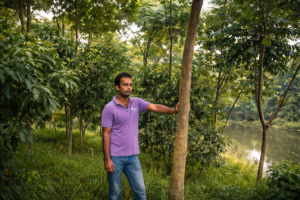
From the very beginning, the farmer Mamun realised that a plantation should be a vital component for the sustainability and profitability of his farm. When the other farmers of the area have planted very few species of trees like Eucalyptus and Acacia even in the crop land, then Mamun has planted more than 4000 saplings of about 40 species of local timber trees, including neem & bamboo as two major items. The left picture shows that the farmer Mamun has planted Jujube, Neem, Lambu, and Jackfruit in a combination to get maximum benefit from his land. Such a plantation is seen everywhere on the farm. Actually, he has considered Jujube as a short-term item from which he can get returns within the short term. He also observed that Jujube is very much sensitive to climatic conditions and doesn’t give good yields every year. That’s why he has planted the other trees in a very well-planned combination as a strategy for his sustainability in case the Jujube fails due to climatic hazards. It is also interesting to note that the farmer Mamun has also planted Eucalyptus and Acacia in his farm, but in the right place, as seen in the picture, as part of the multi-tier system of a sustainable agricultural farm, where these plants have no detrimental effects on crop land.
2. Fruit Gardening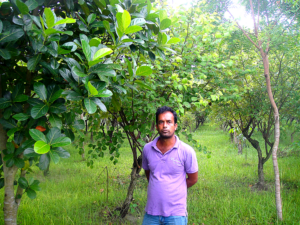
The fruit garden is one of the major components of the farm. When the other farmers replacing the traditional fruit trees by fast growing timber trees like Eucalyptus and Acacia in the homestead as well as going for monoculture of fruits like BAUKUL, Applekul even in the crop field occupying very scarce crop field for producing food crops with a hope to make huge money within very short time then Mamun have planted almost all kinds of local fruits including Palm, Date, Coconut etc. for not only family consumption but also as commercial purpose. He has planted both local and improved varieties of almost all kinds seasonal fruits including 370 plants of Papaya, 700 plants of Banana, 350 plants of Mango of more than 23 varieties where more than 200 plants of one popular but endangered local variety named Harivanga, 120 plants of Litchi of three varieties named China-3, Bombay & Muzaffari, 500 plants of Jujube of four varieties named BAUKUL, Applekul, Taiwanikul, Naricalikul (local endangered variety), and 100 plants of Jackfruits in commercial basis along with other seasonal local fruits. He has a plan to bring all other fruits under commercial production & marketing by turns. It is to mentioning here that this is the first and only commercial fruit garden in this area, when none can even imagine establishing any fruit garden in this area. Manun is the first and so far only supplier of endangered local Mango variety of this area named Harivanga, Kupahari & Kapilbangri which was out of thought for the other people and when many of such extra ordinary indigenous varieties of fruits are under great threat of extinction by the aggression of few commercial timber trees as well as imported exotic fruits like orange, grape, apple full of poisons.
It is to be mentioned here that the returns from fruit cultivation take at least three years, which gradually increase over the years. The returns from Jujube and Mango over the last three years are presented in Graph 1 and Graph 2, respectively. Although it is a commercial farm but due to its diversity of plants, it can be termed as a rich germplasm centre where almost all of the plants, species & varieties are available. Mamun has conserved the diversity as a strategy to combat the challenge of climate change on one hand and to fulfil the consumers’ demand throughout the year on the other. As a consequence, he has been able to create works for his permanent labourers throughout the year.
3. Nursery
Mamun has established a small-scale nursery in his farm mainly to fulfil the demand for saplings for his own farm. He also supplies saplings outside when he gets the order. For example, this year, being known from television news about this farm, one person from Dinajpur (another district of Bangladesh) has given him an order to supply 2000 mango saplings, though saplings are available in his own area. Many of the surrounding people like to purchase fruit tree saplings from his nursery because of the best quality, as well as getting technical advice from him. At present, he has about 1000 saplings of different fruit trees in his nursery.
4. Medicinal Plants
Many medicinal plants have also been planted on this farm, mainly as mother plants to go for extension in the future. At present, there are 29 kinds of medicinal plants on the farm, including Neem, Amlaki, Hartaki, Bohera, Arjun, Tulsi, etc. Mamun has a plan to go for the commercial production of medicinal plants on his farm in the future.
5. Fish Farming 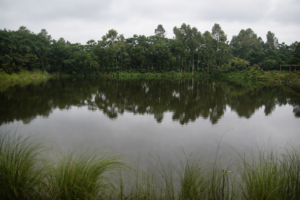
Fish culture is a vital component of this integrated farm from the very beginning. It is worth noting that the fish sector has been separated from the agriculture sector by the policymakers, which again indicates the government’s policy towards monoculture. The growth of the fish sector and its contribution to GDP have been quite significant over the last few decades. The natural fish populations have already been eroded due mainly to water scarcity, partially maybe due to climate change, but mostly due to one-sided water transfer by India. However, the present trend of fish culture is based on monoculture of a few exotic fish varieties like Tilapia, Pangus occupying the crop lands by digging ponds, and based on a huge amount of external artificial feeds is not sustainable for the farmers, though very few people, like big investors as well as the feed corporations, are making huge money out of that. But, Mamun doesn’t follow that because he thinks those are profitable for the short term but not sustainable.
That kind of fish farming needs huge investments, but the return is very uncertain due to the changing climate as well as other associated risks. Moreover, consumers don’t like exotic fish. On the contrary, we still have a huge opportunity to increase the availability of traditional fish without occupying valuable crop lands. Mamun has set such an example of what the pattern of ponds for traditional fish culture in a profitable way. His profit from fish culture over the last four years is presented in Graph 3. The graph indicates that the return from fish culture is increasing day by day because he is using farm byproducts like cow dung, mustard oil cake, etc., as fish feed. At present, he cultivates mixtures of modern & traditional fishes named Rui, Katla, Mrigel, Silver carp, Carfu, Sarputi, Taki, Puti, Chela, Shoal, Shing, Magur, etc.
6. Livestock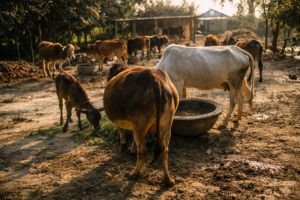
Livestock is another integral part of an integrated farm, not only for the profitability but also to supply cow dung, which is necessary food for plants & fish. At present, there are 8 cows and 8 calves on the farm. The cows are mainly of local species, along with a few crossbreeds which are best adapted to our own climatic conditions. He started with 2 calves, one male and one female, in 2005, purchased with only 12000Tk. After one year, he sold out the male one for Tk 13000, and from the female one, he got 4 calves so far. By this time, he had also purchased two more cows. So far, he has invested Tk. 100000 to purchase cows, while the present valuation of all his cows is more than Tk 300000, besides the income from the milk, as well as the valuation of cow dung. He also has 5 goats in his farm valued at least 15000 Tk. He doesn’t need so much artificial feed to rear the cows and goats; rather, they eat the byproducts of the farm and also create work for permanent labour throughout the year. He has a plan to install local poultry & pigeons soon.
7. Vegetables 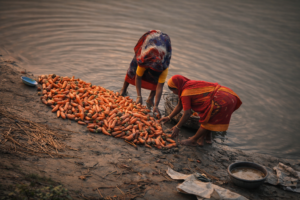
Now, the farmer is producing vegetables in a small scale in his limited land. This year, he has cultivated carrots on only 35 decimal of land, from where he has already sold Tk. 45000 from an investment of only Tk. 12000, except the labour cost (because he has permanent labour). When the other farmers cultivate vegetables mainly considering market demand to get huge profit at a time, then Mamun selects vegetables considering the soil, environment & climatic conditions, as well as feed for his livestock, along with market demand and profitability. As a result, when the other farmers remain in a very vulnerable position with their vegetables to get profit out of their huge investment, as well as risks from unfavourable climatic conditions, then the vulnerability of the farmer Mamun remains minimal due mainly to his integration. He also cultivates vegetables at his pond sides in a trellis from where he gets a considerable amount of profit without investing much.
8. Spices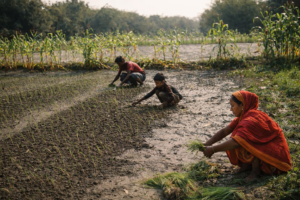
The farmer Mamun also cultivates spices like Onion, Garlic, and Turmeric in a planned way, following proper technologies and timing. For example, this year the majority of farmers are not getting a profitable price for onion & garlic and are turning to other crops. When Mamun transplanted onions and garlic in his field, he was quite confident of getting a profit because he had a plan to preserve if the prices went low during harvesting time. Moreover, he has more market assessment ability than the other ordinary farmers.
9. Other Field Crops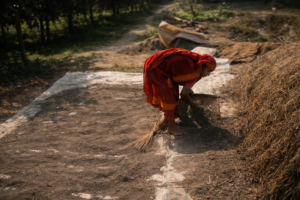
Mamun also produces different crops on his farm. At present, due to his limited land and money for investment, he only produces a few selected crops on a very small scale. This year, he cultivated Jute, Lentil, Rice, and Mustard in his field, mainly for his own family’s consumption and to get byproducts for his farm. He cultivates mustard mainly to produce oil for his family’s consumption as well as to get mustard oil cake as food for his fish and cows. The reasons are the same behind cultivating lentil & rice, from where he gets food both for his family as well as for his livestock and fish. This year, he got a very good price of his jute because of timely sowing and harvesting, as well as the better quality. Among the field crops, he always adapts the high-yielding modern varieties developed by the research organizations of the country, uses quality seeds, and applies improved management techniques that give him the best yields at the lowest cost of production. He also follows the best-fitted cropping patterns considering the soil & climatic conditions of this area.
Marketing system
The existing marketing system is one of the biggest hindrances for the farmers because they are not getting a profitable price for their products, that retards their economic development. Nowadays, agriculture is considered unprofitable for the farmers. Despite the huge risk in agriculture, which has been intensified by climate change, agriculture is never unprofitable. The fact is that the middlemen are grasping almost the whole profit generated from agriculture. However, the present market system doesn’t affect Mamun much because of his proper planning and control over the middlemen due to his consumer linkage. The consumers prefer his products because of their better quality. As a result, a linkage has been established with a group of consumers within the community from where both he and the consumers are being benefited and satisfied. Consumers are getting the best products at a reasonable price, much lower than the prices in the market, while the farmer Mamun is also getting 70-300% profit out of his products. His wife plays an important role in community marketing because the women of the surrounding families give orders to her for different products, mainly fruits. Manun’s fruits are also going abroad through this channel. In this supply chain, the middlemen are just playing the role of suppliers for him, who also getting a reasonable profit instead of being all by the much-talked market syndicates. Her wife has also planned for food processing in the future and establishing an outlet in the town.
Income-Expenditure and Profitability
It is very difficult to calculate the economic profitability of such an integrated farm, mainly because of the integration of the components with each other on one hand and due to not maintaining proper records on the other. It is to mentioning here that the farm is still in the growing stage, and the return has started to come since 2009. However, it was made to calculate the income and expenditure of the farm during the year 2011, presented in Table 1. The figures in the table indicate that the total inputs in the farm during the year 2011 were Tk.. 680900, and the output was Tk.. 817000 during the same period. Therefore, the net return during the same year was Tk. 817000 with a net profit of Tk.136100. In terms of economic scale, the profit seems to be negligible, but the ultimate returns of an integrated agricultural farm must be calculated on a long-term basis.
However, the present valuation as well as a projection of future value based on only the major fixed assets of this farm is presented in Table 2 and Figures 4 & 5. It is observed from the table and the figures that the farms are going to be hugely profitable in the long run, which indicates the sustainability of the farm. It is already mentioned that the land of the farm was purchased only with Tk. 560000 from 2000 to 2010. Only within a very short time, the present value of the land would be at least Tk. 12000000 due mainly to the increasing productivity of the land. After only five years the value of the land is expected to be Tk.15000000 and after 10 years it should be Tk.18000000. However, considering the other fixed items only including timber trees, cows & goats it is observed from the table and features that the present value of the farm would be Tk.8306000 which would be increased at least Tk.12580000 and Tk.16825000 after five and ten years respectively. Moreover, the family members consume the products of the farm, including fruits & vegetables, throughout the years. The family members of the permanent labourers also consume a considerable amount of fruits and other products without pay.
Insiders’ opinion
Mr. Abul Hossain has been working for the last five years on this farm. He has a family of 5 members, husband, wife, and two girls & one boy. The eldest one is a girl and got married when she was in class nine. Their two other children go to school. Earlier, he was a rickshaw puller and could earn hardly about 50/60 tk./day. He has no land of his own. He couldn’t go with a rickshaw every day because of illness or other reasons. So, he had to maintain his family in very hard hardship and could not buy food for his family throughout the year. When Mamun started this farm, he also started working on this farm from the very beginning. Now, he has work every day throughout the year, even during the rainy season when there is no work in this area. Now, he earns Tk.150/day throughout the year, and the food security of his family is ensured.
According to his opinion, this farm is quite different from other farms in this area. The other farms are based on monoculture and are seasonal only. Most of the original farmers of this area have sold their land to the part-time farmers coming from the town. They invest huge amounts of money to cultivate a single crop like potato or maize in their own land or take land leased from other farmers. Sometimes, they make huge profits or often they incur huge losses. But this farm has a variety of items like fruits, fish, vegetables, different crops, etc. So, this farm never loses. There are also works throughout the year. He said that Mamun is an educated farmer, which is essential for farming. For example, this year, Mamun has earned a lot of money from papaya, which is an extra income. The other farmers may earn huge amounts of money at a time, but they can’t run in the long term. He also said that he has seen many farms that ran much more profitably for a few years but couldn’t survive in the long term. But this farm will never fall because of its diversity.
He also said that the farm area was a char. A lot of labourers were required to develop the land, which created jobs for many workers of this area. Now, this farm has become more profitable than other farms. The other farmers invest at a time and also get the return at a time. But there is income in this farm throughout the year. So, when the other farmers need to invest from outside, then this farm doesn’t need investment from outside. He also said that he is very happy working on this farm. Brother (Mamun) is educated in agriculture. “I can learn many things from him that I can use in my own field, and also I can teach other farmers, which I like very much”, Mr. Hossen added.
Alina Begum is a female worker on this farm. She has been working on this farm for the last five years as a permanent worker. Her husband died a few years ago, and now she lives with her mother. She has no land of her own. She has one mother, one son, and two daughters. The eldest daughter got married at the age of 14, and she had to pay Tk.60,000 as dowry. She earned this money working on this farm. Her younger son & daughter are going to school. Her daughter also becomes a victim of violence by her husband for more dowries. She gets 90tk/day throughout the year, when the other female workers in this area earn less, and they don’t work most of the time in a year. She said that she likes working on this farm very much because she feels like working in her own home. Brother (Mamun) treats us like his sister.
She also said that this farm is quite different from the other farms in this area. Cultivation is also quite different from the other farmers. Brother (Mamun) always gains even when the other farmers are failures. Now, many farmers are following him (Mamun), but nobody can establish such an integrated farm.
Mamun’s mother, Ms Khodeja Begum, expressed her feelings, saying that she was very much frustrated when her youngest son, Mamun, wanted to become a farmer. They all thought that their son had gone astray. She had a dream that Mamun would be an Army Officer after passing from Cadet College or would join in any government job like his other brothers. They never expected Mamun to be a farmers mainly because agriculture has no future in this country. But now his mother and other members of his family see a ray of hope when the farm has taken shape and seems to be an example in this area.
Outsiders’ opinion
Mr Mokter Hossain, son of Mr Nesab Ali, a farmer of the village, said that when Mamun started working here, the surrounding people treated him as mad. Earlier, they could not imagine what was going to happen. But now the surrounding people are astonished to see the productivity of the farm. He said that this farm has created work for many people of this area. Many things like fish, fruits, and vegetables are being produced from the farm throughout the year, which was out of the imagination for the people of this area. When he was asked the question of why he and other farmers are not following the example, he replied with frustration that they can’t follow because they have very small pieces of land and don’t have the money to invest. “We also have a lack of knowledge”, he added.
M. Ali Samrat, the director of the local NGO Participatory Advancement Social Service (PASS), said that he is astonished by the works of Mamun. He saluted the spirit of Mamun for taking such a challenge to establish the farm in an area where growing crops is very difficult due to soil conditions and climatic hazards, especially flood & drought. He said that Mamun has set an example for the surrounding people to show the way of development where the NGOs have almost failed despite investing huge of money. According to his opinion, Mamun’s work has created year-round jobs for at least 50 people of the area, which has contributed to ensuring the food security of 50 families. He said that Mamun has become at least 50% successful by his own efforts. Now, the NGOs and donors should come forward to support him as a model farmer to replicate the model within the community.
A few noticeable Impacts of the Farm
1. Employment generation
At present, 7 permanent labourers (4 males & 3 females) of the farm have guaranteed work in this farm throughout the year, while other temporary workers have at least 200 man-days of work during the pick seasons, which has been contributing a lot in mitigating the Monga of this area. It is to be remembered that the researchers recommended to the government to create only 100 days of work to mitigate the Monga in this area. Moreover, most of the money invested in this farm created jobs for many of the Monga-affected people of the area during the last five years. Now, it is necessary to calculate that 7 families depend on about 15 acres of land, which means on average one family can depend on about 2.1 acres of land at this stage of this integrated farm, excluding the suppliers of the products of this farm. But, it is obvious that when the farm is completed with all of its components, then more employment generation would be possible. Therefore, it can be undoubtedly concluded that in order to ensure guaranteed employment throughout the year for the Monga-affected people of this area, there is no alternative but integrated farming like the TIA farm.
2. Food security
It is already mentioned that the area is a Monga-affected area where there is severe food scarcity, especially during the monsoon. It is also necessary to mention that food diversity is very much necessary for ensuring food security. The consumers are getting the diversity of fresh & safe food like fruits, vegetables, fish, and other products from this farm throughout the year, which essentially contributes to their food security. The surrounding people and the workers of this farm also consume the fruits and vegetables now and then, free of cost, which contributes to their food security to some extent.
3. Climate Change
It is already mentioned that the farm area is a disaster-prone area that has been intensified due to climate change. The farmer Mamun has experienced the climate-induced disasters in this area over the last decade, which has helped him to design his farm with proper adaptation strategies. In fact, the wide diversity of this farm is the key strategy for ecosystem-based adaptation. As a result, climate change-induced disasters don’t affect the farm very much. It was experienced during the last few years that if the climatic condition becomes unfavourable for one item, it becomes favourable for other items as well. For example, if excessive rainfall becomes unfavourable for fruit gardens, it becomes favourable for fish culture and vice versa. Moreover, the huge plantation in this farm makes at least a little contribution to climate change mitigation as well.
4. Environmental & Ecological Impacts
Anybody can enjoy the green, fresh, and heavenly environment in this farm, with the chirping of birds and the smell of flowers. Plenty of seasonal fruits are available on the farm; those are also food for insects, birds, as well as both pet and wild animals. Moreover, huge plantations have also created very good habitats for insects, birds, and animals. As a result, the availability of birds, including pests & beneficial birds and insects, has significantly increased on the farm, indicating the revival of the destroyed ecosystem due to monoculture-based modern agricultural practices. The soil condition of this farm has also been improved, and the biodiversity and ecosystem have been revived. Moreover, huge plantations should have a positive impact on the environment.
5. Socio-cultural impacts
A very good social relationship has been established among Mamun & surrounding farmers who love & trust him, and he also loves all. The surrounding farmers also come to him for technical advice when necessary. The farm may be termed as a collective farm of love. The community marketing has also increased the social relationship of Farmer Mamun with the community people. The exchange of seasonal fruits was a good element of the rural culture of Bangladesh, which has almost disappeared. The fruits from this farm are sent to the relatives’ houses, which increases the relationship and strengthens the family bonds.
6. Technology Transfer
This farm has become a practical source of technological knowledge & information for the surrounding farmers. Although the other farmers can’t copy the integrated structure of this farm because of many limitations, they follow Mamun’s work as much as possible. They used to come to Mamun for advice when they felt it necessary. The other farmers also observe that the market players can’t exploit Mamun because of his knowledge of modern technologies, when most of the farmers are being exploited by the market players in many ways, both in the input & product markets. To see this in practice, the surrounding farmers come to him for technological advice. Mamun also learned many things from the farmers as a reciprocal process of knowledge transmission.
7. Gender Equity
At present, six males, including Mamun & four female workers are permanently working in the farm as a family. Although the women are getting less payment due mainly to the existing wage system of the country but they have guaranteed work here throughout the year to maintain their own families. Therefore, the role of these women in the family-level decision-making process has increased.
Achieved Recognition
The farm has emerged as a surprise for the surrounding people as it is being termed as a ‘green revolution in a char land’ where farming is very difficult. Now, the farm has drawn the attention of the media as well as researchers. Local & national print and electronic media have already covered the story on the farm. One of the media has termed the farm as “Green Revolution in Char”. Recently, Dr M. A. Rahim, professor of Bangladesh Agricultural University, along with a few of his colleagues, visited the farm and recognised it as an extraordinary work. Recently, Mamun has been awarded as ‘Local Food Hero’ by Campaign for Sustainable Rural Livelihood (CSRL) for his contribution to food security and climate change in this area.
Present Limitations
The farm has been facing many difficulties and challenges as follows.
- The farm becomes like a separate island during the monsoon because there is no connecting road, though Mamun is preparing a narrow earthen road by his own initiative.
- There is no electric connection to the farm. An environmentally friendly electricity generation system is necessary to develop in the farm.
- There is insufficient manpower in the management system of the farm. In fact, it is just like an ordinary farm of a farmer who doesn’t have enough ability to keep their own records in a desk when they have many tasks to do on the farm. The farmer Mamun is doing a very hard job to survive as a farmer who doesn’t have much backup support from the state, though the farmers are the real owners of the state.
- When the situation of the management system is as mentioned above, then, let alone a documentation & reporting system, which is necessary to compete with the corporate sector for their survival. However, some documentation has been done by Mamun himself and local & national media, which is not enough if we want to know the economic productivity of the farm as well as to know the sustainability of the farm in competition with monoculture-based corporate agriculture.
- A financial management system is equally important for competing with the corporation.
Development Plan Ahead
The farm hasn’t got its complete shape yet. Mamun has a plan to include some more components like commercial culture of indigenous poultry, commercial vegetables production with preservation & processing system, fish-duck mix culture, commercial production, processing & marketing of medicinal plants, honey production, establish food processing & marketing system with outlets, establish a biogas plant, adapt modern organic farming technologies, etc., by turns.
One example may be mentioned here in this regard. The picture beside is the north part of the farm where there is ownership of surrounding farmers, including Mamun. This area could be brought under the collective farming of Fish-Duck-Rice mixed culture. Mamun has his own plan for his own area. The NGO can organise the people here to develop it as a social farm.
Concluding remarks
This farm was developed by a real farmer of Bangladesh who experienced all of the challenges prevailing in the agriculture of the country, including the challenges of climate change. Although food security or Manga was not his consideration, subconsciously, he has contributed a lot. The diversity of fruits, fishes, vegetables, and crops that have been created on the farm is really wonderful. In doing this, the major guiding force for the farmer was his family’s level of food security as well as commercial considerations because this is a commercial farm. He has taken farming as a profession at a time when farmers are really struggling for their survival in this agro-based country. The real fact is that the farmers don’t see a better future in this profession. Very interestingly, the small, marginal, and landless farmers of the country are the most food-insecure people of the country, though they are the majority producers of food. Although Mamun is not a farmer of that category, he has become a model for those categories of farmers who are the victims of the corporate agriculture being introduced by the policy makers of the country. This farm could be a model for the policy makers to realise how we can ensure our food security sustainably by following our thousand-year-old integrated farming system, which is environmentally & ecologically sound. There are many signs that it would be economically viable because of its high productivity if it is calculated in an integrated manner. It is also necessary to assess the social and cultural aspects of the farm. Due to its integration, this farm must be able to produce safe and nutritious food if proper care is taken. There are some more works to do for this farm to establish it as a model sustainable agricultural farm. But, Mamun may not be able to do all these things because of his limitations in terms of financial capacity. Here, there is a concrete role for the government as well as the NGOs to play to make it a social model for replicating it in the rural community throughout the country. It is in fact, a matter of trial, which is not possible for the farmer alone.
Therefore, the farm needs to be established as a model farm to show as an alternative to the monoculture-based modern agriculture to combat the challenge of food security and climate change, as well as to show the future generation that agriculture is the best culture. If the young generation gets financial backup from the state, the golden history of Bengal with Granaryful rice, Pondful fish, and cowshedful cows will return soon within the Golden Jubilee of our independence. The Sonar Bangla of the world poet Rabindranath will be a reality. If the government come forward to establish it as a social model and takes the initiative to replicate it throughout the country, then it will not only be possible to combat the challenge of food security and climate change in the country, but also the government’s efforts of poverty alleviation through “agriculture & rural development” will come true in the near future. However, a comprehensive research by combining agri-scientists of different disciplines from both research & educational institutions is very much essential at this moment, along with a sandwich program for completing the model farm as well as replication in a few selected agro-ecological regions of the country.
A case study on TIA Farm
Mar 31, 2025 | লেখালেখি
EXECUTIVE SUMMARY
The question of seed is a vital agenda for both the existence of the farmers as well as the persistence of the thousand-year-old traditional agriculture of the country. With a view to capturing the huge seed market of the country, the Multinational Companies (MNCs) have introduced patented seeds of hybrid and Genetically Modified (GM) varieties. On-farm conservation of these seeds is not possible which leads to wiping out of farmers’ own seeds. Patent on genetic resources for food and agriculture (GRFA) accelerate corporate control of the seed sector which is a great threat to the food security and livelihoods of small farmers. Patents will reduce access to seeds and genetic resources to farmers and breeders. They could also make seeds more expensive due to royalty payments, restrictive contracts, and increased commercialization. Once a patented seed is planted, companies can insist that farmers purchase new seed every year and penalize them for saving seeds. This compromises farmers’ rights to save, grow, exchange, and sell patented seeds. The use of patented seeds, plants and genetically modified animals would make small farmers dependent on the corporations that own the patents. This could fundamentally change the way of agriculture that is practiced in least developed and developing countries like Bangladesh by facilitating the growth of agribusiness and the decline of small farms and biodiversity.
The adopted and still endorsed practice of the Green Revolution has led to the increase of production but at the cost of the life of the farmland. Current practices of intensified farming require more industrial inputs, high-yielding, and hybrid varieties. The effectiveness of these technologies is still under scrutiny by various groups, but it is evident that, primarily, these inputs are costly. Moreover, the farmers have become dependent on the market for about all the agricultural inputs; the risks in crop production has drastically been increased; biodiversity has become degraded; environment has been polluted; human and animal health is under a great threat of hazards, and most ironically farmers are loosing their knowledge and resources.
The peasants of Bangladesh are already experiencing a tremendous seed crisis. The recent crisis of jute seed is a burning example in this regard. The problems of ever-increasing market price, businesspersons manipulated seed crisis, below quality seed, lower germination rate etc. that are increasing day by day and are going to be a great threat for their existence in the agricultural production system in near future. The corporations have already occupied about 80% of the vegetable seed market, and it is so far 20% for the rice seed market of Bangladesh. In the global context, only ten big multinational corporations control about 40% of the world seed market which indicates that the food security of the world will be controlled by only few multinational corporations- unimaginable. It is not far away when the multinational corporations will capture the whole seed market of the country. And that situation must be suicidal for the farmer as well as the country. Therefore, it is important to promote farmers’ rights to seed and empower the rural communities so that they can protect their own livelihoods.
Seemingly, it is very unfortunate that the government of Bangladesh has no initiative for conservation of indigenous seed resources as well as to protect farmer seed rights. On the contrary, the government policies are encouraging private sector to establish control over seeds. The government has already declared the National Seed Policy (NSP) to promote the seed industry in the private sector. Almost all the provisions of the NSP favor the corporate seed business. The policy also intends to consolidate the conditional opportunity that has already been given to the private sector to import hybrid rice seeds. But, very unfortunately, there is no provision to conserve the indigenous seed resources and biodiversity to what our government committed in the international forums like Convention of Biological Diversity (CBD) and Agenda 21 of the UN Conference on Environment and Development (UNCED).
The multinational companies are promoting hybrid and GM seeds in Bangladesh. Despite the protest by reputed agricultural scientists, plant protection specialists, politicians, NGOs, environmentalists, and intellectuals, the National Seed Approval Committee of the government of Bangladesh approved the import of hybrid seed in 1998 without any prior assessment of the impacts of such seeds in our agriculture. In addition, very recently, Bangladesh has entered into an agreement that will promote genetically modified crops. Under the National Agriculture Research System (NARS), four types of crops will be cultivated in Bangladesh, including drought-and-saline tolerant rice, late blight-resistant potato, fruit and shoot borer-resistant eggplant, and pod borer-resistant chickpea. This project is being co-funded by Cornell University, USA, and USAID. Both the hybrid and GM seeds have various problems and are considered to be a great threat to the existence of the poor farmers of the country.
Introduction
The question of seed is a vital agenda of the people of Bangladesh, particularly the farmers, who constitute more than sixty-six per cent of our population (Bangladesh Bureau of Statistic 2003). In the context of present scenario of agriculture, farmer seed rights is a burning issue for both the existence of the farmer as well as the thousand years old traditional agriculture of the country. Due to adoption of trade liberalization policies by the government of Bangladesh, which is imposed by World Trade Organization (WTO) and International Financial Institutions (IFIs) like World Bank (WB), International Monetary Fund (IMF) etc, the Multinational Corporations (MNCs) have come forward to control the agribusiness of the country. With a view to capture the huge seed market of the country, the MNCs have introduced patented seeds of hybrid and Genetically Modified (GM) varieties. On-farm conservation of these varieties is not possible, which leads to wiping out of farmers’ seeds.
In this context, Caritas Bangladesh (CB), along with the Society for Sustainable Agriculture in Bangladesh (SSA Bangladesh) and Unnayan Dhara (UD) have taken the issue of farmers’ seed rights on a priority basis. A massive awareness raising campaign along with policy advocacy as well as on-farm, in situ, ex situ and on-farm conservation of the indigenous seed resources are demand of this time to protect farmers’ seed rights. The solidarity of the like-minded organizations is also pivotal for success.
This document is jointly prepared by CB, SSA Bangladesh, and UD that reflects the organizational standpoint on the issue. The paper is the output of several grass root level, regional, and national workshops organized by CB and UD on the issue of Corporate Globalization and Farmers’ Rights.
Background
Bangladesh is an agro-based least least-developed country of South-East Asia. About 85% of her population living in the rural areas predominantly are small, marginal and landless farmers and fully depended on agriculture for their livelihood. The majority of the rural population is directly involved in food production through only with a meager 0.07 hectares of agricultural land per capita.
Before the so-called “green revolution” started in the early 1960s, the peasants of Bangladesh were self-sufficient for their seeds. They produced and preserved seeds of various crops in their houses, and mainly the female was engaged in seed preservation activities. There were about 12,500 varieties of rice available in Bangladesh, which were developed by the peasants for thousands of years. But, due to the introduction of High Yielding Varieties (HYV), almost all of the indigenous varieties are endangered, most of which are preserved in the gene bank of the International Rice Research Institute (IRRI) or other countries like America, China, Japan etc. Only a few of them are preserved in the gene bank of the Bangladesh Rice Research Institute (BRRI). These naturally developed varieties showed excellent ability to survive against the region-specific problems of crop production like flood, drought, salinity, soil problem, pest attack, etc.
The adopted and still endorsed practice of the Green Revolution has led to the increase of production but at the cost of the life of the farmland. The trend has been to use more amounts of inputs in the same land to produce crops. The practices have led to degradation of land fertility and productivity in terms of both quality and quantity. Current practices of intensified farming require more industrial inputs, high-yielding and hybrid varieties. The effectiveness of these technologies is still under scrutiny by various groups but it is evident that primarily these inputs are costly. Moreover, the farmers have become dependent on the market for almost all the agricultural inputs; the risks in crop production have drastically been increased; biodiversity has become degraded; environment has been polluted; human and animal health is under a great threat, and most ironically, farmers are losing their own knowledge and resources. The marginal farmers are driven to produce more to supply the market, but in doing so, he/she is not receiving his/her just value due to high input costs.
The peasants of Bangladesh are already experiencing a tremendous seed crisis. The recent crisis of jute seed is a burning example in this regard. The problems of ever-increasing market price, businesspersons manipulated seed crisis, below quality seed, lower germination rate etc. that are increasing day by day and are going to be a great threat for their existence in agricultural production system in near future. The corporations have already occupied about 80% of the vegetable seed market, and it is so far 20% for the rice seed market of Bangladesh. In the global context, only ten big multinational corporations control about 40% of the world seed market which indicates that the food security of the world will be controlled by only a few multinational corporations- unimaginable. It is not far away when the multinational corporations will capture the whole seed market of the country. That situation must be suicidal for the farmer as well as for the country.
Nowadays, after the inclusion of agriculture in the trade liberalization agreements of WTO, the multinational corporations have identified seed business as a thrust sector for their monopoly business. In order to achieve their target, they are developing new varieties like hybrid and GM-varieties by using terminator technology so that the farmers fail to produce their own seeds for cultivation. This will wipe out the farmers’ own seeds from their hands and create an opportunity for their monopoly business. The introduction of such varieties will also promote the business of agrochemicals, agro-equipment and other highly expensive technologies of the multinational corporations. As a result, the peasants will become fully dependent on the corporations for their crop production. This is a great threat for the existence of the poor peasants of Bangladesh in agriculture.
Corporations’ Control over Seeds
The history of the corporate seed business is not very old. The corporations became keenly interested in capturing the world market of agro-business in the name of Research & Development when the first high-yielding variety of wheat, Norin-10B was introduced to the market in 1935. In order to capture the Asian rice market, Rockefeller and Ford Foundation established International Rice Research Institute (IRRI) in Philippines in 1960. It was the starting point of so so-called ‘green revolution’ that paved the way for the corporate business of seeds, agrochemicals, and agro-equipments.
The big multinational companies came forward to capture the world seed market at that time. Since the early 1970s the pesticides industry has gone through a period of consolidation. Today, after a flurry of mergers and acquisitions, corporate domination of the pesticide market and the food system in general has reached a peak. The top five agrochemical companies, Syngenta (a merger of Novartis and AstraZeneca), Aventis (Rhone-Poulanc and AgrEvo), Monsanto (present name Pharmacia), BASF, and DuPont, hold dominant positions in the seeds, pesticides, pharmaceuticals, and related markets. Presently, these companies account for nearly two-thirds of the commercial seed market and virtually 100 percent of the market for GM seeds. Monsanto alone occupies 91% of the genetic crop of the world. Only three big companies, Monsanto (Pharmacia), Aventis Crop Science, and Syngenta controls the major part of the world agriculture and seed market.
Multinational companies captured the whole sector of food and agriculture, which ultimately caused serious suffering to the farmers, losing their own seed varieties. The farmers in Bangladesh are under pressure to use hybrid seeds and, gradually, the local traditional seed varieties. Farmers are deprived of their rights to preserve and use local and indigenous varieties of seeds. Therefore, it is important to promote farmers’ rights to seed and empower the rural communities so that they can protect their own livelihoods.
TRIPS, UPOV, and Farmers’ Seed Rights
Access to Plant Genetic Resources (PGRs) is critical for the propagation of new plant varieties. Through informal breeding and in situ conservation, farmers and indigenous communities developed an infinite variety of landraces and wild varieties. Public sector researchers and commercial plant breeders seek their knowledge to enable continued research and development of new varieties. Landraces and their wild relatives are in the public domain and, hence are freely available to researchers and commercial plant breeders. An international Intellectual Property Rights (IPR) regime, anchored on the Trade Related Aspects of Intellectual Property Rights (TRIPS) and the International Convention for the Protection of New Varieties of Plants (UPOV), seeks to provide exclusive ownership of new plant varieties to commercial breeders.
TRIPS and UPOV are, however not in conformity with two treaties arrived under the aegis of the United Nations (UN). Both the Conventions on Biological Diversity (CBD in 1992), which preceded TRIPS, and the International Treaty on Plant Genetic Resources for Food and Agriculture (ITPGR in 2001) adopted subsequent to the TRIPS, seek to secure the rights of farmers and indigenous communities to PGRs. Unfortunately, unlike TRIPS, these two treaties do not have an enforcement mechanism.
The grant of patents and plant breeders’ rights has two grave implications for access to PGRs and the food security of the developing world, as follows.
First, farmers will be denied the right to save patented or protected seeds for subsequent planting and will have to buy seeds for each season. Globally, the livelihoods of 1.4 billion farmers are at stake. They lose control over plant varieties to corporations that control the seed market. Seed companies have already sued hundreds of Canadian and US farmers for using farm-saved patented seeds. Farmers in developing countries will not be spared. Six big companies (Monsanto, DuPont, Syngenta, Dow, Aventies, and Grupo Pulsar) already own 74% of the patents on major food crops, including rice, wheat, maize, soya, and Sorghum. There are now over 9000 patents on staple crops, and just four multinational companies hold 44% of these.
Second, farmers and researchers will have to seek permission and pay loyalties before they use the patented seeds. This will have consequences for biodiversity. Farmers who traditionally bred and cultivated their own seeds evolved a great variety to meet the special requirements of the ecosystem in which they cultivate. Corporations, however, have no incentive to breed a vast variety of seeds. Economies of scale in research and development lead corporations to focus on only commercially viable varieties. Moreover, laboratory-developed varieties can never replicate the dynamic interactions that take place in the natural ecosystem to produce an immense variety of seeds.
Patent on genetic resources for food and agriculture (GRFA) accelerate corporate control of the seed sector which is a great threat to the food security and livelihoods of small farmers. Patents will reduce access to seeds and genetic resources to farmers and breeders. They could also make seeds more expensive due to royalty payments, restrictive contracts and increased commercialization. Once a patented seed is planted, companies can insist that farmers purchase new seed every year, and penalize them for saving seeds. This compromises farmers’ rights to save, grow, exchange and sell of patented seeds. The use of patented seeds, plants, and genetically modified animals would make small farmers dependent on the corporations that own the patents. This could fundamentally change the way agriculture is practiced in the least developed and developing countries like Bangladesh by facilitating the growth of agribusiness and the decline of small farms and biodiversity.
Pirating Indigenous Knowledge and Seed Resources
Species or varieties of diversified characteristics are preconditioned for developing new varieties because the scientists cannot create gene that regulates the biological character of a plant or animal. So, they have to depend on naturally occurring characteristics of plants or animals. They can only combine characteristics to develop a new character. Bangladesh, like some other Asian and African countries, is very rich in Biodiversity. So, the developed countries and their multinational companies have done and are doing their best to capture the biological diversity of the third world countries of Asia and Africa. They are stealing our genetic resources of plants and animals by using the opportunity of ignorance, unconsciousness, technological weakness, and poverty of the countries.
We believe that Intellectual Property Rights are inappropriate about living organisms and indigenous knowledge, which should be held as non-devisable public goods. But TRIPS has made it possible for companies to patent and exploit the traditional knowledge and local genetic resources- usually plant and medicines- of poor communities worldwide. In the developing world, genetic resources and indigenous knowledge are intricately linked, with the holders of indigenous and community knowledge also the users and preservers of the genetic resources.
Instead of harnessing this knowledge for the benefit of all and the sustainable development of communities, companies are using it for their own profit.
Patents of genetic resources generally do not recognize the rights of local communities to their traditional knowledge. Claming private property rights on plants, processes, and knowledge developed over countries by generations of farmers or traditional healers raises serious questions about the application of the concept of ‘prior art’ in intellectual patent regimes. Indeed, such behavior can be viewed as a form of intellectual property theft.
Bangladesh was very rich in diversity of rice seeds with about 12,500 identified indigenous varieties. But, we have only a few varieties at the farmers’ hands. Most of the varieties are preserved in the gene bank of IRRI. Once, America raised the question of bioterrorism and brought the seeds to Fort Collins and Fort Nox. Seed is now an issue of war because the owner of seeds will control the whole economy of the world.
The patent of the anti-fungal properties of neem, the healing properties of turmeric, and the aromatic qualities of basmati rice are the example of bio-piracy, which illustrate the problem with patent laws allowing legal rights to traditional knowledge and the genetic resources for agriculture. Unfortunately, we have no any records or information in regards of bio-piracy.
Status of Seed Resources in Bangladesh
The means of satisfying nine-tenths or more of all the basic survival needs of the people and farmers of Bangladesh come from the biological diversity. Probably only half or less of this essential diversity comes from the formal cultivation of food and fibers. All these resources come from genetic diversity (a part of biological diversity), which the country is losing every year, and no reliable information is available.
Records show, in 1915, the Agricultural Research Station in Dhaka estimated that there were about 15,000 varieties of rice in Bangladesh but after 70 years, the BRRI could collect about 6000 accessions. Of these, only about 2000 accessions are available to plant breeders, and there are doubts whether these all are viable seeds. From 1910 to 1925, about 2000 varieties of Aus, transplanted Aman, and deep-water traditional rice varieties were grown. By the eighties, a survey could list a total of 12479 names of rice, most of which have disappeared at present. Only a few High Yielding Varieties (HYV) of rice along with the few hybrid varieties are being cultivated at present. The most popular HYV rice varieties are not local; they have been modified in the laboratory and introduced among the farmers.
In the late 1960s, HYV seeds for rice were imported to support the Accelerated Food Production Program sponsored by the Ford Foundation. Thus, during the 1970s, large quantities of HYV seeds were imported from the IRRI in the Philippines and from India. In the year 1970, the BRRI was established to develop varieties that better suited to local growing conditions. So far, the institute has developed 41 HYV varieties and a hybrid variety. On the other hand, Bangladesh Agricultural Research Institute (BARI) has developed 21 varieties of wheat, 4 of maize (including 3 hybrid varieties), 32 of potato, 24 of pulses, 21 of oilseeds, 41 of vegetable and 26 of fruits.
To meet the growing needs for food grains, the Bangladesh Agriculture Development Corporation (BADC) was established in 1960s. The main functions of BADC were to procure modern agricultural inputs (i.e. HYV seeds, fertilizers, pesticides and agro-equipment) and distribute these to the farmer at a highly subsidized cost. The subsidized input cost of BADC was mostly borne by the foreign donor agencies.
But up to 1970s, the diffusion rate of these technologies was very slow due mainly to the unwillingness of the farmers to change their traditional farming system. Under such conditions, the donor agencies advised to gradually reduce subsidy on inputs and to encourage privatization of the input markets. Consequently, a series of privatization and deregulation policies were implemented in the agricultural input market beginning from the 1980s, which therefore became a significant decade in the history of agriculture in Bangladesh. Since then, in the seed, fertilizer, pesticide, and agro-equipment markets, the distribution systems were gradually transferred from the BADC to private traders/multinational companies. At present, the multinational companies, along with local agents, are controlling almost the whole market of seed, agrochemicals, and agro-equipment.
A large number of alien species/varieties of different crops have been introduced in the ecosystem of Bangladesh without proper scientific investigation on their possible impact on the ecosystem and native species. Moreover, recently Bangladesh has entered into an agreement that will promote genetically modified crops. Under the National Agriculture Research System (NARS), four types of crops will be cultivated in Bangladesh including drought-and-saline tolerant rice, late blight resistant potato, fruit and shoot borer resistant eggplant and pod borer resistant chickpea. This project is being co-funded by Cornell University, USA and USAID.
Another research work is going on to develop a vitamin A rich GM variety of rice named “golden rice” which is patented by the multinational company Syngenta. BRRI is conducting the research with support from IRRI. Bangladesh is very rich in vitamin A rich vegetable and fruits. It is, therefore, absurd to develop and promote a vitamin A rich GM crop, which is patented by a MNC. But the government is positively considering to promote the variety.
In this context, Bangladesh needs to enact precautionary principles about HYV, Hybrid & GM crop varieties but there is no serious attempt at the Government level. Rather, the GoB has recently formulated a National Program of Biotechnology as a complementary route to fight poverty and food insecurity. There is a National Executive Committee on Biotechnology as well as taskforce for sustainable biotechnological development.
At more fundamental level, the government of Bangladesh, owing to either a dependency on international largeness for survival or due to a thriving set of internal vested interest, has adopted the policies of privatization, deregulation and liberalization that have ultimately led to further pauperization.
Future Trend of Seed Business in Bangladesh
As stated earlier, the multinational corporation are strengthening their control over the seeds sector of the world, especially agro-based third world countries like Bangladesh. Patents promote the consolidation of global seed and agri-chemical businesses, concentrating power over seed and seed choices in a very few hands. Poor farmers are already vulnerable players in the marketplace, and to be operating in a non-competitive market biased against them increases vulnerability.
Transnational Corporations (TNCs) are paying premium prices to acquire local seed companies in the least developed and developing countries in anticipation of monopoly rents once the IPRs are fully enforced. If this trend continues, the choices of seed available to poor farmers will be severely limited. Already, Monsanto controls 60 percent of the corn market in Brazil. Three companies, Cargill, Pioneer and CP-Dekalb, control 70 percent of the Asian seed market.
If TRIPS provisions and practices are transposed, it will be a disaster for the poor farmers in the least developed and developing countries like Bangladesh. Traditionally, they rely on farm-saved seeds and only enter the market to purchase seeds about once in several years. But, if they buy and plant patented seeds, companies can insist that they purchase new seeds every year. Seeds are often sold in a package with fertilizers, pesticides, which further increases farmer’s dependence on the market while also increasing the risk of indebtedness when crops fail due to adverse climatic conditions. It would also decrease farmers’ access to seeds, reduce efforts in publicly funded plant breeding, increase the loss of genetic resources, prevent seed sharing, and could put poor farmers out of business.
National Seed Policy and Farmer Seed Rights
Seemingly, it is very unfortunate that the government of Bangladesh has no initiative for the conservation of indigenous seed resources as well as to protect farmer seed rights. On the contrary, the government policies are encouraging the private sector to establish control over seed. So far, BADC is the only public sector corporation supplying quality seeds. At present, only a small portion (about 5%) of the required quality seeds for different crops is supplied by the BADC. The government has targeted to increase it to 10% in the fifth five-year plan. The rest of the seeds are produced, preserved, and used under private management, especially at the farmers’ level. Government has already declared the National Seed Policy (NSP) to promote seed industry in the private sector. In the pursuance of the seed policy, the government has revised the Seed Act of 1977 and also formulated seed rules in the light of Seed Act (Amendment) 1997. Almost all the provisions of the NSP favor the corporate seed business. The policy also intends to consolidate the conditional opportunity that has already been given to the private sector to import hybrid rice seeds. But, very unfortunately, there is no provision to conserve the indigenous seed resources and biodiversity to what our government committed in the international forum like Convention of Biological Diversity (CBD) and Agenda 21 of the UN Conference on Environment and Development (UNCED).
Hybrid, GM Seeds, and Farmers Seed Rights
The multinational companies are promoting hybrid and GM seeds in Bangladesh. Despite the protest by reputed agricultural scientists, plant protection specialists, politicians, NGOs, environmentalists, and intellectuals, the National Seed Approval Committee of the government of Bangladesh approved the import of hybrid seed in 1998 without any prior assessment of the impacts of such seeds in our agriculture. In addition, very recently, Bangladesh has entered into an agreement that will promote genetically modified crops. Under the National Agriculture Research System (NARS), four types of crops will be cultivated in Bangladesh, including drought-and-saline tolerant rice, late blight resistant potato, fruit and shoot borer resistant eggplant, and pod borer resistant chickpea. This project is being co-funded by Cornell University, USA, and USAID. Both the hybrid and GM seeds have various problems and are considered to be a great threat to the existence of the poor farmers of the country. The major problems are identified as follows.
Hybrid seed
- On-farm conservation is not possible for the farmer for cultivation in the subsequent season. The farmers are bound to purchase seed from the company every year
- The genetic characteristics of these seeds are very unstable
- Very much vulnerable to pest attack
- The price is very high
- The market is fully controlled by the company
- Require excessive fertilizer and pesticides
- Yield drastically falls down due to recurrent cultivation for several years
- The cost of production as well as the risk remains very high
- Very much sensitive to unfavorable conditions
GM Seed
- GM seeds are developed based on the unsustainable agriculture system of the green revolution. More over, dependency on chemical inputs will more strongly than ever before be built into the agricultural system. This is not at all applicable to the sustainable and holistic concept of ecological agriculture.
- We know far too little about the risks and uncertainties involved in these techniques, which makes it very dangerous to use genetically engineered crops in agriculture.
- There is a big risk of GMOs spreading out of control and it is very difficult to stop once it has been released in nature that is a great threat fo the environment.
- Allergies, unexpected toxins and their health hazards have not been considered enough from the researchers. So far, we have only experienced a small number of cases but there is a great risk that this will become a very serious problem if GMOs are commonly used in agriculture.
- GM seeds are so far used for very shortsighted corporate benefits.
- GM seeds and the handful of giant multinational companies that controls it will, through WTO patents and regulations further exploit the poor farmers’ of least developed and developing countries.
- Sensitive to unfavorable growing conditions
Haridhan: A Farmer’s Innovation of New Rice Variety
‘Haridhan’ is a local variety of rice discovered by Mr. Haripada Kapali a farmer of Ashannagar village under sadar upazila of Jhenaidah district. This variety, cultivated in Aman season, has got some unique features that have attracted farmers’ attention. Unnayan Dhara conducted a study on “Comparative Performance of Haridhan with two other commonly used verities” at Modhupur village of Jhenidah district. Some unique characteristic of Haridhan were reported in the study, which are stated below.
Unique Features of Haridhan
1. Haridhan gives substantial yield
Haridhan provides substantial yield compared to other popular varieties cultivated in the T-Aman season. The study result (Table-1) reveals that Haridhan gave almost same yield (4.3 t/ha) compared to BR-11 (4.4 t/ha) one of the best yielded variety in T-Aman season. It also produced good quality of straw having higher market price than that of other varieties.
Case-1: Haridhan is a high-yielding variety
Mr. Habibur Rahman a poor farmer of Madhupur village of Jhenaidah district, Mr. Habibur Rahman cultivated Haridhan in his 23 decimal of land. He got an excellent yield of 4.9 t/ha. He made a substantial profit of Tk. 2720.00 (46,393.00 Tk/ha) from his piece of land while he expended only Tk. 1305.00 (14,014.57 Tk/ha). He used very less amount of Chemical fertilizer, costing Tk.185 and no pesticides. Many neighboring farmers have become encouraged and collected seed from him for sowing in the next season.
2. Excellent survivability under unfavorable conditions
Haridhan has shown excellent survivability under different unfavorable climatic and soil conditions, which is clear from the case below.
Case-2: Haridhan is to some extent drought tolerant
Mr. Abdul Khaleque is a farmer of Madhupur Village under Sadar Upazila of Jhenidah district. He cultivated Haridhan in his 13 decimal of land in T-aman season for the first time. His field was badly affected by two unfavorable natural conditions. Firstly, the field was affected by severe drought at the maximum tillering stage. And, very unfortunately, the plot was also inundated by rain-induced floodwater later on. In this circumstances, he let alone the hope of any yield.
But, in the end, he got a considerable yield of 3.7 t/ha while the flood-affected fields of Swarna (an Indian Variety) were mostly damaged and produced almost no yield. The flood affected BR- 11 survived to some extent but produced a very low yield.
Case-3: Haridhan is to some extent flood tolerant
“I almost gave up nursing my plot anymore and I became frustrated because I thought I would not get the expected yield. Just after transplantation, the seedlings were inundated, which caused great damage to the tender seedlings. But, very surprisingly the seedlings survived and at last produced good yield,” said Gulam Sarwar, a farmer of Madhupur village of Jhenidah district. He cultivated Haridhan in his 12 decimal of land and got a very good yield of 4.1 t/ha.
3. Lower uptake of chemical fertilizer:
Haridhan needed lower chemical fertilizers (Average cost Tk 2453.96/ha) than BR-11 (Average cost Tk 2806.70/ha). The farmers opined that Haridhan can give good yield even in the low fertile soil where other varieties fail.
4. Lower pest infestation:
Pest infestation, both insects and disease,s was found to be very low in Haridhan than in BR-11 and BR-30. It was found resistant to rice stem borer.
5. Haridhan yielding a higher amount of straw:
Haridhan produced a higher amount of high-quality straw that is sold in the market at a higher rate than that of other available rice varieties.
What to do for Protecting Farmer Seed Rights
- Banning the import and promotion of seeds of hybrid and GM varieties that can not be preserved by the farmers for growing in the next season
- Strengthening research for increasing yield and cost-effectiveness of indigenous varieties of crops.
- Promotion of indigenous varieties
- To encourage farmers to diversify cropping
- In situ and ex- situ conservation of indigenous varieties
- Community seed bank development
- Seed Resource Centre Development
- Proper documentation of biodiversity for protecting bio-piracy
- Patronizing farmers’ innovation (such as Haridhan) and indigenous knowledge. And study, conservation and promotion of Haridhan
- Strengthening BADC so that it can meet the total demand of quality seeds
- Policy advocacy for conservation and strengthening research on indigenous seeds
- Policy advocacy for resisting the introduction of hybrid and GM crops
- Awareness campaign to raise farmers’ voices for their seed rights
- Networking with like-minded NGOs funded by Caritas & APHD
- Capacity building of both farmers and NGOs on conservation, development and promotion of indigenous varieties
- Resisting corporate control over seed resources
- Resisting patent on life form
- Revision of TRIPS, resisting UPOV and developing a sui generics system for deserving Intellectual property rights in the light of Convention of Biological Diversity (CBD 1992).
Conclusion
The question of seed is a vital agenda for both the existence of the farmer and the country’s thousand-year-old traditional agriculture. To capture the country’s huge seed market, the MNCs have introduced patented seeds of hybrid and Genetically Modified (GM) varieties. On-farm conservation of these varieties is not possible, which leads to wiping out farmers’ own seeds.
Patent on genetic resources for food and agriculture (GRFA) accelerate corporate control of the seed sector which is a great threat to the food security and livelihoods of small farmers. Patents will reduce access to seeds and genetic resources to farmers and breeders. They could also make seeds more expensive due to royalty payments, restrictive contracts, and increased commercialization. Once a patented seed is planted, companies can insist that farmers purchase new seed every year and penalize them for saving seeds. The compromises farmers’ rights to save, grow, exchange and sell patented seeds. The use of patented seeds, plants and genetically modified animals would make small farmers dependent on the corporations that own the patents. This could fundamentally change the way agriculture is practiced in the least developed and developing countries like Bangladesh by facilitating the growth of agribusiness and the decline of small farms and biodiversity.
The peasants of Bangladesh are already experiencing a tremendous seed crisis. The problems of ever-increasing market price, businesspersons manipulated seed crisis, below quality seed, lower germination rate etc. that are increasing day by day and going to be a great threat for their existence in agricultural production system in near future. The corporations have already occupied about 80% of vegetable seed market and it is so far 20% for rice seed market of Bangladesh. In the global context, only ten big multinational corporations control about 40% of the world seed market which indicates that only a few multinational corporations will control the food security of the world which is just unimaginable. It is not far away when the multinational corporations will capture the whole seed market of the country. That situation must be suicidal for the farmer as well as for the country.
Seemingly, it is very unfortunate that the government of Bangladesh has no initiative for conservation of indigenous seed resources as well as to protect farmer seed rights. On the contrary, the government policies are encouraging private sector to establish control over seed. The government has already declared the National Seed Policy (NSP) to promote the seed industry in the private sector. Almost all the provisions of the NSP favor the corporate seed business. The policy also intends to consolidate the conditional opportunity that has already been given to the private sector to import hybrid rice seeds. But, very unfortunately, there is no provision to conserve the indigenous seed resources and biodiversity to what our government committed in the international instruments like Biodiversity Convention and Agenda 21.
In the aforesaid context, it is a crucial issue to protect farmers’ seed rights. Only a few NGOs in Bangladesh have taken the issue into consideration, but quite insufficient. Unfortunately, the farmers are not concerned at all about the tremendous impact of corporate control over seed resources. Massive awareness campaign as well as policy advocacy is needed. The solidarity of like-minded organizations is also essential for success.
Mar 31, 2025 | লেখালেখি
পূর্ববর্তী অধ্যায়সমূহের আলোচনা থেকে এটা সুস্পষ্ট যে, সবুজ বিপ্লবের হাত ধরে যে বাণিজ্যিক কৃষি এদেশে প্রবর্তিত হয়েছে তা দানাদার খাদ্যশস্যের উৎপাদন বাড়ালেও দেশের সংখ্যাগরিষ্ঠ ক্ষুদ্র, প্রন্তিক ও ভূমিহীন কৃষকদের খাদ্য নিরাপত্তাসহ জীবিকার নিরাপত্তা ও স্থায়িত্বশীল উন্নয়নের পথে বড় অন্তরায় হিসেবে প্রতিভাত হয়েছে। কিন্তু বাণিজ্যিক বিশ্বায়নের বর্তমান বাস্তবতায় বাণিজ্যকে অস্বীকার করার উপায় নেই। কিন্তু বাংলাদেশের প্রেক্ষাপটে কৃষির বর্তমান ধারার বাণিজ্যিকীকরণ দেশের সংখ্যাগরিষ্ঠ ক্ষুদ্র, প্রন্তিক ও ভূমিহীন কৃষকদের জন্য মারাত্মক বিপর্যয় ঢেকে আনবে যা সম্পর্কে ইতোপূর্বে বিস্তারিতভাবে আলোচিত হয়েছে। কারণ বাস্তব সত্য এই যে, বর্তমান ধারার বাণিজ্যিক কৃষিতে ক্ষুদ্র উৎপাদকদের কোন স্থান নেই। এই বাণিজ্যিক কৃষির মূলমন্ত্র হল খামারের আয়তন যত বড় হবে, যান্ত্রিকীকরণ যত বেশি হবে এবং যত বেশি পুঁজিঘন প্রযুক্তি ব্যবহার করা যাবে উৎপাদনশীলতা তত বেশি হবে। কাজেই, বাণিজ্যিক কৃষিতে ক্ষুদ্র ও প্রান্তিক কৃষকরা গতিশীল উৎপাদক নয়। কারণ তাঁদের পুঁজি নেই, আধুনিক প্রযুক্তিগত জ্ঞান ও দক্ষতা নেই, সর্বোপরি জমিই নেই। এসব কৃষক নিজের একখন্ড জমি বা অন্যের কাছ থেকে একখন্ড জমি বর্গা নিয়ে তাতে নিজের ও পরিবারের সদস্যদের শ্রম ও সর্বস্ব মূলধন বিনিয়োগ করে যা কিছু উৎপাদন করে তা দিয়ে কোনরকমে নিজেদের জীবিকা নির্বাহ করতে পারে মাত্র। কিংবা কোন কোন ক্ষেত্রে গ্রামীণ ক্ষমতা কাঠামোর মধ্যে তাও পারে না। ধসে পড়ার দিকেই এদের ঝোঁক থাকে। অনেকে হয়তো ধসে না পড়ে একটু এগিয়ে যায়। তাই এটা সত্য যে, কোনরকম বেঁচে থাকা এই ব্যাপক সংখ্যক কৃষককে দিয়ে কৃষিতে গতিশীলতা আসতে পারে না। তাই হয়ত ‘বাণিজ্যিক কৃষির প্রচলন করা’ খসড়া কৃষিনীতি (২০১০)-এর অন্যতম উদ্দেশ্য ঠিক করা হয়েছে। যদিও সবুজ বিপ্লবের হাত ধরে বাণিজ্যিক কৃষি এদেশে অনেক আগেই প্রবর্তিত হয়েছে।
এটা ভুলে গেলে চলবে না যে, সবুজ বিপ্লবের হাত ধরে যে বাণিজ্যিক কৃষি এদেশে প্রবর্তিত হয়েছে তা বৈষম্য সৃষ্টিতে সহায়ক। কারণ, পুঁজিঘন বর্তমান কৃষি ব্যবস্থায় পুঁজিরই সঞ্চয়ন হচ্ছে এবং হবে। কাজেই এ কৃষি ব্যবস্থা পুঁজিপতি অকৃষক এবং পুঁজিহীন কৃষকের মধ্যে বৈষম্য উত্তরোত্তর বাড়িয়ে দিবে তাতে সন্দেহের অবকাশ নেই। যে বৈষম্য থেকে মুক্তির স্বপ্ন নিয়ে দেশের কৃষক-শ্রমিকসহ আপামর জনতা এক রক্তক্ষয়ী মুক্তিযুদ্ধে ঝাপিয়ে পড়েছিল সে স্বপ্ন আজও সুদুর পরাহত। এর প্রধান কারণ, স্বাধীনতা লাভের পর গত চার দশক ধরে দাতাদের পরামর্শে ও মদদে আমরা এক ভ্রান্ত পথে হেটেছি যার ফলশ্রæতিতে কর্পোরেট পুঁজি আজ এদেশের কৃষিকে গ্রাস করতে যাচ্ছে যার সাথে এ দেশের শতকরা প্রায় ৮০ ভাগ কৃষিনির্ভর গ্রামীণ জনগোষ্ঠীর ভাগ্য জড়িত। কাজেই স্বাধীনতার চেতনা শুধু কথামালায় নয়, যদি বাস্তবে থেকে থাকে তবে এখনও সময় আছে সঠিক সিদ্ধান্ত নেবার; এখনও সময় আছে ঘুরে দাড়াবার। তবে তার জন্য প্রয়োজন বর্তমান কৃষি ব্যবস্থার আমূল সংস্কারের সুদৃঢ় রাজনৈতিক সিদ্ধান্ত।
কিন্তু কৃষি একটি ব্যাপক বিষয়। কৃষি শুধু ফসল উৎপাদন নয় বরং মৎস্য, বনজ ও প্রণিসম্পদসহ সকল প্রাকৃতিক উৎপাদন ব্যবস্থাই এর অন্তর্ভূক্ত। পাশাপাশি জমি, জলা, জঙ্গলসহ প্রাকৃতিক সম্পদের বন্টন ও ব্যবস্থাপনাও এর সাথে অঙ্গাঙ্গিভাবে জড়িত। সর্বোপরি এটি একটি দেশের আর্থসামাজিক ব্যবস্থা ও সংস্কৃতিরও প্রধান নিয়ামক। স¤প্রতি এসবের সাথে যুক্ত হয়েছে খাদ্য নিরাপত্তা ও জলবায়ু পরিবর্তনজণিত দুর্যোগ মোকাবিলার চ্যালেঞ্জ। কাজেই কৃষিসংস্কারও একটি ব্যাপক ও সামগ্রিক বিষয়। উপরোক্ত সকল বিষয়কে সমন্বিতভাবে বিবেচনায় না নিলে সঠিকভাবে একটি কার্যকর কৃষি সংস্কার কর্মসূচি প্রণয়ন ও বাস্তবায়ন করা সম্ভব নয়। এজন্য প্রযোজন ব্যাপক নীতিনির্ধারণী গবেষণা, সংশ্লিষ্ট সকল মহলের মতামত গ্রহণ এবং সর্বোপরি কৃষিনির্ভর গ্রামীণ জনগোষ্ঠীর কার্যকর অংশগ্রহণ। কাজেই এই স্বল্প পরিসরের আলোচনায় কৃষি সংস্কারের কোন পূর্ণাঙ্গ রূপরেখো তুলে ধরা সম্ভব নয়। বাংলাদেশের কৃষির বর্তমান প্রেক্ষাপটে কৃষিসংস্কারের সবচেয়ে বড় দুটি ক্ষেত্র হবে দেশের ভূমি ব্যবস্থা ও বাজার ব্যবস্থার সংস্কার। নিম্নে এ দুটি ক্ষেত্রে সংস্কার সম্পর্কে সংক্ষেপে আলোকপাত করা হল। পাশাপাশি কৃষির সমাগ্রিক সংস্কারের সম্ভাব্য একটি দিকনির্দেশনামূলক রূপরেখাও তুলে ধরার চেষ্টা করা হল।
ভূমিসংস্কার
কৃষির সূচনালগ্ন থেকে কৃষকরাই প্রকৃতিপ্রদত্ত জমিকে চাষাবাদের উপযোগি করেছে, সন্তানসম লালন-পালন করেছে। কিন্তু অত্যন্ত দুর্ভাগ্য ও পরিতাপের বিষয় এই যে, এই সন্তানের মালিকানা কৃষক কখনও পায়নি। কাল থেকে কালান্তরে কার্যত একটি দস্যু শ্রেণী শাসকরূপে কৃষকের মাথার উপর চেপে বসে দেশ শাসনের নামে নিতান্তই গায়ের জোরে জমির মালিকানা কুক্ষিগত করে রেখেছে। সামন্তযুগ থেকে শুরু করে আজকের তথাকথিত গণতান্ত্রিক যুগেও এর ব্যত্যয় চোখে পড়ে না। এই উপমহাদেশে রাজা, বাদশা, নবাব এবং সর্বশেষ ইংরেজ লর্ড এবং তাদের পদলেহী জমিদার শ্রেণীর হাত থেকে ১৮৮৫ সালের ‘বঙ্গীয় প্রজাস্বত্ব আইন’ এবং পরবর্তীতে ১৯৫০ সালের ‘রাষ্ট্রীয় অধিগ্রহণ ও প্রজাস্বত্ব আইন’ অনুসারে কৃষকরা জমির কিছুটা স্থায়ী ভোগদখলের সুযোগ পেলেও অধিকাংশ জমি রাষ্ট্রীয় সুবিধাভোগী, ভূমিগ্রাসী অকৃষকদের হাতেই কুক্ষিগত থেকে গেছে। এই অবস্থার পরিবর্তনের জন্য যে ধরণের ভূমি সংস্কার অপরিহার্য ছিল তেমনটি করার সৎসাহস বা সদিচ্ছা কোন কালেই শাসক শ্রেণী দেখায় নি।
রাষ্ট্রীয় অধিগ্রহণ ও প্রজাস্বত্ব আইন অনুসারে এখনও দেশের সমস্ত জমির মালিক রাষ্ট্র হলেও কোন শাসনামলেই রাষ্ট্র তার কৃষক জনগোষ্ঠীর মাঝে কৃষিজমির ন্যায্য বন্টনের কোন উদ্যোগ কার্যত গ্রহণ করে নি। উপরন্তু মালিকানার ক্ষেত্রে চরম বৈষম্য সৃষ্টিকারী একটি ব্যবস্থাকে সবসময় পৃষ্ঠপোষকতা দিয়ে গেছে যে ব্যবস্থায় বৈধ বা অবৈধভাবে একটি ভূমিগ্রাসী শ্রেণী কৃষিজমিকে নির্বিচারে কুক্ষিগত করে চলেছে। অত্যন্ত পরিতাপের বিষয় এই যে, রাষ্ট্র নিজেও আজ একই ধরণের ভূমিকায় অবতীর্ণ রয়েছে। অথচ যে মুক্তির স্বপ্ন নিয়ে বাংলাদেশ নামক একটি স্বাধীন রাষ্ট্র প্রতিষ্ঠিত হয়েছিল সে স্বপ্ন পূরণের পথে প্রথম সোপান হওয়ার কথা ছিল ভূমি সংস্কার। কিন্তু অত্যন্ত দুঃখজনক হলেও সত্য যে, স্বাধীনতা লাভের অব্যবহিত পরে বাংলাদেশের প্রথম পরিকল্পনা কমিশন ভুমি সংস্কারের কিছু খসড়া সুপারিশমালা প্রণয়ন করে এবং তা বিবেচনার জন্য তৎকালীন মন্ত্রী পরিষদে পেশ করে যা বাস্তবায়নের কোন উদ্যোগ গ্রহণ করা হয় নি। এগুলো নিম্নে তুলে ধরা হলো।
১. জমির উৎপাদনক্ষমতার অঞ্চলভিত্তিক পার্থক্য বিবেচনা করে জমির সর্বোচ্চ সিলিং পরিবারপ্রতি ১০ একরে নামিয়ে আনা (এই সিলিং খামারের আয়তন নয় বরং জমির মালিকানার ভিত্তিতে নির্ধারিত হবে)।
২. সিলিংউদ্বৃত্ব জমি, যেখানে সম্ভব কৃষক সমবায়ের মধ্যে বন্টন করা।
৩. সিলিংউদ্বৃত্ব জমি অগ্রাধিকার ভিত্তিতে সেই জমির বর্গাদার, ভূমিহীন শ্রমিক এবং কর্মহীনদের মধ্যে বন্টন করা।
৪. ক্ষুদ্র ও মাঝারি শ্রেণীর কৃষকদের সমবায়ে যুক্ত হওয়ার সুযোগ দেওয়া।
৫. প্রস্তাবিত সিলিং-এ প্রভাবিত হয়নি এমন মালিকের জমি যেসব বর্গাদার চাষ করত তার চাষাবাদ চালিয়ে যাওয়ার জন্য উক্ত বর্গাদারদের আইনগত ও অর্থনৈতিক ভিত্তি সুসংহত করা।
৬. সমাজতান্ত্রিক নীতিমালা অনুসারে যৌথ খামারের মডেল প্রদর্শণী করা।
৭. একটি বিশেষজ্ঞ কমিটি সিলিং নির্ধারণ এবং বাস্তবায়নের বিস্তারিত কর্মপন্থা ঠিক করার জন্য “পরিবার”-এর সুনির্দিষ্ট সংজ্ঞা নির্ধারণ করবে।
৮. একটি সমবায় খামারে প্রত্যেক সদস্যের এক একরের বেশি জমি থাকতে পারবে না। যদি সম্ভাব্য অংশগ্রহণকারীর সংখ্যা চাহিদার তুলনায় বেশি হয় (জনপ্রতি জমির অনুপাত ০.৫ একর ভিত্তিতে) তবে লটারির মাধ্যমে সমবায়ের সদস্য নির্বাচন করা হবে।
৯. সুবিধাজনক ব্লকে উদ্বৃত্ব জমি সহজলভ্য হলে অথবা যৌথ খামার গড়ে তোলার সুযোগ আছে একে অপরের এমন কাছাকাছি হলে সমবায়ভিত্তিক যৌথ খামার গড়ে তুলতে হবে।
১০. একজন মালিক-কৃষক যদি সমবায়ে অংশগ্রহণ করতে চায় তবে তার জন্য দুইটি সুযোগ থাকবে যথাঃ ১) সম্পূর্ণভাবে তার জমি সমবায়কে সমর্পন করে পূর্ণ সদস্যপদ লাভ অথবা ২) সমবায়ের স্বত্বাধিকারে জমি সমর্পন করা। দ্বিতীয় ক্ষেত্রে সমবায়, উক্ত জমির ঐতিহাসিক ফলনের একতৃতীয়াংশের সমান নির্দিষ্ট ভাড়া প্রদান করবে।
১১. সমবায় খামারের উৎপাদন ব্যবস্থাপনা এবং বন্টনভার সংশ্লিষ্ট সমবায়ের সদস্যদের দ্বারা নির্বাচিত ব্যবস্থাপনা কমিটির উপর ন্যাস্ত থাকবে। এক্ষেত্রে দিকনির্দেশনামূলক নীতিমালা হবে নিম্নরূপঃ
ক. সদস্যদের দ্বারা গণতান্ত্রিকভাবে অনুমোদিত একটি পরিকল্পনার ভিত্তিতে প্রত্যেক সমবায়ের উৎপাদন কার্যক্রম পরিচালিত হবে;
খ. উৎপাদিত ফসলের অংশভাগ শ্রম-দিবসে তার অবদানের ভিত্তিতে নির্ধারিত হবে। উৎপাদিত দ্রব্যের প্রায় ২০-২৫% সঞ্চয় তহবিলে জমা করা হবে যা জমির উন্নয়ন, যন্ত্রপাতি ক্রয় এবং কমিউনিটি উন্নয়ন ও আয় স্থিতিশীলতার জন্য ব্যয় করা হবে।
১২. সরকার ব্যাংকিং ও স্থানীয় প্রশাসনের মাধ্যমে সমবায়গুলোকে শক্তিশালী প্রাতিষ্ঠানিক, আর্থিক ও উপকরণগত সহায়তা প্রদান করবে।
১৩. সমবায় পরিচালনার জন্য কাঠামোগঠন কর্মসূচি হাতে নেওয়া হবে।
১৪. সিলিং অন্তর্ভূক্ত বর্গাচাষীদের জন্য বর্গাকৃত জমি অব্যাহতভাবে চাষ করা এবং সে জমি কখনও বিক্রী হলে তা কিনে নেওয়ার অধিকার থাকবে। বর্গাচাষকৃত জমির ভাড়া হবে জমির ঐতিহাসিক উৎপাদনশীলতার এক-তৃতীয়াংশের সমমূল্যের সাধারণ ভাড়া।
উক্ত সুপারিশমালা বাস্তবায়িত হলে ক্ষুদ্র, প্রান্তিক ও ভূমিহীন কৃষকদের ভাগ্যের কিছুটা হলেও গুণগত পরিবর্তন আসতে পারত। কিন্তু দুর্ভাগ্যজনক হলেও সত্য যে, রাষ্ট্রীয় সুবিধাভোগী শ্রেণী কর্তৃক নিয়ন্ত্রিত রাজনৈতিক ব্যবস্থায় উপরোক্ত উদ্যোগগুলো গ্রহণ করার মত সৎসাহস বা সদিচ্ছা কোনটাই আমাদের রাজনৈতিক নেতৃত্বের মাঝে লক্ষ করা যায় নি। উপরন্তু স্বাধীনতা পরবর্তী সরকারগুলো উল্টোপথেই হেটেছে। ভূমি সংস্কারের ইস্যুটি আজ একটি অশ্রাব্য ও মৃত ইস্যুতে পরিণত হয়েছে যাকে আবার জীবিত করা এখন সময়ের দাবী।
বাংলাদেশে জমির মালিকানার ভিত্তিতে কৃষককে পাঁচটি শ্রেণীতে ভাগ করা হয়। যেমনঃ বড়, মাঝারি, ক্ষুদ্র, প্রান্তিক ও ভূমিহীন কৃষক (সারণি-১)। সারণিতে দেখা যাচ্ছে যে, বাংলাদেশে খামারের আয়তন খুবই ছোট। এখানে মাত্র ৩ হেক্টরের বেশি জমি থাকলেই সে বড় কৃষক। বাংলাদেশের কৃষকদের মাথাপিছু জমির পরিমান মাত্র ০.১২ হেক্টর যেখানে খামারের গড় আয়তন ডেনমার্কে ১৫ হেক্টর, যুক্তরাজ্যে ৪৫ হেক্টর এবং মার্কিন যুক্তরাষ্ট্রে ১০০ হেক্টর। অথচ বর্তমান মুক্ত বাজার ব্যবস্থায় আমাদের এই ক্ষুদ্রাতিক্ষুদ্র দরিদ্র কৃষকদেরকেই ধনী বিশ্বের বৃহৎ খামার মালিকদের সাথে প্রতিযোগিতায় নামতে হবে।
সারণি-১: কৃষকের শ্রেণী, জমির পরিমান ও শতকরা হার
| কৃষকের শ্রেণী |
জমির পরিমান |
কৃষক পরিবার (%) |
জমির মালিকানা (%) |
| হেক্টর |
একর |
| ভূমিহীন |
০.০-০.১৯ |
০.০-০.৪৯ |
৫২.৬৫ |
৪.৫ |
| প্রান্তিক |
০.২-০.৫৯ |
০.৫০-১.৪৯ |
২৩.৫৩ |
১৮.৫ |
| ক্ষুদ্র |
০.৬-১.০ |
১.৫-২.৪৯ |
১০.৫ |
১৮.২ |
| মাঝারি |
১.০-৩.০ |
২.৫-৭.৫ |
১১.৬৫ |
৪২.৪ |
| বড় |
>৩.০ |
>৭.৫ |
১.৬৭ |
১৬.৪ |
উৎসঃ বাংলাদেশ কৃষি সম্প্রসারণ অধিদপ্তর, স্ট্র্যাটেজিক প্ল্যান ২০০২-২০০৬
উপরের সারণি থেকে আরও দেখা যাচ্ছে যে, এ দেশের কৃষক জনগোষ্ঠীর মধ্যে ভূমিহীন কৃষক প্রায় শতকরা প্রায় ৫৩ ভাগ (যারা মূলত কৃষি শ্রমিক ও বর্গা কৃষক), প্রান্তিক কৃষক শতকরা প্রায় ২৪ ভাগ এবং ক্ষুদ্র কৃষক শতকরা প্রায় ১১ ভাগ। এই তিন শ্রেণীর কৃষকই মোট কৃষক জনগোষ্ঠীর শতকরা প্রায় ৮৮ ভাগ। বর্তমান ব্যয়বহুল চাষাবাদের কারণে এরা কৃষিতে টিকে থাকতেই হিমসিম খাচ্ছে। অনেকে ইতোমধ্যেই কৃষি থেকে ছিটকে পড়েছে। প্রধানত ব্যয়বহুল চাষাবাদ এবং উত্তরাধিকার প্রথায় জমির খন্ডায়নের কারণে প্রচুরসংখ্যক কৃষক প্রতিনিয়ত ভূমিহীনে পরিণত হচ্ছে। ফলে, ভূমিহীনের সংখ্যা দিন দিন বেড়ে চলেছে। একথা সত্য যে, বাংলাদেশে যে পরিমাণ চাষযোগ্য জমি রয়েছে তাতে বর্তমান এবং ক্রমবর্ধমান কৃষক জনগোষ্ঠীর সবাই কৃষিনির্ভর জীবিকা নির্বাহ করতে পারবে না। তাই বিকল্প কর্মসংস্থানের সুযোগ সৃষ্টি করাও অপরিহার্য।
জমির মালিকার বিষয়টি বিবেচনায় নিলে সারণী-১ থেকে আরও দেখা যায় যে, এ দেশের অর্ধেকেরও বেশি (৫২.৬৫%) কৃষক ভূমিহীন যাদের মালিকানায় দেশের মোট আবাদি জমির মাত্র ৪.৫%। অন্যদিকে, মাঝারি ও বড় কৃষক সংখ্যায় মাত্র শতকরা ১২ ভাগ হলেও মোট জমির শতকরা প্রায় ৫৯ ভাগই তাদের দখলে। অথচ ৮৮ ভাগ ক্ষুদ্র, প্রান্তিক ও ভূমিহীন কৃষকদের দখলে আছে মোট জমির মাত্র শতকরা ৪১ ভাগ। দেশের সোয়া কোটি গ্রামবাসীর এক ইঞ্চিও জমি নেই এবং বর্গাচাষীর সংখ্যা প্রায় সাড়ে তিন কোটি। একটি তথ্যে দেখা যায় যে, অকৃষকদের হাতে মোট চাষের জমির অর্ধেকেরও বেশি কুক্ষিগত আছে। এই অকৃষকদের জীবিকার প্রধান উৎস ভূমি নয়। কৃষি উৎপাদনে তারা তাদের মেধা বা পুঁজি বিনিয়োগ করে না। এর ফলে একদিকে যেমন জমি ক্ষতিগ্রস্থ হয় তেমনি জাতীয় ঊৎপাদনেরও ক্ষতি হয়। কাজেই ভূমি সংস্কারের ক্ষেত্রে এ বিষয়গুলোকে বিশেষ গুরুত্ব দিয়ে বিবেচনায় নিতে হবে।
কার্যকর ভূমি সংস্কার করতে হলে অকৃষকদের হাত থেকে কৃষি জমি উদ্ধারের কোন বিকল্প নেই। এজন্য জমির সর্বোচ্চ সিলিং নির্ধারণ করে সিলিং-উদ্বৃত্ত জমি উদ্ধার করতে হবে এবং উদ্ধারকৃত জমিসহ সরকারি খাস জমি ভূমিহীন, প্রান্তিক ও ক্ষুদ্র কৃষকদের মাঝে আনুপাতিক হারে বন্টন করে জমির মালিকানায় যথাসম্ভব সমতা বিধান করতে হবে। কৃষিজমি ও অকৃষিজমি সুনির্দিষ্টভাবে চিহ্নিত করতে হবে এবং অকৃষিকাজে কৃষিজমির ব্যবহার রোধকল্পে কঠোর আইন প্রণয়ন ও তার বাস্তবায়ন করতে হবে। অতপর জমির মালিকানা অক্ষুন্ন রেখে মাঠ ভিত্তিক বা পাড়া ভিত্তিক বা গ্রাম ভিত্তিক সকল কৃষকের জমিকে একত্রিত করে সমবায়ভিত্তিক যৌথ খামার ব্যবস্থা গড়ে তুলতে হবে।
কৃষি-বাজার-ব্যবস্থার সংস্কার
বাণিজ্যিক বিশ্বায়নের এ যুগে একটি দেশের অর্থনৈতিক উন্নয়নে বাজারের প্রয়োজনীয়তা অপরিহার্য। কিন্তু বাজারের উপর চোখ না রাখলে, প্রয়োজনমতো নিয়ন্ত্রণ না করলে এবং যাদের আত্মনির্ভর উন্নয়নে রাষ্ট্রের অগ্রণী ভূমিকা থাকবে বাজারের খেলায় তাদেরকে শক্তিশালী করতে না পারলে, বাজার জাতির উন্নয়ন স্বপ্ন বানচাল করে দিতে পারে। কৃষিপ্রধান এ দেশের উৎপাদন প্রক্রিয়ায় দরিদ্র কৃষক শ্রেণীর টিকে থাকার ক্ষমতা না থাকায় তারা যা উদ্বৃত্ত উৎপাদন করে বাজার তা অন্যের হাতে (মধ্যস্বত্বভোগী ও লুটেরা বণিক শ্রেণী) তুলে দেয়। কৃষক এক্ষেত্রে তার উদ্বৃত্ত উৎপাদনের ন্যায্য মূল্য থেকেও বঞ্চিত হয়। উদাহরণস্বরূপ, গ্রামাঞ্চলে কৃষক যখন এক টাকা কেজি দরে টমেটো বিক্রী করে সেই টমেটোই শহরে এসে দাম হয় আট টাকা কেজি। এভাবেই তার উদ্বৃত্ব মূল্যটা বেহাত হয়ে যায়। কিন্তু সে যখন ক্রেতা হিসেবে বাজারে অন্য দ্রব্য কিনতে যায় তখন তাকে অত্যন্ত চড়া দামেই তা কিনতে হয়। এরূপ বাজার ব্যবস্থার কারণে কৃষক দিন দিন দরিদ্র থেকে দবিদ্রতর হচ্ছে।
আমাদের কৃষির অন্যতম প্রধান বৈশিষ্ট্য হল বাৎসরিক ও মৌসুম ভিত্তিতে কৃষিপণ্যের মূল্যের অত্যধিক উঠা-নামা। এক বছর কোন ফসলের দাম ভাল পেলে কৃষক সে ফসল উৎপাদনে বেশি উৎসাহিত হয়। ফলে, পরের বছর চাহিদার তুলনায় উৎপাদন অনেক বেশি হয় এবং মূল্যের ধস নামে। আবার দাম না পেয়ে পরের বছর কৃষক উৎপাদনে নিরুৎসাহিত হয়, ফলে উৎপাদন হয় চাহিদার তুলনায় কম এবং দাম উর্ধ্বমুখী হয়। অন্যদিকে, উৎপাদিত ফসলের প্রক্রিয়াজাতকরণ ও সংরক্ষণের সুবিধার অভাব এবং ঋণ পরিশোধ ও পরিবারের মৌলিক প্রয়োজন মেটানোর তাগিদ ইত্যাদি কারণে কৃষক ফসল উঠার অল্প দিনের মধ্যেই উদ্বৃত্ত পণ্যের অধিকাংশই বাজারজাত করতে বাধ্য হন। অথচ পণ্যের চাহিদা সারা বছরব্যাপী। ফলে ফসল উঠার সময় যোগান বেশি হওয়ায় কৃষি পণ্যের দাম কমে, আবার কয়েক মাস পরেই যোগানের স্বল্পতার জন্য মূল্যের ঊর্ধ্বগতি ঘটে। ধরা যাক, এ বছর দেশে এক লক্ষ টন আলু উৎপাদিত হলো যা জানুয়ারি ও ফেব্রæয়ারি বা বড়জোর মার্চ মাসের মধ্যেই কৃষক মাড়াই করবে এবং বাজারে তুলতে বাধ্য হবে। কিন্তু জানুয়ারি থেকে মার্চ এই মাসে বাজারে আলুর চাহিদা হয়ত মাত্র ত্রিশ হাজার টন অথচ বাজারে সরবরাহ এক লক্ষ টন। কাজেই বাজারের স্বাভাবিক নিয়মেই তখন দাম কম হবে। কিন্তু কম দামে এই আলু কিনে মধ্যস্বত্বভোগীরা মজুদ করবে এবং বছরের বাকী সময় ধরে নিয়ন্ত্রিত যোগানের মাধ্যমে ইচ্ছেমত মুনাফা হাতিয়ে নিবে। নিত্যপ্রয়োজনীয় দ্রব্যের অত্যধিক উঠানামা স্বল্প আয়ের উৎপাদক ও ভোক্তা উভয়ের জন্যই কাম্য নয়। এর থেকে লাভবান হয় মূলত ব্যবসায়ী শ্রেণী। তা ছাড়া খামারের ছোট আয়তন এবং উৎপাদিত পণ্যের বেশিরভাগ পরিবারের প্রয়োজন মেটাতে ব্যবহৃত হওয়ার কারণে বাজারজাতকৃত পণ্যের পরিমাণের হ্রাস-বৃদ্ধি হয় অনেক বেশি (পরিবারের প্রয়োজন যেহেতু স্থিতিশীল)। কাজেই, বাজারের অস্থিতিশীলতার প্রবণতা বাংলাদেশের মতো সাবসিস্ট্যান্স কৃষি অর্থনীতিতে অনেক বেশি। ধান ও পাটের মতো স্পর্শকাতর (মূল খাদ্য ও অর্থকরী ফসল বিধায়) পণ্যের বাজারের অস্থিতিশীলতার প্রভাব রাজনীতির উপরও পড়ে। সেজন্য কৃষকদের আয় ও খাদ্য নিরাপত্তা বজায় রাখার ক্ষেত্রে গুরুত্বপূর্ণ কৃষি পণ্যের দামের স্থিতিশীলতা অর্জন পৃথিবীর অনেক দেশেই অনুসৃত কৃষি নীতির অন্যতম লক্ষ্য। অথচ দুর্ভাগ্যজনক হলেও সত্য যে, বাংলাদেশের কৃষি নীতির স্বল্প, মধ্য বা দীর্ঘ মেয়াদি লক্ষ্যসমূহের কোনটিতেই বাজার নিয়ন্ত্রণ ও গুরুত্বপূর্ণ কৃষিপণ্যের দামের স্থিতিশীলতা অর্জনের কথা বিবেচিত হয় নি।
পক্ষান্তরে, খাদ্যশস্যের বাজারে সরকারি হস্তক্ষেপ সংকুচিত করার জন্য দাতা সংস্থাগুলো অনেকদিন থেকেই সরকারের উপর চাপ দিয়ে আসছে। নব্বই দশকের প্রথমার্ধে এই চাপ অত্যন্ত বৃদ্ধি পায়। এরূপ চাপের ফলে সরকার বাজার নিয়ন্ত্রণের জন্য মূলত বাণিজ্যিক ভিত্তিতে খাদ্য আমদানি এবং খাদ্যখাতে বিদেশী সাহয্যের উপর বেশি নির্ভরশীল হয়ে পড়ে যা প্রকারান্তরে কৃষকের উৎপাদিত ফসলের ন্যায্য মূল্য প্রাপ্তিতে অন্তরায় সৃষ্টি করে এবং লাভবান হয় কেবল আমদানিকারক ব্যবসায়ি গোষ্ঠী।
অন্যদিকে, সরকারের অত্যন্ত সীমিত আকারের অভ্যন্তরীণ খাদ্য সংগ্রহ ও বিতরণ ব্যবস্থা থেকেও লাভবান হয় মূলত শহুরে ভোক্তা ও অবস্থাপন্ন শ্রেণী, খাদ্য ব্যবসায়ী, মিল মালিক এবং কার্যক্রম পরিচালনায় নিয়োজিত সরকারি কর্মচারীরা। আর ক্ষতিগ্রস্ত হয় কৃষক। সরকারের অভ্যন্তরীণ খাদ্য সংগ্রহ নীতি উদ্বৃত্তের বছরে মূল্যের নিম্নগতি রোধে ব্যর্থ। ক্ষুদ্র ও মাঝারি কৃষক সরকারি ক্রয় কেন্দ্রে খাদ্য বিক্রয়ে উৎসাহী নন। কারণ নানা অজুহাতে তাদের কাছ থেকে অনেক সময় পণ্য ক্রয় করা হয় না এবং পণ্যের বিনিময়ে নগদ টাকা বুঝে পেতে অনেক হয়রানিরও শিকার হতে হয়।
বন্যা ও খরার বছরগুলোতে সরকারের খাদ্য আমদানি কার্যক্রম বাজারকে স্থিতিশীল করার পরিবর্তে আরো অস্থিতিশীল করে তোলে। প্রাকৃতিক দুর্যোগজনিত ঘাটতির পরিমাণ প্রকৃত ঘাটতির তুলনায় বেশি করে দেখিয়ে প্রয়োজনের তুলনায় অতিরিক্ত খাদ্য আমদানি করা হয়। কৃষকগণও বন্যাজনিত ক্ষয়ক্ষতি পোষানো এবং পণ্যের বেশি মূল্য পাওয়ার আশায় প্রাকৃতিক দুর্যোগের পরের মৌসুমে অতিরিক্ত খাদ্য উৎপাদন করে। এই বাড়তি উৎপাদন ও আমদানিকৃত খাদ্য একই সময়ে বাজারে আসে। ফলে মূল্যের ধস নামে। অন্যদিকে, আন্তর্জাতিক বাজারে মূল্যের ধস বা রপ্তানিকারক দেশের ডাম্পিং নীতি আমাদের কৃষকদের আয়ের উপর মারাত্মকভাবে নেতিবাচক প্রভাব ফেলে।
একসময় এদেশের কৃষি ছিল দেশের গ্রামীণ জনগোষ্ঠীর জীবন ব্যবস্থা যা আজ আর নেই। কৃষি আজ বাণিজ্যই শুধু নয় তা বিশ্ব বাণিজ্যের অবিচ্ছেদ্য অংশ। আজ কৃষক তার খাদ্য বা নিজস্ব প্রয়োজনের কথা চিন্তা করে নয়, উৎপাদন করে বাজারের জন্য। কিন্তু পরিতাপের বিষয় এই যে, বাজার ব্যবস্থার উপর কৃষকের কোন নিয়ন্ত্রণ না থাকার কারণে উৎপাদন থেকে তেমন কোন লাভ কৃষকের ঘরে উঠছে না। যারা বাজার নিয়ন্ত্রণ করছে তারা একদিকে যেমন বীজ, সার, কীটনাশকসহ অন্যান্য কৃষি উৎপাদন উপকরণ বিক্রী করে ইচ্ছেমত মুনাফা হাতিয়ে নিচ্ছে অন্যদিকে, সকল ব্যয়ভার ও ঝুঁকি কাঁধে নিয়ে মাথার ঘাম পায়ে ফেলে কৃষক যা উৎপাদন করছে তার লভ্যাংশটাও তারা হাতিয়ে নিচ্ছে। কৃষক যে পণ্য লোকসানে বিক্রী করে সে পণ্য থেকেই কয়েকগুণ লাভ তুলে নেয় মধ্যস্বত্বভোগীরা। এরূপ বাজার ব্যবস্থার কারণে কৃষক দিন দিন দরিদ্র থেকে দবিদ্রতর হচ্ছে। কার্যত কৃষক আজ মুক্ত বাজার ব্যবস্থার দাসে পরিণত হয়েছে।
অথচ দুঃখজনক ব্যাপার হল, এই বাজার ব্যবস্থার ফাঁকিটাও কৃষক বুঝে উঠতে পাচ্ছে না। কারণ, কৃষি যে একটা ব্যবসা বা বাণিজ্য এই সত্যটাই স্বাভাবিক কারণেই কৃষকের মাথায় ঢুকেনা। ফসল ফলাতে গিয়ে কৃষক নিজে এবং তার পরিবারের সদস্যরা যে শ্রম দেন এবং তাঁর জমি ও অন্যান্য স্থায়ী বিনিয়োগের মূল্য ইত্যাদি কৃষক কখনও হিসেবের মধ্যে ধরে না। এসব ব্যয় ধরা হলে বাস্তবে ফসলের চাষ বিশেষ করে ধানের চাষ মোটেও লাভজনক নয়। প্রকৃত প্রস্তাবে, কৃষক নিজে ভর্তুকি দিয়েই এ জাতির আহার জোগাচ্ছে।
কৃষকের উৎপাদিত পণ্যের ন্যায্য মূল্য প্রাপ্তির ক্ষেত্রে যেসব সমস্যা চিহ্নিত করা যায় তার মধ্যে প্রধান হল অর্থ সংকট। অর্থাৎ অর্থ সংকটের কারণে প্রায় সব কৃষকই ফসল সংগ্রহের সাথে সাথেই তাদের উৎপাদিত ফসল বিক্রী করে দিতে বাধ্য হয়। এমনকি নিজেদের খাদ্য হিসেবে যেটুকু প্রয়োজন সেটুকুও তাঁরা ধরে রাখতে পারেনা। কারণ, অধিকাংশ কৃষকই তাঁদের চাষের খরচ যোগাতে উচ্চ সুদে ধার-দেনা বা বাকী-বর্গা করে থাকেন। কাজেই, ফসল ঘরে উঠামাত্রই মাথার উপর নেমে আসে পাওনাদারের খরগ। আর সব কৃষক যখন একসাথে তাদের ফসল বাজারে নিয়ে আসে তখন বাজারে সরবরাহ অত্যধিক বেড়ে যাওয়ার কারণে বাজার অর্থনীতির স্বাভাবিক নিয়মেই দাম কমে যায়। তা ছাড়াও রয়েছে বাজার সিন্ডিকেট যারা কৃষকের এরূপ অসহায়ত্বের পুরো সদ্ব্যবহার করে নিজেরা ইচ্ছেমত ফসলের মূল্য নির্ধারণ করে যে দামে কৃষক তার পণ্য বিক্রী করতে বাধ্য হয়।
তা ছাড়াও, অনেক সময় দেখা যায় যখন কৃষকের পণ্য বাজারে আসছে মুক্ত বাজার অর্থনীতির দোহাই দিয়ে তখনও আমদানি নিয়ন্ত্রণ করা হয় না। আর এ সুযোগে ব্যবসায়িরা পরিকল্পিতভাবে উৎপাদন মৌসুমে অধিক আমদানি করে এবং পূর্বেই আমদানি ও মজুদকৃত শস্য কৃষকের ফসল উঠার প্রাক্কালে বাজারে ছেড়ে দেয়। ফলে, বাজারে সরবরাহ অত্যধিক বেড়ে যায় এবং কৃষকের পণ্যের দাম কমে যায়।
অন্যদিকে, মজার ব্যাপার হচ্ছে, উৎপাদক কৃষক ও ভোক্তা উভয়েই বাজারের খেলোয়াড়দের খেলার পুতুলের মত ব্যবহৃত হচ্ছে; উভয় পক্ষই ঠকছে। কারণ, ফসল উঠার পরপরই কৃষকের সব পণ্য মধ্যস্বত্বভোগী মহাজনদের গুদামে চলে যায়। আর তারা সারা বছরজুড়ে নিয়ন্ত্রিত সরবরাহের মাধ্যমে এবং অধিকাংশ ক্ষেত্রে কৃত্রিম সংকট সৃষ্টি করে অতি উচ্চমূল্যে সেসব বিক্রী করে থাকে। এর ফলে, একদিকে যেমন কৃষক ন্যায্য মূল্য থেকে বঞ্চিত হচ্ছে অন্যদিকে ভোক্তাসাধারণকেও অধিক মূল্যে এসব পণ্য কিনতে হচ্ছে। এমনকি খোদ কৃষকও যখন বাজার থেকে এসব পণ্য কিনতে যায় তাকেও উচ্চ মূল্যে তা কিনতে হয়।
অথচ আশ্চর্যের ব্যাপার হল এই যে, কৃষক যেসব পণ্য উৎপাদন করে সেসব মানুষের বেঁচে থাকার জন্য অপরিহার্য পণ্য যার চাহিদা সাধারণত দামের সাথে সম্পর্কিত নয়। অর্থাৎ দাম বাড়লেও এসব পণ্যের চাহিদার খুব বেশি হেরফের হবে না। কাজেই এসব পণ্য উৎপাদন করে লোকসান গুনার সঙ্গত কোন কারণ নেই। বাস্তবে লোকসান হয়ওনা। বাজারে চাল, ডাল, তেল, মসলা, তরিতরকারীর দাম দেখলেই এর সত্যতা মেলে। অথচ, অত্যন্ত দুঃখজনক হলেও সত্য যে, কৃষককে প্রতিনিয়ত লোকসান গুনে যেতে হচ্ছে। বর্তমান বাজার ব্যবস্থাই এ অবস্থার জন্য দায়ী। আর আমাদের রাষ্ট্র ব্যবস্থা এই বাজার ব্যবস্থাকেই পৃষ্ঠপোষকতা দিয়ে যাচ্ছে। এর কারণ খুবই সুস্পষ্ট যা পাশের চিত্রে তুলে ধরার চেষ্টা করা হয়েছে। অর্থাৎ এটাই কাম্য যে, রাষ্ট্র ব্যবস্থা জনগণের স্বার্থে বাজারকে নিয়ন্ত্রণ করবে। কিন্তু বর্তমান রাষ্ট্র ব্যবস্থায় বাস্তবে তা ঘটে না। কারণ, দেশের সংখ্যাগরিষ্ঠ কৃষক জনগণ রাষ্ট্রীয় পর্যায়ে নীতিনির্ধারণের জন্য তাদের যেসব প্রতিনিধি নির্বাচন করেন তারা প্রকৃতপক্ষে ব্যবসায়িদের প্রতিনিধি বা অধিকাংশক্ষেত্রে নিজেরাই ব্যবসায়ি। কাজেই, এসব নীতিনির্ধারকগণ যেসব নীতিমালা তৈরি ও বাস্তবায়ন করেন তা স্বাভাবিকভাবেই ব্যবসায়িদের অনুক‚লে যায়।
সুতরাং এসব সমস্যার স্থায়ী সমাধান করতে হলে বর্তমান বাজার ব্যবস্থায় পরিবর্তন আনতেই হবে। এক্ষেত্রে মুক্ত বাজারের ধোয়া তুলে হাত গুটিয়ে বসে থাকার কোন সুযোগ নেই। আমাদের দেশের নীতিনির্ধারক মহল যারা মুক্ত বাজারের কথা বলে বাজারের উপর হস্তক্ষেপ থেকে বিরত থাকতে চান তারা প্রকৃতপক্ষে আমজনতাকে বোকা বানিয়ে নিজেদের স্বার্থ হাসিল করতে চান। এরা কোন না কোনভাবে মুক্ত বাজারের সুবিধাভোগী। অন্যদিকে, বিদেশি শক্তি যারা মুক্ত বাজারের আফিম গিলিয়ে আমাদেরকে নির্বোধের মত ব্যবহার করছে তাদের নিজেদের বাজার মোটেও মুক্ত নয়। প্রকৃত প্রস্তাবে, তারা মুক্ত বাজারের নামে আমাদের বাজার দখলের পথকে সুগম করতে চায়। আমাদের কৃষকদেরকে ভর্তুকি দিতে গেলেই বিশ্ব ব্যাংক, আইএমএফ হুমকি-ধামকি শুরু করে অথচ এসব প্রতিষ্ঠানের প্রভুরা কোটি কোটি ডলার ভর্তুকি দিয়ে উৎপাদিত পণ্য আমাদের মত গরীব দেশে ডাম্পিং করে আমাদের বাজার দখল করে নিচ্ছে তা নিয়ে টু শব্দটি তারা করে না। কাজেই নামেমাত্র স্বাধীন দেশে ঠুটো জগন্নাথ হয়ে থাকার মধ্যে কোন বাহাদুরী নেই। আজ সময় এসেছে মাথা তুলে দাড়াবার।
আশার কথা হচ্ছে এই যে, বর্তমান অর্থমন্ত্রী বলছেন, ‘প্রয়োজনে বাজারে হস্তক্ষেপ করতে হবে’। বর্তমান কৃষিমন্ত্রী প্রতিনিয়ত কৃষকের স্বার্থ রক্ষার কথা বলছেন। মাননীয় প্রধানমন্ত্রীও সমাজ থেকে বৈষম্য কমিয়ে সুষম উন্নয়নের জন্য কৃষি ও গ্রামীণ উন্নয়নের দিকে গুরুত্বারোপ করছেন, বর্তমান সরকার কর্তৃক গৃহীত অর্থনৈতিক কর্মকান্ডে যার কিছু প্রতিফলনও দেখা যাচ্ছে। তবে, ক্যান্সারের ঘায়ে মলম লাগানোর মত করে কিছু কথাবার্তা বা ব্যবস্থা নিলেই এই সমস্যার সমাধান সম্ভব নয়। রোগের সঠিক কারণ বর্তমান উৎপাদন ও বাজার ব্যবস্থার মধ্যে নিহিত। সুতরাং রোগ সারাতে হলে গোটা ব্যবস্থারই চিকিৎসা প্রয়োজন। অর্থাৎ বর্তমান উৎপাদন ও বাজার ব্যবস্থার একটি সামগ্রিক সংস্কার ছাড়া আমাদের সামনে দ্বিতীয় আর কোন পথ খোলা নেই।
কৃষি পণ্যের ন্যায্য মূল্য নিশ্চিতকরণে কয়েকটি সুপারিশ
১. সমবায় বা সমবায় ও কর্পোরেট ব্যবস্থার সংমিশ্রণে কোন এক পদ্ধতিতে কৃষকদের সংগঠিত করে একটি সমষ্টিগত উৎপাদন ও বাজারজাতকরণ ব্যবস্থা গড়ে তোলার জন্য প্রয়োজনীয় পদক্ষেপ গ্রহণ করা;
২. কৃষকের উৎপাদিত ফসলের উপর “শস্য ঋণ” দেওয়ার ব্যবস্থা করা;
(এখানে উল্লেখ্য যে, কৃষি ব্যাংকের বর্তমান নীতিমালায় উৎপাদিত ফসলের উপর ঋণ দেওয়ার কোন বিধান নেই। ঋণ দেওয়া হয় কেবল উৎপাদন ব্যয় যোগানোর জন্য। আর দুঃখজনক বাস্তবতা এই যে, যাদের এই ঋণের প্রয়োজন সবচেয়ে বেশি তারা নানাবিধ জটিলতার কারণে এই ঋণের ধারেকাছেও ঘেষতে পারেনা। বর্তমান সরবারের নির্বাচন মেনিফেস্টোতে তাই ঋণের পরিমাণ বাড়ানো, ঋণদান প্রক্রিয়া সহজতর করা এবং বর্গাচাষীদের ঋণপ্রাপ্তি নিশ্চিত করার সুস্পষ্ট অঙ্গীকার রয়েছে যার কিছু বাস্তবায়নও পরিলক্ষিত হচ্ছে। এক্ষেত্রে ঋণের পরিমাণ বৃদ্ধি ও কৃষকদের ঋণ প্রাপ্তির ক্ষেত্রে সকল জটিলতা দূর করে শস্য ঋণ ব্যবস্থা চালু করা প্রয়োজন।)
৩. ‘শস্য গুদাম ঋণ প্রকল্প’-এর অনুরূপ কার্যক্রম দেশের প্রত্যেক গ্রামে চালু করা।
৪. এনজিওগুলো গ্রামাঞ্চলে যে ঋণ দিচ্ছে তার সুদের হার কমানো, সাপ্তাহিক কিস্তির পরিবর্তে মৌসুমী কিস্তি চালু করা এবং উৎপাদিত ফসলের উপর মৌসুমী ঋণ দেওয়ার ব্যবস্থা করা।
৫. বেসরকারী ব্যাংকগুলোর জন্য গ্রামাঞ্চলে শাখা খোলা এবং কৃষি ঋণ প্রদান বাধ্যতামূলক করা।
৬. সরকারি ধান, পাট ইত্যাদি শস্য ক্রয় কার্যক্রমে সরাসরি কৃষকের কাছ থেকে ক্রয় করতে প্রয়োনীয় ব্যবস্থা গ্রহণ করা।
৭. উৎপাদন ব্যয় সঠিকভাবে হিসেব করে কৃষিপণ্যের মূল্য নির্ধারণ করা।
৮. উৎপাদন ব্যয়ের প্রায় একতৃতীয়াংশই হলো সেচ খরচ। কাজেই সেচ খরচ কমানোর জন্য সেচকাজে বিদ্যুৎ সরবরাহ বাড়ানো বা সৌর বিদ্যুতের মত নবায়নযোগ্য জ্বালানি ব্যবহারের জন্য দীর্ঘমেয়াদি পরিকল্পনা গ্রহণ করা।
৯. জৈব সার, জীবাণু সার ও জৈব বালাইনাশক উৎপাদন এবং আমদানীকৃত রাসায়নিক সারে ভর্তুকি প্রদানের পরিবর্তে অভ্যন্তরীন উৎপাদন বৃদ্ধির মাধ্যমে ফসলের উৎপাদন ব্যয় হ্রাসের দীর্ঘমেয়দি পরিকল্পনা গ্রহণ করা।
১০. বাজার ব্যবস্থার উপর সরকারি নজরদারি জোড়দার করা এবং যেকোন ধরণের অনিয়ম, দুর্ণীতি, স্বজনপ্রীতি ও দলীয়করণ কঠোরহস্থে দমন করা।
১১. কৃষিপণ্যের মজুদদারি রোধে কঠোর ব্যবস্থা গ্রহণ করা।
১২. কৃষক যাতে তার উৎপাদিত পণ্য সরাসরি ভোক্তার কাছে নিয়ে যেতে পারে তার জন্য সরকার ও বেসরকারী খাত মিলে যৌথভাবে প্রয়োজনীয় উদ্যোগ গ্রহণ করা।
১৩. পচনশীল কৃষিপণ্য সংরক্ষণের জন্য কৃষকদের মালিকানায় সংরক্ষণাগার স্থাপনের উদ্যোগ গ্রহণ করা।
১৪. কৃষি পণ্যের বাজার অবকাঠামোর উন্নয়ন কার্যক্রম জোড়দার করা।
১৫. কৃষিপণ্য পরিবহন সহজতর ও ব্যয় হ্রাসের জন্য রেলপথ ও নদীপথের যোগাযোগ ব্যবস্থার উন্নয়ন করা।
যাহোক, বাজারের উপর কৃষক বা উৎপাদক শ্রেণীর প্রত্যক্ষ নিয়ন্ত্রণ প্রতিষ্ঠার লক্ষ্যকে সামনে রেখে বাংলাদেশের বর্তমান কৃষি বাজার ব্যবস্থার আমূল সংস্কার অত্যাবশ্যক। এ লক্ষ্যে কৃষকদের হাতে তাদের উদ্বৃত্ত উৎপাদন ধরে রাখার জন্য তাদের আর্থিক সক্ষমতা বাড়ানোর ব্যবস্থা করা এবং তৃণমূল কৃষক সংগঠনের মাধ্যমে যৌথ উৎপাদন, সংরক্ষণ ও বিপণন ব্যবস্থা গড়ে তোলা প্রয়োজন যাতে উৎপাদন ও বাজারজাতকরণের সকল পর্যায়ে কোন মধ্যস্বত্বভোগীর অনুপ্রবেশের পথ রুদ্ধ হয়। এমনভাবে বাজার কাঠামোর সংস্কার প্রয়োজন যাতে উৎপাদক শ্রেণীর হাতেই পুনর্বিনিয়োগের জন্য উদ্বৃত্ত উৎপাদন পুঁজি হিসেবে থেকে যেতে পারে।
একাজে সরকারকেই গুরুত্বপূর্ণ ভূমিকা পালন করতে হবে। সরকারের কৃষি বিপণন অধিদপ্তরের গবেষণা ও পরিকল্পনা শাখাকে আরো শক্তিশালী করতে হবে। কৃষি সম্প্রসারণ অধিদপ্তরের সঙ্গে এই সংস্থার প্রাতিষ্ঠানিক সংযোগ বৃদ্ধি করতে হবে, যাতে মূল্যের উঠানামার তথ্যের ভিত্তিতে সম্প্রসারণ বিভাগ বিভিন্ন শস্যের উৎপাদনে কৃষকদের উৎসাহিত বা নিরুৎসাহিত করতে পারে। আন্তর্জাতিক বাজারে কৃষিপণ্যের মূল্যের উঠানামা যাতে অভ্যন্তরীণ বাজারের মূল্যকে প্রভাবিত করতে না পারে তার জন্য আমদানি-রপ্তানি বাণিজ্য কঠোর হাতে নিয়ন্ত্রণ করতে হবে। ভোগবিলাসী ধনীক শ্রেণী তার টাকার জোরে বিদেশী বিলাসী পণ্য আমদানি করবে। তাতে বাণিজ্য ঘাটতি বেড়ে গিয়ে জাতির পরনির্ভরতা বাড়বে এবং দেশজ পণ্য নিরুৎসাহের কারণে দেশের অর্থনীতিতে স্থবিরতা আনবে। যেমনঃ গুড়োদুধ ও দুগ্ধজাতদ্রব্য, ফাস্ট ফুড, বিদেশী ফল ইত্যাদির অবাধ আমদানি দেশজ উৎপাদনকে ব্যাহত করছে। এসব বিলাসদ্রব্য আমদানি কঠোরহস্থে নিয়ন্ত্রণ করতে হবে। আমাদেরকে মনে রাখতে হবে যে, পাশ্চাত্যের শিল্পোন্নত দেশগুলোর চাপিয়ে দেওয়া বাজার অর্থনীতির স্রোতে গা ভাসিয়ে দিলে আমরা বাজারে টিকতে পারব না। এজন্য আমাদের সংরক্ষণবাদী নীতি অবলম্বন করতে হবে। আমাদের উপলব্ধি করতে হবে যে, একসময় যারা সামরিক শক্তির জোরে তৃতীয় বিশ্বের দরিদ্র দেশসমূহে উপনিবেশ স্থাপন করে শোষণ-লুন্ঠনের মাধ্যমে তাদের অর্থনৈতিক সমৃদ্ধি অর্জন করেছে তারাই আজকের পরিবর্তিত বিশ্ব ব্যবস্থায় অর্থনৈতিক, প্রযুক্তিগত ও সামরিক শক্তির জোরে বাজার দখল করে এসব দেশকে বাণিজ্যিক উপনিবেশে পরিণত করার মাধ্যমে তাদের অর্থনৈতিক উন্নতি অব্যাহত রাখতে চাইছে। আজকে যদি তারা আমাদেরকে বাজারের কাছে আত্মসমর্পণ করতে বলে এটা যে তাদের স্বার্থেই বলছে, আমাদের স্বার্থে নয়, এই চেতনাবোধটুকু অবশ্যই আমাদের থাকা প্রয়োজন।
কৃষির সামগ্রিক সংস্কারে করণীয়
বাংলাদেশের জাতীয় উৎপাদন, কর্মসংস্থান, দারিদ্র বিমোচন, খাদ্য নিরাপত্তা, জনমানুষের জীবন-জীবিকা এবং আর্থ-সামাজিক উন্নয়নে কৃষির অবদান এখনও ব্যাপক। দেশের প্রায় দুই-তৃতীয়াংশ মানুষ কৃষির উপর নির্ভরশীল এবং মোট শ্রমশক্তির শতকরা প্রায় ৫২ ভাগ কৃষিতে নিয়োজিত। সুতরাং কৃষি খাতকে পাশ কাটিয়ে এদেশের উন্নয়নের চিন্তা করাও অবান্তর। বিশ্বে যেসব দেশ আজ শিল্পোন্নত তাদের ইতিহাস পর্যালোচনা করলেও দেখা যায় যে তারা কৃষির উন্নয়নের সোপানে দাড়িয়েই শিল্পোন্নয়নের দিকে মনোযোগি হয়েছে। অথচ স্বাধীনতার পর ৩৯ বছর পেরিয়ে গেলেও কৃষিপ্রধান এদেশের কৃষি ও কৃষকের উন্নয়ন যথেষ্ট গুরুত্ব পায়নি।
পক্ষান্তরে, ক্রমবর্ধমান জনসংখ্যার খাদ্য নিরাপত্তা নিশ্চিত করার নামে যে কোন উপায়ে প্রধানত ধানের উৎপাদন বৃদ্ধির এক ভ্রান্ত লক্ষ্যকে সামনে রেখে এবং বিশ্বব্যাংকের চাপিয়ে দেওয়া কাঠামোগত সংস্কার কর্মসূচি বাস্তবায়ন করতে গিয়ে এমন একটি কৃষি ব্যবস্থা কৃষকের উপর চাপিয়ে দেওয়া হয়েছে যা কৃষককে কার্যত বাজারের দাসে পরিণত করেছে। দেশীয় উপকরণনির্ভর স্থায়িত্বশীল কৃষি প্রযুক্তির উদ্ভাবন এবং ব্যবহারের দিকে যথেষ্ট গুরুত্ব না দিয়ে ক্রমবর্ধমান হারে রাসায়নিক সার, কীটনাশক এবং অন্যান্য বাজারনির্ভর এবং আমদানিনির্ভর কৃষি উপকরণের ব্যবহারকে উৎসাহিত করা হয়েছে যা দেশের কৃষিকে কৃষকের হাত থেকে কেড়ে নিয়ে বাজারের হাতে জিম্মি করে ফেলেছে। ফলে, বাজারের খেলোয়াড়দের কারসাজিতে একদিকে যেমন ফসলের উৎপাদন ব্যয় এ দেশের সংখ্যাগরিষ্ঠ ক্ষুদ্র, প্রান্তিক ও ভূমিহীন কৃষকের সাধ্যের বাইরে চলে যাচ্ছে অন্যদিকে, মাটির উর্বরতা ও উৎপাদন ক্ষমতা হ্রাসের ফলে ফলন হ্রাস, ফসল চাষের ঝুঁকি বৃদ্ধি, সেচ সংকট, সার সংকট, বীজ সংকট, ভেজাল বীজ সার ও কীটনাশক এবং জলবায়ুগত পরিবর্তনের ফলে প্রাকৃতিক দুর্যোগ বৃদ্ধিসহ নানাবিধ সংকট ও সমস্যায় কৃষক দিশেহারা হয়ে পড়ছে। তাছাড়া, মানব স্বাস্থ্য, পরিবেশ ও জীববৈচিত্র্যও আজ মারাত্মক হুমকির সন্মুখীন। সর্বোপরি ধ্বংস হয়েছে এ দেশের হাজার বছরের স্বনির্ভর ও স্থায়িত্বশীল কৃষি ব্যবস্থা।
অন্যদিকে, বর্তমান বাজার ব্যবস্থার উপর কৃষকের কোন নিয়ন্ত্রণ না থাকার কারণে উৎপাদন থেকে তেমন কোন লাভ কৃষকের ঘরে উঠছেনা। যারা বাজার নিয়ন্ত্রণ করছে তারা একদিকে যেমন বীজ, সার, কীটনাশকসহ অন্যান্য কৃষি উৎপাদন উপকরণ বিক্রী করে ইচ্ছেমত মুনাফা হাতিয়ে নিচ্ছে অন্যদিকে, সকল ব্যয়ভার ও ঝুঁকি কাঁধে নিয়ে মাথার ঘাম পায়ে ফেলে কৃষক যা উৎপাদন করছে তার লভ্যাংশটাও তারা হাতিয়ে নিচ্ছে। কৃষক যে পণ্য লোকসানে বিক্রী করছে সে পণ্য থেকেই কয়েকগুণ লাভ তুলে নিচ্ছে মধ্যস্বত্বভোগীরা। কার্যত কৃষক আজ বাজরের দাসে পরিণত হয়েছে। এরূপ মধ্যস্বত্বভোগী ফড়িয়া, মহাজন, আড়তদার, মজুদদার ব্যবসায়ী, বীজ-সার-কীটনাশক কোম্পানি, বীজ-সার-কীটনাশক ব্যবসায়ী, সুদখোর মহাজন, ভূমি ও জলাধার গ্রাসী, হাট-বাজারের ইজারাদার, কৃষি ব্যাংকের দালাল চক্র, ঘুষখোর সরকারী কর্মকর্তা, ঋণ ব্যবসায়ি এনজিও মিলে চারদিক থেকে কৃষককে এক শোষণ-শৃংখলে বন্দী করে কৃষি উৎপাদনের সুফলটুকো লুটেপুটে নিচ্ছে। তাই এই শৃংখল থেকে কৃষকের মুক্তির জন্য প্রয়োজন বর্তমান কৃষি ব্যবস্থার সামগ্রিক সংস্কার। বাংলাদেশের কৃষির সামগ্রিক সংস্কার কর্মসূচী প্রণয়নের ক্ষেত্রে জাতিসংঘের খাদ্য ও কৃষি সংস্থা কর্তৃক প্রণীত চাষি সনদ এবং গ্রামীণ জীবনযাত্রার স্থায়িত্বশীল উন্নয়নের জন্য প্রচারাভিযান কর্তৃক প্রণীত সামগ্রিক কৃষ সংস্কার কর্মসূচী সহায়ক ভূমিকা পালন করতে পারে। নিম্নে এগুলো সম্পর্কে সংক্ষেপে আলোকপাত করা হল।
চাষী সনদ
১৯৮১ সালে জাতিসংঘের খাদ্য ও কৃষি সংস্থা (এফএও) কর্তৃক আয়োজিত কৃষি সংস্কার ও গ্রামীণ উন্নয়ন বিষয়ক বিশ্ব সম্মেলনে একটি ‘চাষী সনদ’ (Peasants’ Charter, ১৯৮১) গৃহীত হয়। এই সনদে এমন একটি কৃষি সংস্কারের সুপারিশমালা তুলে ধরা হয় যার মূল লক্ষ্য হবে অর্থনৈতিক, সামাজিক, সাংস্কৃতিক, পরিবেশগত ও মানবিক দৃষ্টিকোণ থেকে গ্রামীণ জনগোষ্ঠীর জীবন ও কার্যক্রমের রূপান্তর। প্রস্তাবনাগুলো বাংলাদেশের কৃষির চলমান সংকট ও সমস্যাগুলো মোকাবিলা করে গোটা কৃষক সম্প্রদায় বিশেষ করে ক্ষুদ্র, প্রান্তিক ও ভূমিহীন কৃষকদের আর্থ-সামাজিক উন্নয়ন এবং সার্বিকভাবে দেশের কৃষি ও গ্রামীণ উন্নয়নের জন্য অত্যন্ত গুরুত্বপূর্ণ। সুপারিশগুলো সংক্ষেপিত আকারে নিন্মে তুলে ধরা হল।
ভূমি মালিকানার পুনর্বিন্যাস
১. ব্যক্তি মালিকানাধীন জমির সর্বোচ্চ সিলিং নির্ধারণ করা।
২. মৎস্য চাষের উপযোগী জলাশয় অধিগ্রহণ ও পুনরুদ্ধার করে সেগুলো সহজ শর্তে কৃষক ও মৎস্যজীবিদের মধ্যে চাষের জন্য বিতরণ করা।
৩. অধিগ্রহণ ও পুনরুদ্ধারকৃত জমি বা জলাশয় বন্টনের ক্ষেত্রে প্রতিষ্ঠিত বর্গাচাষী, ক্ষুদ্র ও প্রান্তিক, ভূমিহীন ও কৃষি শ্রমিক বিশেষকরে বঞ্চিতদের প্রধান্য দিতে হবে এবং বন্টনের পর সেগুলো যাতে যথাযথভাবে ব্যবহার হয় তার জন্য সমবায় বা অন্য কোন ধরণের কৃষক সংগঠন গঠনসহ রাষ্ট্রের সার্বিক সহায়তায় উন্নয়ন কর্মসূচি গ্রহণ ও বাস্তবায়ন করা।
৪. বণ্টনকৃত জমি বা জলাশয় অব্যবহার, অপব্যবহার ও হস্তান্তর রোধ করার জন্য গতিশীল ও দৃঢ়প্রতিজ্ঞ পুনর্বন্টন কার্যক্রম বাস্তবায়ন ও প্রতিরোধমূলক আইন প্রবর্তন করা।
৫. সংস্কার পরবর্তীকালে সম্পদের যেকোন ধরণের পুঞ্জিভবন ও শোষণ রোধ করার জন্য কৃষক সংগঠন, সমবায়, সমষ্টিগত ও রাষ্ট্রীয় খামার গড়ে তোলা এবং উপকারভোগীদের অংশগ্রহণে উন্নয়ন কার্যক্রম বাস্তবায়নে প্রতিষ্ঠানিক সহায়তা প্রদান করা।
বর্গাপ্রথা ও গ্রামীণ মুজুরি কাঠামোর সংস্কার
৬. বর্গাদার ও লিজ বন্দোবস্ত গ্রহণকারী কৃষকদের দলিলের ব্যবস্থা করা।
৭. বর্গা ও লিজ বন্দোবস্ত গ্রহণকারী কৃষকদের অনুক‚লে সর্বোচ্চ মূল্য নির্ধারণ নিশ্চিত করার জন্য আইন প্রণয়ন ও বাস্তবায়ন করা।
৮. সামাজিক ন্যায়পরায়ণতা, ঋণ ও সেবা গ্রহণের অধিকার সমুন্নত করা এবং বিনিয়োগ উৎসাহিত করার জন্য বর্গা ও লিজ বন্দোবস্ত গ্রহণকারী কৃষকদের জন্য বর্গা বা লিজের মেয়াদকালের নিরাপত্তা বিধান করা।
৯. দলীয় সংহতি, আইন বাস্তবায়ন প্রক্রিয়া তদারকি করা এবং আইনগত ভুল সংশোধনে তাদের ক্ষমতা বৃদ্ধির জন্য বর্গাদারদের সংগঠন গড়ে তুলতে উৎসাহ প্রদান করা।
১০. গ্রামীণ শ্রমিকদের শোষণ থেকে রক্ষা করার লক্ষ্যে কাজের শর্তাবলী, ন্যূনতম মুজুরী ইত্যাদি বিষয়ক বিধি প্রণয়ন ও বাস্তবায়ন করা।
প্রথাগত ভোগদখল নিয়ন্ত্রণ
১১. অসম বেসরকারিকরণ ও অনুপস্থিত মালিকানা রোধ এবং ক্ষুদ্র চাষীদের স্বার্থ সংরক্ষণ করা।
১২. ভূমি ও পানির অধিকারের উপর বৃহত্তর পরিসরে কমিউনিটির নিয়ন্ত্রণ ও ব্যবস্থাপনার সিস্টেম প্রবর্তন করা।
১৩. গোচারণভূমির অধিকতর দক্ষ ব্যবহারের জন্য কর্মসূচি গ্রহণ ও বাস্তবায়ন করা।
জমি একত্রিতকরণ এবং যৌথ চাষাবাদ, সমবায়, সমষ্টিগত এবং রাষ্ট্রীয় খামার স্থাপনে উৎসাহদান
১৪. খন্ডিত ও বিক্ষিপ্ত জমিগুলোকে একত্রিতকরণের জন্য জোড়ালো কার্যক্রম গ্রহণ করা।
১৫. কমিউনিটিভিত্তিক এবং এলাকাভিত্তিক উন্নয়ন কর্মসূচির সহিত একত্রিত জমির সমন্বয় সাধন এবং একত্রিতকরণের ফলে উদ্বৃত্ব শ্রমিকদের কর্মসংস্থান নিশ্চিত করার জন্য ব্যবস্থা গ্রহণ করা।
১৬. দলগত চাষ, রাষ্ট্রীয় মালিকানাধীন খামার, জনগণের মালিকানাধীন খামার, সমবায় এবং অন্য কোন ধরণের যৌথ মালিকানা ব্যবস্থাকে উৎসাহিত করা।
কৃষি সংস্কারে জনগণের অংশগ্রহণ
১৭. ভূমি সংস্কারের উপকারভোগীদের সংগঠন গঠনে উৎসাহিত করা এবং তাদেরকে ভূমি ও জলাশয়ের পুনর্বন্টন, সংশ্লিষ্ট সকল আইনের বাস্তবায়ন প্রক্রিয়ার সহিত সম্পৃক্ত করা।
১৮. ক্ষুদ্র চাষী, ভূমি সংস্কারের উপকারভোগী এবং অন্যান্য চাষী গ্র“পের সাথে সরকারি ঋণ ও অন্যান্য উপকরণ সরবরাহ ব্যবস্থার সংযোগ স্থাপন করা।
১৯. অবকাঠামো খাতে বিনিয়োগের জন্য উপকারভোগীদের শ্রম ও অন্যান্য সম্পদের কার্যকর ব্যবহারের সুযোগ নিশ্চিত করা।
নারীদের সমন্বিতকরণ
২০. যেসব আইন নারীদের উত্তরাধিকার, মালিকানা এবং সম্পদের নিয়ন্ত্রণের ক্ষেত্রে বৈষম্যের সৃষ্টি করে সেসব আইন রহিত করা।
২১. যৌথ মালিকানা এবং স্বামীর অনুপস্থিতিতে নারী উৎপাদকদের সহমালিকানা প্রদান এবং তাদের ব্যবহারকৃত ভূমির ব্যাপারে সিদ্ধান্ত গ্রহণের আইনগত অধিকার প্রদান করাসহ নারীদের মালিকানার অধিকার নিশ্চিত করা।
২২. জমি, গবাদিপশু এবং অন্যান্য উৎপাদনশীল সম্পদের উপর নারীদের সমঅধিকার নিশ্চিতকরণের জন্য পদক্ষেপ গ্রহণ করা।
২৩. বিভিন্ন জনসংগঠন যেমন: বর্গাচাষী সংগঠন, শ্রমিক ইউনিয়ন, সমবায়, ক্রেডিট ইউনিয়ন ও সংগঠন ইত্যাদিতে নারীদের পূর্ণ সদস্যপদ ও সমান ভোটাধিকার নিশ্চিত করা।
২৪. বিদ্যমান সরবরাহ ব্যবস্থায় বৈষম্যহীন প্রবেশাধিকার নিশ্চিত করার মাধ্যমে নারীদের কৃষি উপকরণ ও অর্থনৈতিক সেবা প্রাপ্তি নিশ্চিত করা।
২৫. কৃষিপণ্য উৎপাদন, প্রক্রিয়াজাতকরণ, সংরক্ষণ ও বিপণন কার্যক্রমে নারীদের ভূমিকায় সহায়তার জন্য কৃষি প্রশিক্ষণ ও সম্প্রসারণ কর্মসূচির আওতা বৃদ্ধি করা।
ইনপুট ও সেবা
২৬. ক্রয়কৃত কৃষি ইনপুট-এর বিশেষত ক্ষুদ্র কৃষক ও তাদের গ্রুপ কর্তৃক বর্ধিত ও অধিক দক্ষ ব্যবহার নিশ্চিত করার জন্য মূল্য নীতি, সুদের হার এবং সংশ্লিষ্ট অন্যান্য নীতিমালা গ্রহণ ও পুনর্বিন্যাস করা।
২৭. সংগঠিত ক্ষুদ্র কৃষক দল এবং গ্রামীণ দরিদ্রদের অন্যান্য দলের সরাসরি ও বর্ধিত অংশগ্রহণসহ সমতাভিত্তিক প্রবেশাধিকার এবং ন্যায্য মূল্য নিশ্চিত করার জন্য ইনপুট এবং আর্থ-সামাজিক সেবাদানকারী স্থানীয় ও আঞ্চলিক প্রতিষ্ঠান গড়ে তোলা এবং শক্তিশালীকরণ।
২৮. ঋণ, বস্তুগত উপকরণ, সম্প্রসারণ, কৃষি-কারিগরি প্রশিক্ষণ, বিক্রয়কেন্দ্রসহ সার্বিক সেবা এবং স্থানীয় পর্যায়ে বিতরণ ব্যবস্থার কার্যকরী সমন্বয় সাধনের জন্য সময়মত সরবরাহ নিশ্চিত করা।
২৯. বাজার প্রতিষ্ঠানসমূহের পরিবর্তন সাধন এবং বাজারবহির্ভূত প্রক্রিয়ার মাধ্যমে সাবসিস্ট্যান্স ও অন্যান্য ক্ষুদ্র কৃষক এবং সমবায়ের কাছে ইনপুটের বর্ধিত প্রবাহ নিশ্চিত করার জন্য প্রাধিকারভিত্তিক মূল্যে এবং প্রযোজ্য ক্ষেত্রে কর্মসূচি প্রণয়ন ও প্রতিষ্ঠান গড়ে তোলা।
ঋণ এবং বাজার ব্যবস্থার সংস্কার
৩০. ইনপুট এবং সেবার ক্ষেত্রে বিস্তৃত প্রবেশাধিকারের সুযোগ সৃষ্টি করা এবং মূল্যের উর্ধ্বগতি নিয়ন্ত্রণ ও সরবরাহ ব্যবস্থার ব্যয় সর্বনিন্ম পর্যায়ে রাখার লক্ষ্যে বাজার-শহর, সাধারণ সুবিধাদি এবং গ্রামীণ সেবা কেন্দ্র প্রতিষ্ঠা এবং শক্তিশালী করা।
৩১. ইনফরমাল মার্কেট, কৃষক সমবায় এবং স্বায়ত্বশাসিত সংস্থাসমূহের কার্যকর ব্যবহারের মাধ্যমে ক্ষুদ্র কৃষকদের উৎপাদিত পণ্যের বাজারজাতকরণ, সংরক্ষণ ও পরিবহন ব্যবস্থা উন্নতকরণ।
৩২. সরকারী এবং বেসরকারি ঋণদানকারী প্রতিষ্ঠানের ঋণদান ব্যবস্থার পূনর্বিন্যাসের মাধ্যমে ক্ষুদ্র কৃষকদের গৃহ নির্মাণ, ভোগ ও উৎপাদনের কাজে প্রয়োজন অনুযায়ি ঋণের ব্যবস্থা করা যাতে মহাজনি ঋণের হাত থেকে কৃষক মুক্তি পেতে পারে।
৩৩. ক্ষুদ্র কৃষকদের উপকরণ ও অন্যান্য সেবা সরবরাহের অধিক ব্যয় ও ঋণের ঝুঁকি পুষিয়ে নেওয়ার জন্য একটি ভর্তুকি তহবিল গঠন করা
৩৪. ক্ষুদ্র কৃষক ও নিম্ন আয়ের উৎপাদকদের খেলাপি ঋণের জন্য ঋণদানকারী প্রতিষ্ঠানের ক্ষতিপূরণের লক্ষ্যে ঝুঁকি তহবিল গঠন করা।
৩৫. কৃষিপণ্য ও উপকরণের দামের ঋতুভিত্তিক ও বছরভিত্তিক অত্যাধিক উঠানামা রোধ করা এবং উৎপাদকের ন্যায্য মূল্য নিশ্চিত করার জন্য ব্যবস্থা গ্রহণ করা।
৩৬. ফসল ক্ষতিগ্রস্ত হওয়া এবং উৎপাদিত ফসলের মূল্যের উঠনামার কারণে ক্ষুদ্র কৃষকদের ঝুঁকি নিরসনের জন্য বীমা, ক্ষতিপূরণমূলক অর্থায়ন এবং মূল্য সহায়তা প্রদান করা।
৩৭. সরকারি অর্থ বরাদ্দ বৃদ্ধি ও স্থানীয় সম্পদের সুষ্ঠু ব্যবহারের মাধ্যমে উপকরণ সরবরাহ ও উৎপাদিত পণ্যের বাজারজাতকরণে (পরিবহণ এবং অন্যান্য সুযোগ-সুবিধা, বাজার, গ্রামীণ সেবা কেন্দ্র ইত্যাদি) গ্রামীণ অবকাঠামোর উন্নয়ন ও সম্প্রসারণ করা।
একটি বিকল্প প্রস্তাবনা
পরিশেষে বলা যায়, বাণিজ্যিক বিশ্বায়নের এ যুগে আমাদের অথনৈতিক উন্নয়ন করতে হলে কৃষির উন্নয়ন ও কৃষিভিত্তিক শিল্পায়নের মাধ্যমেই তা করতে হবে। আমাদের কৃষিকে দীর্ঘমেয়াদে গতিশীল রাখতে হলে কৃষিক্ষেত্রে উদ্বৃত্ত মূলধনের বিনিয়োগ বাড়াতে হবে। শুধু উৎপাদনশীলতা ও বার্ষিক আয় বাড়ালেই অথনৈতিক উন্নয়ন সম্ভব হবে না। উদ্বৃত্ত মূলধন গঠন করে তা বিনিয়োগের মাধ্যমে দীর্ঘমেয়াদী উৎপাদনশীলতা যাতে বাড়ানো যায় সেদিকে নজর দিতে হবে। তা ছাড়া কৃষি বাণিজ্যের পুরোপুরি উদারীকরণ সম্পন্ন হলে অদূর ভবিষ্যতে এ দেশের কৃষককে বৈদেশিক কৃষি পণ্যের সাথে এক অসম প্রতিযোগিতার মুখোমুখি হতে হবে। এই প্রতিযোগিতায় টিকে থাকতে হলে প্রয়োজন কৃষির খামারায়ন ও শিল্পায়ন। আর এজন্য প্রয়োজন কৃষিতে ব্যাপক বিনিয়োগ নিশ্চিত করা।
কিন্তু কে করবে এই বিনিয়োগ? বর্তমান প্রেক্ষাপটে কৃষকের পক্ষে কৃষি খামার ও কৃষি শিল্পে বিনিয়োগ এক কথায় অসম্ভব। সুতরাং স্বাভাবিকভাবেই এ বিনিয়োগ করবে পুঁজিপতিরা যাদের পুঁজির প্রধান যোগানদার হবে ব্যাংক ও অন্যান্য অর্থলগ্নিকারী প্রতিষ্ঠান যেখানে কৃষকের কোন অভিগম্যতা নেই। কাজেই, ব্যাংকের পুঁজি খাটিয়ে, কৃষকের জমি ও স্বস্তা শ্রম ব্যবহার করে মুনাফা হাতিয়ে নিবে পুঁজিপতিরা। পক্ষান্তরে, দেশের কৃষিনির্ভর ব্যাপক জনগোষ্ঠী হবে কর্মহীন। কারণ পুঁজিপতিদের খামারায়ন ও শিল্পায়ন হবে যন্ত্রনির্ভর যেখানে কর্মসংস্থান হবে সীমিত। আর যেহেতু এদেশে বিকল্প কর্মসংস্থানের সুযোগও কম তাই আমাদের কৃষিতে এ ধারার খামারায়ন ও শিল্পায়ন ক্ষুদ্র, প্রান্তিক ও ভূমিহীন কৃষক জনগোষ্ঠী ও কৃষি শ্রমিকের জীবন-জীবিকার উপর মারাত্মক বিপর্যয় ডেকে আনবে। কাজেই কৃষিতে যদি খামারায়ন ও শিল্পায়ন করতে হয় তবে তাতে কৃষকের অংশীদারিত্ব নিশ্চিত করতে হবে। কৃষিভিত্তিক বিনিয়োগের জন্য কৃষকদের রয়েছে প্রয়োজনীয় জমি ও শ্রমশক্তি। তাদের ঘাটতি হলো পুঁজি, ব্যবস্থাপনাগত জ্ঞান আর স্থায়িত্বশীল প্রযুক্তির। এসব ক্ষেত্রগুলোতে সহায়তা পেলে কৃষকরাই হয়ে উঠতে পারে সবচেয়ে বেশী প্রতিযোগিতার ক্ষমতাসম্পন্ন বিনিয়োগকারী। এতে করে শুধু যে কৃষকের আর্থসামাজিক উন্নয়ন ঘটবে তাই নয়, মজবুত হবে এ দেশের অর্থনৈতিক ভিত্তি।
অন্যদিকে, বাজার ব্যবস্থার উপর কৃষকের নিয়ন্ত্রণ প্রতিষ্ঠা করাও অত্যন্ত জরুরী। শুধু কাঁচামাল উৎপাদন করে বাজারে তুলে দিলেই হবে না, কাঁচামালের সংরক্ষণ ও প্রক্রিয়াজাতকরণ করে সর্বশেষ ভোগ্যপণ্য পর্যন্ত যেতে হবে। উদাহরণস্বরূপ, কৃষকরা মরিচ, হলুদ, ধনিয়া ইত্যাদি খুব স্বল্প মূল্যে কাঁচা অবস্থায় বাজারে বিক্রী করে দেয়। তারপর তা কয়েক হাত ঘুরে যায় গুড়া মসলা প্রস্তুতকারী কারখানায়। সেখানে গুড়া মসলা হিসেবে প্যাকেটজাত হয়ে উচ্চমূল্যে বাজারে বিক্রী হয়। অথচ শুধু পুঁজির ব্যবস্থা করতে পারলে কৃষক নিজেই এই ব্যবসা করতে পারে। প্রথমিকভাবে এরূপ ছোট আকারের সহজ ব্যবসা দিয়ে শুরু করে একসময় বৃহৎ শিল্প প্রতিষ্ঠার দিকে যাওয়া যেতে পারে।
বর্তমান ধারার কৃষি ব্যবস্থায় এবং বৈশ্বিক কৃষি বাণিজ্যের বর্তমান গতিধারা বিবেচনায় কৃষকের অধিকার প্রতিষ্ঠা, আর্থ-সামাজিক অবস্থার উন্নয়ন ও খাদ্য নিরাপত্তা নিশ্চিত করা অত্যন্ত দুরূহ ও সময়সাপেক্ষ ব্যাপার। অন্যদিকে, বহুজাতিক কোম্পানি নামক বিষবৃক্ষ দিনে দিনে ডালপালা বিস্তার করে সর্বগ্রাসী মহীরূহ রূপ ধারণ করছে। বহুজাতিক কোম্পানির বাণিজ্যের আগ্রাসন মোকাবিলার জন্য প্রয়োজন সমগ্র উৎপাদন ও বাজার ব্যবস্থার উপর কৃষকের নিয়ন্ত্রণ প্রতিষ্ঠা করা যা বিচ্ছিন্ন অবস্থায় থেকে কখনই কৃষকের পক্ষে সম্ভব হবে না। এ জন্য কৃষকের ঐক্যবদ্ধ ও সংগঠিত প্রচেষ্টা আশু প্রয়োজন। এ ক্ষেত্রে যতই কালক্ষেপন করা হবে ততই এ আগ্রাসন মোকাবেলার সম্ভাবনা ক্ষীণ থেকে ক্ষীণতর হবে।
কিন্তু এরূপ যৌথ উৎপাদন ব্যবস্থা গড়ে তোলার কৌশল কি হবে তা বিতর্কের বিষয়। সমবায়ভিত্তিক খামার ব্যবস্থা একটি ভাল বিকল্প হতে পারত। এদেশে ষাটের দশক থেকে সরকারী পৃষ্ঠপোষকতায় যে সমবায় ব্যবস্থা গড়ে তোলার চেষ্টা হয়েছে, যা ছিল বহুজাতিক কোম্পানির প্রযুক্তি বিস্তারের কৌশলমাত্র, তা বহুজাতিক কোম্পানির বাণিজ্যের প্রসারে ব্যাপক ভূমিকা রাখলেও কৃষকের স্বার্থ রক্ষায় স্বাভাবিক কারণেই ব্যর্থ হয়েছে। অন্যদিকে, ব্যক্তি স্বাতন্ত্রবাদের বিস্তার ও কৃষকের মাঝে রাজনৈতিক বিভাজন এমন এক ভয়াবহ রূপ ধারণ করেছে যে, এমতাবস্থায় সমবায়ভিত্তিক খামার ব্যবস্থা গড়ে তোলার সম্ভাবনা খুবই ক্ষীণ। কাজেই, সমবায় এবং বর্তমান কর্পোরেট ব্যবস্থার সংমিশ্রণে নতুন কোন ব্যবস্থার কথা ভাবতে হবে। এ জন্য প্রয়োজন কৃষকের প্রত্যক্ষ অংশগ্রহণে এবং সংশ্লিষ্ট সকলের সম্মিলিত প্রয়াসের মাধ্যমে সরকারী উদ্যোগে একটি বিকল্প কৃষি ও গ্রামীণ উন্নয়ন মডেল গড়ে তোলা।
তথ্যসূত্রঃ
১। আলম, ড. এম. এন. (২০০৪): বাংলাদেশের উন্নয়নে কৃষির অবদান ও সম্ভাবনা, একবিংশ শতাব্দির কৃষির চ্যালেঞ্জ ও সম্ভাবনা, কৃষি কর্মী মহাসম্মেলন ও প্রযুক্তি মেলা-২০০৪ উপলক্ষ্যে প্রকাশনা, কৃষি মন্ত্রণালয়, ঢাকা, বাংলাদেশ।
২। আলী, এ.কে.এম. মাসুদ ও অন্যান্য (২০০২): বিশ্ব বাণিজ্য সংস্থার কৃষিচুক্তি, ইনসিডিন বাংলাদেশ, ঢাকা।
৩। উবিনীগ (২০০৫): কৃষি খাদ্যে জেনেটিক ইঞ্জিনিয়ারিং: কৃষক ও জনগণের জন্য হুমকি, উবিনীগ, ঢাকা।
৪। ওমর, ব. (১৯৯৮): চিরস্থায়ি বন্দোবস্তে বাংলাদেশের কৃষক, মাওলা ব্রাদার্স, ঢাকা।
৫। জেজেএস (২০০৩): বিশ্বায়নের আগ্রাসন ও বাংলাদেশের কৃষক, জেজেএস, খুলনা।
৬। পাক্ষিক চিন্তা (১৯৯৪): বছর-৩, সংখ্যা ১৬-১৭, ৩০ এপ্রিল ১৯৯৪।
৭। পার্থ, পা. (২০০৪): বীজ সংকট: কৃষকের বীজের অধিকার, বারসিক, লালমাটিয়া, ঢাকা।
৮। মজহার, এফ (২০০৪): বাণিজ্য ও বাংলাদেশের জনগণ, চিন্তা প্রকাশনা, ঢাকা, বাংলাদেশ।
৯। মুক্তা, জেড. এইচ (২০০৩): আন্তর্জাতিক বাণিজ্য ও খাদ্য নিরাপত্তা, পলিসি সাপোর্ট ইউনিট, এ্যাকশন এইড বাংলাদেশ, ঢাকা।
১০। মুক্তা, জেড. এইচ (২০০৪): বিশ্ব বাণিজ্য সংস্থার বৈধতার সংকট, এ্যাকশন এইড বাংলাদেশ, ঢাকা।
১১। রহমান, এ. (২০০২): বাংলাদেশের আতœনির্ভর উন্নয়নের জন্য কাঠামোগত রূপান্তও, কনসেপ্ট পেপার, বাংলাদেশ অর্থনীতি সমিতি সাময়িকী, ঢাকা।
১২। রিকাবদার, এম.এফ. এইচ (২০০৪): খাদ্য ও পুষ্টির সন্ধানে, কৃষি তথ্য সার্ভিস, বাইকালার অফসেট প্রেস, ঢাকা।
১৩। হোসেন, এম. (২০০০): কৃষি পণ্যের বাজারে সরকারি হস্তক্ষেপের কার্যকারিতা: বাংলাদেশের অভিজ্ঞতার পর্যালোচনা ও কয়েকটি সুপারিশ, বাংলাদেশ উন্নয়ন সমীক্ষা, খন্ড-১৭, বার্ষিক সংখ্যা, ঢাকা।
- Mazhar, F (2004): Popular Strategies of Food Sovereignty in the Context of ‘Globalization’, Nayakrishi Andolon, Okkhar Mudrayan, Dhaka.
- Barakat, A & Maksud, A.K.M (2002): Fate of Bangladesh Agriculture Against Globalization: Some Critical Issues, Bangladesh Journal of Political Economy, Vol XVI, No.-1, Bangladesh Economic Association, Dhaka, p. 257-276.
- Mahfuzullah (2002): Intellectual Property Rights and Bangladesh, BELA & CFSD, Dhaka, Bangladesh.
- Action Aid (2004): Trade Related Intellectual Property Rights and Threat to Food Security and Farmers Rights, Action Aid, UK.
- Kanniah, R (2003): TRIPS, Farmers’ Rights and Food Security-The Issue at Stake. Briefing Paper, Consumer International, London, UK.
- VOICE (2004): No to GMO and Corporisation of Food and Agriculture, Food Sovereignty, Vol-1, No-1.
- http://en.wikipedia.org/wiki/Green_Revolution
- http://geography.about.com/od/globalproblemsandissues/a/greenrevolution.htm
http://www.foodfirst.org/media/opeds/2000/4-greenrev.html
Mar 31, 2025 | লেখালেখি
নারীর হাত ধরে কৃষির সূচনা হলেও বর্তমান রাসায়নিক কৃষি ব্যবস্থায় পুরুষের নিয়ন্ত্রণ ও আদিপত্য ক্রমশ বাড়ছে। কারণ, কৃষি এখন অনেকটাই বাজারনির্ভর। যেহেতু বাজারে নারীদের অভিগম্যতা নেই বললেই চলে তাই কৃষিতেও নারীদের অভিগম্যতা দিন দিন কমছে। উদাহরণস্বরূপ বীজের কথাই ধরা যাক। কৃষক পরিবারে বীজ সংরক্ষণের কাজটি ছিল মূলত নারীদের। এই বীজ সংরক্ষণের মাধ্যমেই নারীরা ফসল চাষের সিদ্ধান্ত গ্রহণ প্রক্রিয়ায় জড়িয়ে পড়তেন। তা ছাড়া, একসময় বাংলাদেশের কৃষি ছিল একটি সমন্বিত ব্যবস্থা যার অধিকাংশ কাজই ছিল গৃহস্থালীকেন্দ্রিক। যেমন: চাষের গরুটিকে দেখাশুনা করা, গরুর গোবরটা জমিতে দেওয়ার জন্য সংরক্ষণ করা এসব কাজ করতে গিয়ে নারী সংসারে অত্যন্ত গুরুত্বপূর্ণ হয়ে উঠতেন। যদিও পুরুষতান্ত্রিক ব্যবস্থায় তার কাজের যথাযথ মূল্যায়ন বা স্বীকৃতি তখনও ছিল না তবুও গুরুত্ব ছিল এখনকার চেয়ে অনেক বেশি। বর্তমানে নারীর কাজ প্রধানত শস্য মাড়াই, ঝাড়াই আর শুকিয়ে বাজারের জন্য প্রস্তুত করে দেওয়া যেখানে নারী নিছক একজন শ্রমিকের ভূমিকা পালন করে থাকে। ফলে, বর্তমান চাষ ব্যবস্থায় নারী-পুরুষের বৈষম্য বা জেন্ডার বৈষম্য বাড়ছে বলেই মনে হয়।
জেন্ডার (Gender) কি?
যে কোন দেশে যে কোন সমাজে অর্থনৈতিক, সামাজিক, সাংস্কৃতিক, রাজনৈতিক ও ঐতিহ্যগতভাবে নারী ও পুরুষের কাজের ভিন্নতা রয়েছে। সমাজে নারী ও পুরুষের এই ভিন্নমূখী ভূমিকা ও দায়িত্ব পালন তাদের দৈহিক কাঠামোগত পার্থক্য দ্বারা নির্ণীত হয় নি, বরং সমাজ আরোপিত আচার-আচরণ, মুল্যবোধ ও নিয়মনীতি দ্বারা নির্ধারিত হয়েছে। সমাজ ও সংস্কৃতি দ্বারা নির্ধারিত নারী পুরুষের এরূপ ভিন্নতাকেই জেন্ডার বলা হয়। জন্মগত ও দৈহিকভাবে নারী পুরুষের পার্থক্যকে নির্ণয় করা হয় পুলিঙ্গ ও স্ত্রীলিঙ্গ হিসাবে। পক্ষান্তরে, জেন্ডার হচ্ছে নির্দিষ্ট সমাজের সামাজিকীকরণ প্রক্রিয়ার ধারাবাহিকতা। যেমন: সামাজিক ও সাংস্কৃতিকভাবে নারী মায়ের দায়িত্ব পালন, ঘর গৃহস্থালীর কাজ ও সেবা শুশ্রুষা দায়িত্ব পালন করে থাকে। অন্যদিকে, পুরুষের জন্য থাকে পরিবারের বাইরের কাজ, সমাজ ও রাষ্ট্রের নেতৃত্বদানের কাজ, পরিবার পরিচালনা ও কর্তাব্যক্তি হিসেবে দায়িত্ব পালন ইত্যাদি। কাজ বা দায়দায়িত্বের এরূপ বিভাজন শুরু হয় জন্মলগ্ন থেকেই; একটি মেয়ে শিশু ও একটি ছেলে শিশুর প্রতি পৃথক আচরণ করার মাধ্যমে। যেমনঃ শৈশবে খেলাধুলার সরঞ্জাম হিসেবে একটি ছেলে শিশুকে যখন দেওয়া হয় বন্দুক, সাইকেল, টেনিস বল বা ক্রিকেট ব্যাট তখন একটি মেয়ে শিশুকে দেওয়া হয় পুতুল, রান্নার হাড়ি-পাতিল ইত্যাদি। এভাবেই পরিবার বা সমাজ নির্ধারিত গুণাবলী ও বৈশিষ্ট্য নিয়ে ছেলে শিশুটি বলবান পুরুষে ও মেয়ে শিশুটি দুর্বল, কোমলমতি ও সেবাধর্মী নারীতে পরিণত হয়। তাই ঐতিহ্যগতভাবেই সমাজ নির্ধারণ করে দেয় নারী ঘর গৃহস্থালির কাজ করবে এবং পুরুষ বাইরের কাজ এবং পরিবার ও সমাজ পরিচালনার কাজ করবে। সামাজিকভাবে আরোপিত নারী ও পুরুষের এরূপ শ্রম বিভাজন সমাজ পরিবর্তনের সাথে সাথে ক্রমান্বয়ে প্রাতিষ্ঠানিক রূপ লাভ করেছে।
নারী-পুরুষের দৈহিক ভিন্নতাকে কেন্দ্র করে সামাজিক শ্রম বিভাজন প্রাতিষ্ঠানিক রূপলাভ করেছে যা নিম্নরূপঃ-
১. উৎপাদনমুখী ও আয়বর্ধক কাজ
বাণিজ্যিকভাবে বা এককভাবে গৃহের চাহিদার জন্য যে সকল উৎপাদনমূলক কাজ করা হয় যেমনঃ জমিতে ফসল উৎপাদন, মাছ ধরা, হাস-মুরগী ও গরুছাগল পালন ইত্যাদি। এসব কাজে নারী ও পুরুষ উভয়েরই অংশগ্রহণ থাকে।
২. পুনঃউৎপাদনমুখী কাজ
ঘর-গৃহস্থালী এবং পরিবারের সদস্যদের দেখা শোনা, সন্তান ধারণ ও লালন পালন, রান্নাবান্না, পানি ও জ্বালানী সংগ্রহ, পরিবারের সদস্যদের সেবা-শুশ্রুষা ইত্যাদি কাজগুলোর অধিকাংশই নারী করে থাকে এবং এর মধ্যে সন্তান ধারণ এককভাবেই নারীর কাজ।
৩. সামাজিক কাজ
সামাজিক কাজের মধ্যে পড়ে বিভিন্ন সামাজিক উৎসব উৎযাপন, সমাজ উন্নয়নমূলক কাজ, স্থানীয় রাজনীতি প্রভৃতি। এসব কাজে পুরুষের অংশগ্রহণ তুলনামুলকভাবে অনেক বেশি থাকে।
উপরে বর্ণিত কাজগুলোর দিকে লক্ষ্য করলে দেখা যায় যে, এই কাজগুলিতে নারী-পুরুষ, বালক-বালিকা সকলের আংশগ্রহণ ঘটলেও নারী পুনঃউৎপাদনশীল কাজের প্রায় পুরোটাই এবং কোন কোন ক্ষেত্রে উৎপাদনমূলক কাজের অর্ধেকেরও বেশি সম্পন্ন করে থাকে। উৎপাদন ও পুনঃউৎপাদন এই দুটি ক্ষেত্রে নারীর অংশগ্রহণ অধিক থাকায় নারীকে পুরুষের চেয়ে অধিক শ্রম দিতে হয় এবং অনেক বেশি কাজ করতে হয়। শস্য উত্তোলন পরবর্তী কাজগুলো (যেমন: শস্য ও বীজ প্রক্রিয়াজাতকরণ, সংরক্ষণ ইত্যাদি) সাধারণত নারীই করে থাকে। দীর্ঘদিন থেকে এ কাজে সম্পৃক্ত থাকার ফলে এই বিষয়ে তার দক্ষতা ও অভিজ্ঞতাও বেশি থাকে।
সামাজিক অবস্থান, নিয়মনীতি, চিন্তা-চেতনা ও মুল্যবোধ নারী ও পুরুষকে ভিন্নতা দান করেছে। স্থানীয় সম্পদ ব্যবহারের সুযোগের ক্ষেত্রে নারী-পুরুষের সমান অধিকার থাকে না। ভূমি, পানি, মজুরী, অর্থ, নেতৃত্ব, শিক্ষা, স্বাস্থ্য, তথ্য প্রভৃতির উপরও নারী-পুরুষের সমান নিয়ন্ত্রণ থাকে না। নারী ও পুরুষের শ্রম বিভাজন এবং সম্পদের উপর অসম নিয়ন্ত্রণের ফলে তাদের আকাঙ্খা, চাহিদা, জ্ঞান, দক্ষতা ও অভিজ্ঞতাসমূহও ভিন্ন হয়।
স্থায়িত্বশীল কৃষিতে নারীর ভূমিকা
স্থায়িত্বশীল কৃষিতে ব্যবহৃত উৎপাদন উপকরণগুলো মূলত স্থানীয় সম্পদনির্ভর যা কৃষক পরিবারের ভিতরেই থাকে। এখানে বাইরের উপকরণ যেমন: বীজ, রাসায়নিক সার ও কীটনাশক প্রভৃতি ব্যবহার করা হয় না। কৃষক পরিবারের নিজস্ব গোবর বা জৈব সার, বীজ প্রভৃতি নারীরা রক্ষণাবেক্ষণ করে থকে। ব্যাপকভাবে স্থায়িত্বশীল কৃষির সম্প্রসারণ ঘটলে নারীদের কাজের মাত্রা আরও বেড়ে যাবে। সেক্ষেত্রে পুরুষদেরকেও নারীদের কাজের প্রতি সহানুভূতিশীল ও সহমর্মী হতে হবে এবং পরস্পর কাজ ভাগ করতে হবে। খামারের কার্যাবলী বিশ্লেষণ থেকে দেখা যায় যে, খামার পরিচালনায় নারী পুরুষ (বালক/বালিকা) সকলের অংশগ্রহণ থাকলেও খামারটি পরিচালনায় নারীর ভূমিকা অত্যন্ত নগণ্য হয়। স্থায়িত্বশীল কৃষিতে নারী-পুরুষের অংশগ্রহণ সমান বা ক্ষেত্রবিশেষে বেশি। কাজেই, নারীর কাজের যথাযথ মূল্যায়ন ও স্বীকৃতি দান অত্যন্ত জরুরী।
প্রশিক্ষণের প্রয়োজনীয়তা
স্থায়িত্বশীল কৃষিতে নারীদের অংশগ্রহণ শ্রম-ঘন্টা হিসেবে অনেক বেশি ইতিমধ্যে তা জানা গেছে। কৃষিতে নারীর এরূপ অংশগ্রহণকে আরও দক্ষভাবে ব্যবহার করতে হলে প্রয়োজন সঠিকভাবে এর কলাকৌশল সর্ম্পকে জানা। এ লক্ষ্য অর্জনে প্রয়োজন প্রশিক্ষণ। কৃষক নারী তার দীর্ঘদিনের প্রচলিত জ্ঞান অনুযায়ী বীজ সংরক্ষণ করেছে তার মূল্যায়ন দরকার তবে সেই সাথে প্রয়োজন আধুনিক কলাকৌশল সম্পর্কে তাকে অবহিত করা। এজন্য পুরুষের পাশাপাশি নারী প্রশিক্ষণের বিষয়টিকেও অধিক গুরুত্ব দিতে হবে।
সিদ্ধান্ত গ্রহণে নারীর অংশগ্রহণের প্রয়োজনীয়তা
স্থায়িত্বশীল কৃষিতে নারীর অংশগ্রহণকে আরও কার্যকর করতে হলে সিদ্ধান্ত গ্রহণ প্রক্রিয়ায় নারীর অংশগ্রহণ নিশ্চিত করার কোন বিকল্প নেই। কিন্তু বাস্তবক্ষেত্রে দেখা যায়, পরিবার পরিচালনা, ফসল নির্বাচন, গৃহস্থালীর জন্য প্রয়োজনীয় ক্রয়-বিক্রয়, সন্তান ধারণ ইত্যাদি সিদ্ধান্তগুলো গ্রহণ করার ক্ষেত্রে পুরুষের একক আধিপত্য বজায় থাকে। ফলে, সিদ্ধান্তগ্রহণ প্রক্রিয়ায় নারীর অংশীদারিত্ব না থাকায় একজন নারী যতখানি ভালো ফলাফল দিতে পারতো তা দিতে পারে না।
সম্পদের উপর নারীর নিয়ন্ত্রণ
সম্পদের উপর নিয়ন্ত্রণের ক্ষেত্রে ভিন্নতার কারণে মানুষের সেই সম্পদ ব্যবহার করার ইচ্ছা, শক্তি ও মানসিকতাতেও ভিন্নতা আসে। যেমনঃ একজন বর্গাচাষী বর্গাকৃত জমিতে গোবর বা জৈব সার ব্যবহার, চারিদিকে স্থায়ি গাছ লাগানো ইত্যাদির মতো জমির দীর্ঘমেয়াদি ব্যবস্থাপনায় কখনও উৎসাহিত হবে না। কারণ, এক্ষেত্রে দীর্ঘদিন জমি তার অধিকারে থাকবে এমন কোন নিশ্চয়তা নেই। তাই সে চাইবে যত অল্প সময়ে জমি থেকে যতবেশি লাভ তুলে নেওয়া যায়। ফলে, বর্গাকৃত জমিতে অধিক রাসায়নিক সার, বালাইনাশক প্রভৃতি ব্যবহার হয়ে থাকে যা দীর্ঘমেয়াদে জমির উপর ক্ষতিকর প্রভাব ফেলে।
কৃষিতে নারী শ্রম দেয় কিন্তু জমি ও উৎপন্ন ফসলের উপর তার নিয়ন্ত্রণ থাকে না। অন্যদিকে, বাজারে নারীর প্রবেশাধিকার না থাকায় উৎপাদিত ফসল বিক্রিত অর্থের উপরও তার কোন নিয়ন্ত্রণ থাকেনা। উৎপাদিত ফসলের উপর নারীর অধিকার ও নিয়ন্ত্রণ না থাকায় সমস্ত মন, মেধা ও শ্রম দিয়ে উৎপাদন করার ক্ষেত্রে তার উৎসাহ অনেক সময় কমে যায়। এরূপ উৎসাহ কমে যাওয়ায় সবচেয়ে ক্ষতিগ্রস্থ হয় কৃষি। কৃষি থেকে অধিক উৎপাদন পেতে হলে পুরুষের পাশাপাশি নারীকেও সম্পদের নিয়ন্ত্রণ ও অধিকার দিতে হবে। সম্পদের নিয়ন্ত্রণে সমতা এলে নারীর সিদ্ধান্ত গ্রহণের ক্ষমতাও বৃদ্ধি পায় যা কৃষির জন্য প্রয়োজনীয়। সমাজের অর্থনৈতিক কাঠামোর তিনটি স্তরের সম্পদ নিয়ন্ত্রণ ও সিদ্ধান্ত গ্রহণ প্রক্রিয়া বিশ্লেষণ করলে সম্পদের উপর নারীর নিয়ন্ত্রণের একটি চিত্র পাওয়া যাবে। নিম্নের ছকে বিষয়টি উপস্থাপন করা হল।
| চাষী পরিবার |
উৎপাদন কাজে শ্রমদান |
সম্পদের উপর নিয়ন্ত্রণ |
সিদ্ধান্ত গ্রহণ ক্ষমতা |
| বড় চাষী |
দেয়না |
নেই |
নেই |
| মাঝারী চাষী |
দেয় |
নেই |
সামান্য |
| ক্ষুদ্র চাষী/দিনমজুর |
দেয় |
সামান্য |
মোটামুটি |
সুতরাং দেখা যাচ্ছে যে, বড় চাষী পরিবারে নারীরা সাধারণতঃ উৎপাদন কাজে শ্রম দেয়না এবং তাদের সম্পদের উপর নিয়ন্ত্রণ নেই তাই সিদ্ধান্ত গ্রহণের ক্ষমতাও নেই। মাঝারী চাষী পরিবারে নারীরা সাধারণতঃ উৎপাদন কাজে শ্রম দেয় কিন্তু সম্পদের উপর নিয়ন্ত্রণ নেই তাই সিদ্ধান্ত গ্রহণের ক্ষমতাও সামান্য। পক্ষান্তরে, ক্ষুদ্র চাষী/দিনমজুর পরিবারে নারীরা সাধারণতঃ উৎপাদন কাজে শ্রম দেয় এবং তাদের সম্পদের উপর সামান্য হলেও নিয়ন্ত্রণ থাকে তাই সিদ্ধান্ত গ্রহণের ক্ষমতাও মোটামুটি থাকে।
তাই স্থায়িত্বশীল কৃষি ব্যবস্থায় নারীর অংশগ্রহণকে অধিক কার্যকর করতে হলে সিদ্ধান্ত গ্রহণ ক্ষমতা ও সম্পদের উপর নিয়ন্ত্রণ নারীকে দিতে হবে। এজন্য প্রয়োজন-
ক. বনায়ন, নার্সারী প্রতিষ্ঠা, হাঁস-মুরগী পালন, গরু-ছাগল পালন ইত্যাদি আয়বর্ধক ক্ষুদ্র উদ্যোগগুলোতে নারীর অংশগ্রহণ বৃদ্ধি করা;
খ. নারীদের উৎপাদিত দ্রব্য বাজারজাতকরণের সুযোগ সৃষ্টির লক্ষ্যে বাজারে নারীর প্রবেশাধিকার নিশ্চিত করা;
গ. পুরুষকে নারীর কাজের প্রতি সহানুভূতিশীল ও অংশীদার হতে উদ্বুদ্ধ করা;
ঘ. বিভিন্ন প্রাতিষ্ঠানিক পদে নারীর অংশগ্রহণ বৃদ্ধিতে সহায়তা করা;
ঙ. স্থায়িত্বশীল কৃষিতে নারীর দক্ষতা বৃদ্ধিতে প্রশিক্ষণের ব্যবস্থা করা;
চ. নারীর দীর্ঘদিনের অভিজ্ঞতাকে স্বীকৃতি দেওয়া এবং অভিজ্ঞতা বিনিময় করা।
Mar 31, 2025 | লেখালেখি
ইতোপূর্বেই আলোচিত হয়েছে যে, কৃষি এখন বিশ্ব বাণিজ্যের উদীয়মান সেক্টর প্রতিশ্রুতিশীল শিল্প। এই শিল্পের উৎপাদনশীলতা বৃদ্ধির জন্য বিশ্বব্যাপি সবুজ বিপ্লব প্রযুক্তির ব্যাপক বিস্তারের মাধ্যমে যে কৃষি ব্যবস্থা গড়ে তোলা হয়েছে তাকে রাসায়নিক কৃষি বলা হয়। ইতোপূর্বে এটাও আলোচিত হয়েছে যে, এই রাসায়নিক কৃষির প্রভাবে নিঃশেষ হচ্ছে মাটির প্রাণশক্তি ও প্রাকৃতিক সম্পদ, ধ্বংস হচ্ছে পরিবেশ, জীববৈচিত্র্য এবং কৌলিক বৈচিত্র্য (জেনেটিক ডাইভারসিটি) যা স্থায়িত্বশীল উন্নয়নের জন্য মারাত্মক হুমকিস্বরূপ। পাশাপাশি, চলমান রাসায়নিক কৃষি উৎপাদনশীলতার উপরও দীর্ঘমেয়াদী ক্ষতিকর প্রভাব ফেলছে যা ভবিষ্যৎ প্রজন্মের খাদ্য নিরাপত্তাকে মারাত্মক হুমকির মুখে ঠেলে দিচ্ছে। পরিবেশগত বিপর্যয় রোধ এবং জীববৈচিত্র্য সংরক্ষণের মাধ্যমে স্থায়িত্বশীল উন্নয়নের (Sustainable Development) প্রতিজ্ঞা নিয়ে ১৯৯২ সালের জুন মাসে ব্রাজিলের রিও ডি জেনিরোতে জাতিসংঘ আয়োজিত ধরিত্রী সম্মেলন (ঊধৎঃয ঝঁসসরঃ) অনুষ্ঠিত হয় যেখানে বাংলাদেশও অন্যতম প্রতিজ্ঞাবদ্ধ দেশ। স্থায়িত্বশীল উন্নয়ন বলতে চলমান কোন উন্নয়ন উদ্যোগ বা প্রক্রিয়াকে বুঝায় যা গতি না হারিয়ে টিকে থাকতে সক্ষম। কৃষিপ্রধান বাংলাদেশের স্থায়িত্বশীল উন্নয়নের জন্য স্থায়িত্বশীল কৃষি ব্যবস্থা গড়ে তোলার কোন বিকল্প নেই।
স্থায়িত্বশীল কৃষির ধারণা
স্থায়িত্বশীল কৃষি (Sustainable Agriculture) বলতে এমন এক কৃষি ব্যবস্থাকে বুঝায় যা উৎপাদনের মৌলিক ভিত্তি যেমন: মাটি, পানি, পরিবেশ ইত্যাদি সংরক্ষণ করে উৎপাদনশীলতা বজায় রাখতে সক্ষম। অর্থাৎ স্থায়িত্বশীল কৃষি ব্যবস্থা হল এমন একটি কৃষি ব্যবস্থা যা প্রাকৃতিক সম্পদের যথাযথ ব্যবহারের মাধ্যমে পরিবেশের ভারসাম্য ও জীববৈচিত্র্য বজায় রেখে ক্রমবর্ধমান জনসংখ্যার জন্য খাদ্য, পুষ্টি ও অন্যান্য চাহিদা পূরণে সক্ষম হবে এবং ভবিষ্যৎ প্রজন্মের চাহিদা মেটানোর মতো প্রাকৃতিক সম্পদ সংরক্ষণ করবে। স্থায়িত্বশীল কৃষি ব্যবস্থা মানুষের প্রয়োজনের সাথে সঙ্গতিপূর্ণ স্থানীয় সম্পদভিত্তিক ব্যয়সাশ্রয়ী কৃষি প্রযুক্তিনির্ভর এবং কৃষকের সামর্থ্য ও নিজস্ব জ্ঞানভিত্তিক এমন একটি সমন্বিত উদ্যোগ ও ব্যবস্থাপনা যা হবে পরিবেশসম্মত, অর্থনৈতিকভাবে লাভজনক, সামাজিকভাবে ন্যায্য ও সমদর্শী, সাংস্কৃতিকভাবে যথাযথ, যথোপযুক্ত প্রযুক্তিনির্ভর, সামগ্রিক বিজ্ঞানভিত্তিক এবং সমগ্র মানবিক উন্নয়নে সহায়ক। অর্থাৎ যে কৃষি ব্যবস্থা পরিবেশের ভারসাম্য বজায় রেখে প্রাকৃতিক সম্পদের পরিমিত ব্যবহার ও সংরক্ষণের মাধ্যমে মানুষের পরিবর্তনশীল চাহিদা পূরণে সক্ষম এবং সেইসাথে ন্যায়ভিত্তিক সমাজ প্রতিষ্ঠায় সহায়ক তাই স্থায়িত্বশীল কৃষি। নিন্মে স্থায়িত্বশীল কৃষির মৌলিক ধারণাসমূহের উপর আলোকপাত করা হল।
ক) পরিবেশবান্ধব
স্থায়িত্বশীল কৃষি ব্যবস্থা প্রকৃতি, মাটি ও মানুষের ক্ষতি না করে পরিবেশের ভারসাম্য বজায় রাখতে সহায়ক হবে। অর্থাৎ স্থায়িত্বশীল কৃষি ব্যবস্থায় এমন কৃষি প্রযুক্তির ব্যবহার হবে যা প্রাকৃতিক সম্পদের ক্ষতিসাধন না করে সার্বিক প্রতিবেশের (ফসল, গাছ, মাছ, মানুষ থেকে শুরু করে মাটিস্থ অনুজীবসমূহ) সজীবতা সংরক্ষণ করবে। এটা তখনই সম্ভব হবে যখন জৈব প্রক্রিয়ার মাধ্যমে মাটি ব্যবস্থাপনা ও ফসল উৎপাদন করা যাবে। পাশাপাশি পুনরুৎপাদন ও ব্যবহার করা যায় না এমন শক্তি-সম্পদ (খনিজ কয়লা, পেট্রোল, ডিজেল ইত্যাদি) এবং রাসায়নিক প্রণালীতে প্রস্তুতকৃত কৃত্রিম উপকরণ যথাসম্ভব পরিহার করে স্থানীয় সম্পদ, জৈব উপকরণ এবং লোকজ জ্ঞান ও প্রযুক্তির এমনভাবে সমন্বয় ও সদ্ব্যবহার করা যেন সকল প্রকার দূষণ এড়ানো যায় এবং শক্তি ও সম্পদের অপচয় ও অপব্যবহার কমানো সম্ভব হয়। অর্থাৎ স্থায়িত্বশীল কৃষি ব্যবস্থায় পুনরুৎপাদনশীল সম্পদ ব্যবহারের উপর গুরুত্ব দেওয়া খুবই জরুরি।
খ) অর্থনৈতিকভাবে লাভজনক
স্থায়িত্বশীল কৃষি ব্যবস্থায় স্থানীয় ও পুনরুৎপাদনশীল সম্পদ এবং লোকজ জ্ঞান ও প্রযুক্তি ব্যবহারের ফলে তা অর্থনৈতিকভাবেও লাভজনক হবে। কারণ, এতে করে উৎপাদন খরচ হবে সর্বনিম্ন যা প্রকৃত লাভকে বাড়িয়ে দিবে। তা ছাড়া, অর্থনৈতিক লাভালাভ শুধুমাত্র উৎপাদনের ক্ষেত্রেই নয় বরং প্রাকৃতিক সম্পদ সংরক্ষণ, সামগ্রিক ও দীর্ঘমেয়াদি উৎপাদনশীলতা বজায় রাখা এবং পরিবেশ, স্বাস্থ্যগত ও অর্থনৈতিক ঝুঁকি নিরসনের নিরিখে দেখতে হবে।
গ) সামাজিকভাবে ন্যায্য ও সমদর্শী
স্থায়িত্বশীল কৃষি ব্যবস্থায় সম্পদ ও ক্ষমতা এমনভাবে ব্যবহৃত হবে যা সমাজের নারী পুরুষ নির্বিশেষে সকল মানুষের মৌলিক চাহিদা পূরণে সক্ষম হবে এবং ভূমিতে তাদের অধিকার, উৎপাদনের জন্য পর্যাপ্ত অর্থ প্রাপ্তি, কারিগরি সহায়তা প্রাপ্তি এবং বাজার ব্যবস্থায় প্রবেশাধিকার ইত্যাদি নিশ্চিত করবে। পপশাপাশি, কর্মক্ষেত্রে এবং সমাজে নারী-পুরুষ নির্বিশেষে সকল মানুষের সিদ্ধান্ত গ্রহণের সুযোগ থাকবে।
ঘ) সংস্কৃতিকভাবে যথাযথ
সবুজ বিপ্লবের নামে রাসায়নিক ও ভারী যান্ত্রিক প্রযুক্তি প্রচলনের সাথে সাথে পরিবর্তিত হয়েছে কৃষি ব্যবস্থা ও ঐতিহ্যবাহী গ্রামীণ খাদ্য ও পুষ্টি গ্রহণের ধরন এবং আবহমান গ্রামীণ সংস্কৃতি। কিন্তু স্থায়িত্বশীল কৃষি ব্যবস্থায় কৃষি প্রযুক্তি ও ব্যবস্থাপনা এমন হবে যা কৃষকের নিজস্ব জ্ঞান ও সংস্কৃতির সাথে সামঞ্জস্যপূর্ণ হবে।
ঙ) লাগসই প্রযুক্তিনির্ভর
স্থায়িত্বশীল কৃষি ব্যবস্থায় প্রযুক্তি উদ্ভাবন, উন্নয়ন ও ব্যবহার ব্যক্তি, গোষ্ঠী বা শ্রেণী স্বার্থে না হয়ে তাতে সার্বজনীন বৈশ্বিক দৃষ্টিভঙ্গি ও মূল্যবোধের প্রতিফলন ঘটে। এতে যথোপযুক্ত প্রযুক্তির উন্নয়ন ও সঠিক ব্যবহার সার্বিক উন্নয়নে অবদান রাখে। সকল অবস্থায় প্রযুক্তি একরকম না হওয়াই স্বাভাবিক এবং কোন একটি প্রযুক্তি একস্থানে সফলতা আনলেও অন্যত্র অকার্যকর হতে পারে। কোন প্রযুক্তি তখনই যথার্থ লাগসই বিবেচিত হবে যদি তা নির্দিষ্ট এলাকার ফসল, জমি বা মাটি, জলবায়ু, কৃষকের দক্ষতা ও ব্যবস্থাপনাগত সামর্থ্য এবং সংস্কৃতির সাথে খাপ খায় এবং গণস্বার্থ সংরক্ষণে অন্যান্য নীতির বিরদ্ধে ব্যবহৃত না হয়।
চ) সম্পূর্ণ বিজ্ঞান ভিত্তিক
কৃষির স্থায়িত্বশীলতার জন্য সম্পূর্ণ বৈজ্ঞানিক ভিত্তি একটি প্রধান বিবেচ্য বিষয়। উদাহরণ হিসেবে বলা যায় বর্তমান অসম্পূর্ণ বৈজ্ঞানিক পদ্ধতি ফসলকে রোগ-বালাই প্রতিরোধ ক্ষমতাসম্পন্ন করতে কৌলিক প্রতিস্থাপনের (Genetic Transformation) উপর নির্ভরশীল। বিকল্প হিসেবে বিজ্ঞানীদের উপলদ্ধি করা দরকার কিভাবে প্রকৃতির সম্পূর্ণ বিজ্ঞানে পরিবেশগত অবস্থা, ফসলের আন্তঃপরিচর্যা, মাটির উর্বরতা বৃদ্ধির কৌশলসমূহ ও অন্যান্য প্রয়োজনীয় সহযোগী উপাদানের পারস্পরিক ক্রিয়া-প্রতিক্রিয়া ও সহযোগিতায় প্রকৃতিগতভাবে ফসলে প্রতিরোধ ক্ষমতা তৈরি হয়।
ছ) সমগ্র মানবিক উন্নয়নে সহায়ক
কৃষি কেবল ফসল উৎপাদন ব্যবস্থা নয় এটি একটি জীবন ব্যবস্থা। কৃষি উৎপাদন ব্যবস্থা কৃষিনির্ভর একজন ব্যক্তি বা জনগোষ্ঠীর জীবন-যাপন পদ্ধতি, কৃষ্টি, সংস্কৃতি ইত্যাদি সবকিছুর সাথে ওতপ্রোতভাবে জড়িত। কাজেই, স্থায়িত্বশীল কৃষির চূড়ান্ত লক্ষ্য হল সার্বিক মানবিক উন্নয়নের মাধ্যমে সভ্যতার বিকাশ সাধন। কাজেই, সামাজিক স্থিতিশীলতার জন্য কৃষি ব্যবস্থাকে অবশ্যই মানুষের ব্যবহার উপযোগী ও কল্যাণকর হতে হবে। স্থায়িত্বশীল কৃষি ব্যবস্থায় সকল জীবকেই (গাছ, মানুষ ও অন্যান্য প্রাণী) মর্যাদা ও শ্রদ্ধার সাথে বিবেচন করা হয়। এতে সকল মানুষের (ধর্ম, বর্ণ, গোত্র, নারী-পুরুষ নির্বিশেষে) দক্ষতা ও মৌলিক মর্যাদার স্বীকৃতি থাকবে এবং মানুষের সম্পর্কে পারস্পরিক সততা, আত্মসম্মান, সহযোগিতা এবং সমবেদনার মতো মানবিক মূল্যবোধ প্রতিষ্ঠিত থাকবে।
স্থায়িত্বশীল কৃষির নীতিমালা
যদি রাসায়নিক কৃষির দ্বারা সৃষ্ট সমস্যাগুলো বুঝতে পারা যায় তা হলে একটি বিকল্প স্থায়িত্বশীল কৃষি পদ্ধতির প্রয়োজনীয়তার কথা আন্তরিকভাবে অনুভব না করে পারা যায় না। যাহোক, রাসায়নিক কৃষির ঋণাত্মক প্রভাবসমূহ সফলভাবে মোকাবিলা করতে হলে স্থায়িত্বশীল কৃষি পদ্ধতির ক্ষেত্রে যেসব মূলনীতিগুলো অবশ্যই মেনে চলা আবশ্যক সেগুলো নিম্নরূপ:
১. প্রাকৃতিক পরিবেশের কোনরূপ ক্ষতি সাধন না করা;
২. কোন নির্দিষ্ট এলাকার আর্থ-সামাজিক, সাংস্কৃতিক ও পরিবেশগত অবস্থার সাথে সামঞ্জস্য রেখে ফসল বা পশুপাখির জাত বা প্রজাতি নির্বাচন করা;
৩. শস্য ও পশুপাখি এবং কৃষিচর্চার বহুমুখীকরণ করা যাতে কৃষি খামারের জৈবিক ও অর্থনৈতিক স্থিতিশীলতা বাড়াবে;
৪. মাটির মান বজায় রাখতে মাটি ব্যবস্থাপনার উন্নয়ন;
৫. উপকরণের দক্ষ ও মানবিক ব্যবহার নিশ্চিত করা;
৬. প্রযুক্তি বা পদ্ধতি ব্যবহারে কৃষকের সামর্থ্য থাকবে এবং প্রযুক্তিটি টেকসই হবে;
৭. কৃষকের নিজস্ব উপকরণনির্ভর হবে অর্থাৎ বাহ্যিক উপকরণের উপর কম নির্ভরশীল থাকবে;
৮. কৃষকের লক্ষ্য এবং জীবনাচারের পছন্দ বিবেচনায় নেওয়া;
অন্যদিকে, রাসায়নিক কৃষির বিকল্প কৃষি ব্যবস্থা হিসেবে স্থায়িত্বশীল কৃষি ব্যবস্থার প্রবর্তন করা দরকার, যার ভিত্তি হল প্রাকৃতিক বনভূমির অভ্যন্তরীণ পরিবেশ পদ্ধতি (ইকোসিস্টেম)। উদ্ভিদের জন্ম, বৃদ্ধি, উৎপাদন, পুনরুৎপাদন, টিকে থাকা থেকে শুরু করে মাটি, পরিবেশ ও ইকোসিস্টেম সংরক্ষণ ইত্যাদির ক্ষেত্রে প্রাকৃতিক বনভূমিতে একটি নিখুঁত স্থায়িত্বশীল পদ্ধতি বা সিস্টেম দেখা যায়। সুতরাং স্থায়িত্বশীল কৃষির মূল বৈশিষ্ট্যসমূহ প্রাকৃতিক বনভূমি থেকেই সনাক্ত করা যেতে পারে যা নিম্নরূপঃ
১. জীববৈচিত্র্য (Biodiversity) অর্থাৎ বৈচিত্র্যময় উদ্ভিদ ও প্রাণির উপস্থিতি;
২. সজীব মাটি (Living Soil) বা অনুজীবসমৃদ্ধ মাটি;
৩. পুনরাবর্তন (Recycling) বা পুষ্টি চক্রের সক্রিয়তা;
৪. বহুস্তর বিশিষ্ট গঠন (Multi-tier System) বা ভূমির বন্ধুরতা অনুসারে ফসলবিন্যাস;
৫. বহন/সহ্য ক্ষমতা (Bearing Capacity) বা উৎপাদনের সাথে ভোক্তা সংখ্যার সাম্যাবস্থা।
নিম্নে বৈশিষ্ট্যসমূহ বিস্তারিতভাবে আলোচিত হল।
১. জীববৈচিত্র্য
প্রাকৃতিক অরণ্যে উদ্ভিদের রোগ-বালাই জনিত সমস্যা নেই বললেই চলে। অনুজীব, প্রাণি এবং উদ্ভিদের প্রজাতি ও জাতসমূহের বৈচিত্র্যই এর কারণ। উদাহরণস্বরূপ বলা যায় প্রাকৃতিক অরণ্যের প্রতি একর জমিতে প্রায় ১০০টি প্রজাতির উদ্ভিদ বর্তমান। কিন্তু এক একর কৃষি জমিতে প্রজাতির বৈচিত্র্য খুবই কম। বর্তমানে একক ফসল চাষের ফলে এই সংখ্যা একটিতে এসে পৌঁছেছে। শুধুমাত্র বৈচিত্র্যই পরিবেশের ভারসাম্য নিশ্চিত করে। পক্ষান্তরে, একক ফসলের আবাদ পরিবেশের ভারসাম্য বিঘিœত করে এবং উদ্ভিদের রোগ-বালাইয়ের প্রাদুর্ভাব ঘটিয়ে পরিবেশের ক্ষতি সাধন করে থাকে। সুতরাং কৃষি খামারের স্থায়িত্ব নিশ্চিত করতে জীববৈচিত্র্যকে সর্বাধিক গুরত্ব দেওয়া প্রয়োজন। এ ছাড়াও খামারের বৈচিত্র্য আয়ের উৎস বাড়ায় যা ঐ খামারের ফসলহানির ঝুঁকি কমায়। ফসল বৈচিত্র্য নিশ্চিতকারী খামার পদ্ধতি নিম্নরূপঃ
- ফসল বৈচিত্র্য বা বহুমুখী ফসলের আবাদ (Crop diversification)
- মিশ্র ফসলের চাষ (Mix cropping)
- শস্য পর্যায় বা শস্য আবর্তন অবলম্বন (Crop Rotation)
- খামারের চারপাশে বহুব্যবহার উপযোগী স্থায়ী গাছ লাগানো
- মাছ চাষ ও বিবিধ প্রাণিসম্পদ পালন (গবাদিপশু, মৌমাছি ইত্যাদি) ।
২. সজীব মাটি
সজীব মাটির অর্থ হল মাটিতে প্রচুর সংখ্যক অণুজীবের উপস্থিতি। মাটির উর্বরতা এবং ফসল চাষের উপযোগিতা অনুজৈবিক কার্যাবলী দ্বারা নির্ধারিত হয়। যেহেতু অনুজীবের জন্য খাদ্য ও যত্নের প্রয়োজন সেহেতু মাটির জন্যেও খাদ্য ও পরিচর্যার প্রয়োজন। নিম্নলিখিত বিষয়াবলী সজীব মাটির নিশ্চয়তা দেয়:
- মাটিতে নিয়মিত জৈব পদার্থের যোগান দেওয়া;
- মাটির ক্ষয় রোধের জন্য মাটির উপরিভাগ ঢেকে রাখা বা মালচিং করা;
- রাসায়নিক সার, আগাছা নাশক ও কীটনাশক ইত্যাদি ক্ষতিকর পদার্থ মাটিতে প্রয়োগ না করা।
৩. পুনরাবর্তন
প্রাকৃতিক অরণ্যে পুষ্টি-চক্রের মাধ্যমে পুষ্টি উপাদান বা শক্তির পুনরাবর্তন সম্পন্ন হয়। সব কিছুই মাটি থেকে আসে এবং মাটিতেই ফিরে যায়। এভাবে আবর্তিত হয় বলে বিশ্বপ্রকৃতির কোন কিছুই অপ্রয়োজনীয় নয়। পালাক্রমে সবকিছুই প্রয়োজনীয় হয় এবং কাজে লাগে। প্রাকৃতিক সম্পদের যথাযথ ও সঠিক ব্যবহারের জন্য এই আবর্তন অপরিহার্য। কিন্তু বর্তমান কালের কৃষি অনুশীলনে এই আবর্তন ধারা সর্বদাই বিঘ্নিত হয় বলে বিভিন্ন সমস্যার সৃষ্টি হচ্ছে। পুষ্টির আবর্তন ধারা সম্পর্কে যথেষ্ট জ্ঞান না থাকা এবং সবকিছুর সাথে সম্পর্কের কথা বিবেচনা না করে সাময়িক লাভের জন্য কোন একটি বিশেষ বিষয়ের উপর গুরুত্ব দেওয়ার প্রবণতার জন্য এসব সমস্যাবলীর সৃষ্টি করছে। সুতরাং সমস্যা সমাধান করতে আবর্তন ধারা সম্পর্কে জ্ঞান এবং একই সাথে কৃষিচর্চায় কিভাবে তা পুনরাবর্তন করা যায় সে সম্পর্কে জানা ও তার প্রয়োগ অত্যন্ত জরুরি। খামারের প্রতিটি উপাদান থেকে লাভবান হওয়ার জন্য পুনরাবর্তন এসব উপাদানগুলির মধ্যে কার্যকর সম্পর্ক গড়ে তোলে। বাহ্যিক উপকরণের ব্যবহার কমিয়ে স্থানীয় সহজলভ্য সম্পদের সুষ্ঠু ব্যবহারের মাধ্যমে খামারকে লাভজনক করতে তাই পুনরাবর্তন অপরিহার্য।
৪. বহুস্তরবিশিষ্ট গঠন
কৃষিতে উৎপাদনের প্রকৃত উৎস হল সূর্যের আলো এবং বৃষ্টির পানি। সব সময়ই প্রাকৃতিক অরণ্যে বায়োমাস উৎপাদন কৃষির তুলনায় বেশি। এর কারণ অরণ্যে বনানীর বহুস্তর বিশিষ্ট কাঠামো যা সূর্যালোক ও বৃষ্টির পানিকে সর্বোচ্চ মাত্রায় কাজে লাগাতে পারে। সচরাচর কাঠমোগতভাবে ফসলের মাঠ আনুভূমিক যা উক্ত প্রাকৃতিক সম্পদ সর্বোচ্চ মাত্রায় কাজে লাগাতে পারে না। কৃষি জমিতে সূর্যালোক ও বৃষ্টির পানি যথাযথভাবে ব্যবহৃত হলে তা ফসলের জন্য সুফল বয়ে আনতে পারে। যদি এমনটি না হয় তা হলে সূর্যালোক ও বৃষ্টির পানি খরা ও ভূমিক্ষয়ের প্রধান কারণ হয়ে দাঁড়ায়। যে সমস্ত বিষয়াবলী একটি খামারকে বহস্তরবিশিষ্ট কাঠামোতে রূপদান নিশ্চিত করে তা নিম্নরূপঃ
- খামারের চারিদিকের আইলে বিভিন্ন প্রজাতির স্থায়ী গাছ লাগানো এবং নিচে ছায়া পছন্দকারী ফসলের আবাদ করা;
- সুষ্ঠু-বিন্যাসের মাধ্যমে ফসলের ক্ষেতে বহুব্যবহার উপযোগী গাছ লাগানো এবং বিভিন্ন উচ্চতার ফসল আবাদ করা।
৫. বহন/সহ্য ক্ষমতা
প্রতিটি ব্যবস্থারই একটি নির্দিষ্ট পরিমাণ বহন/সহ্য ক্ষমতা থাকে। যেমনঃ একটি মোটর সাইকেলের দুইজন মানুষ বহন করার ক্ষমতা রয়েছে। ঐ মোটর সাইকেলটিতে পাঁচজন মানুষ কখনই বহন করা যাবে না। অনুরূপভাবে মাটির একটা নির্দিষ্ট বহন/ধারণ ক্ষমতা রয়েছে। যেমনঃ এক একর জমিতে যে ফসল উৎপাদন হয় তাতে পাঁচজন মানুষের সারা বছর চলে। কিন্তু এক একর জমি থেকে দশ জন মানুষের সারা বছর চলবে না। জনসংখ্যার দ্রুত বৃদ্ধির সাথে পরিবেশের ভারসাম্যের একটি নিবিড় সম্পর্ক রয়েছে। তাই বিশ্বব্যাপী জনসংখ্যাকে বহন ক্ষমতার মধ্যে রাখার জন্য সাধ্যমতো চেষ্টা করতে হবে। যদিও এ কাজটি সহজ নয়, তাই নিম্ন লিখিত ব্যবস্থা গ্রহণের মাধ্যমে এটিকে ভারসাম্য অবস্থায় রাখা যেতে পারে।
- জনগণের মধ্যে জনসংখ্যা ও ক্রমবর্ধমান চাহিদা পূরণ, নিরাপদ মাতৃত্ব ইত্যাদি বিষয়ে শিক্ষা ও সচেতনতা বৃদ্ধি করা;
- জন্ম নিয়ন্ত্রণ উপকরণের সহজলভ্যতা নিশ্চিত করা;
- উন্নততর স্বাস্থ্য ও পুষ্টি সুবিধা নিশ্চিত করা ইত্যাদি।
রাসায়নিক ও স্থায়িত্বশীল কৃষি ব্যবস্থার তুলনামূলক আলোচনা
| রাসায়নিক কৃষি ব্যবস্থা |
স্থায়িত্বশীল কৃষি ব্যবস্থা |
| প্রযুক্তি ও রাসায়নিক উপকরণের ব্যবহার বিশেষজ্ঞদের জ্ঞান ও প্রযুক্তিনির্ভর। |
স্থানীয় জ্ঞান ও প্রযুক্তিনির্ভর তাই কৃষক সহজেই অনুশীলন করতে পারে এবং প্রযুক্তি উন্নয়নে সক্রিয়ভাবে অংশগ্রহণ করতে পারে। |
| একক ফসল আবাদের কারণে জমি অনুর্বর হয় ফলে বর্ধিত হারে রাসায়নিক সার ব্যবহার করতে হয়। এতে কৃষকের অতিরিক্ত খরচ বাড়ে ও পরিবেশ নষ্ট করে। উৎপাদন পদ্ধতি পরিবেশসম্মত নয়। |
বহুফসল ও শস্য পর্যায় অনুসরণ করা হয় এবং জৈবসার ও প্রাকৃতিক পদ্ধতিতে বালাই ব্যবস্থাপনা করা হয়। কোন প্রকার রাসায়নিক সার ও বিষ ব্যবহার করতে হয় না বিধায় উৎপাদন পদ্ধতি পরিবেশসম্মত। |
| কৃষককে বীজের জন্য বাজারের উপর বা বিদেশী বহুজাতিক কোম্পানির উপর নির্ভর করতে হয়। অধিকাংশ সময়ে কৃষক তাঁর পছন্দমতো ও মানসম্মত বীজ পায় না এবং অনেক সময় কৃষক প্রতারিত হয়। |
কৃষকের খামারে বীজ উৎপাদন ও সংরক্ষণ করা হয়, সে কারণে কৃষক তার প্রয়োজনে পছন্দমতো মানসম্পন্ন বীজ ব্যবহার করতে পারে। |
| প্রায় সব উপকরণ বাজার থেকে বেশি মূল্যে কিনতে হয় এবং অধিকাংশ সময়ে প্রয়োজনমতো পাওয়া যায় না। ফলে, উৎপাদন খরচ ও পরনির্ভরশীলতা বাড়ে। |
প্রয়োজনীয় উপকরণের বেশিরভাগ খামারের অভ্যন্তরে তৈরি বা স্থানীয়ভাবে সংগ্রহ করা হয়। ফলে, প্রয়োজনমতো মানসম্মত উপকরণ ব্যবহার করা যায়। এতে খরচ কম হয় এবং স্বনির্ভরতা বাড়ে। |
| প্রাথমিক পর্যায়ে ফলন বাড়লেও পরবর্তীতে ফলন ক্রমান্বয়ে হ্রাস পেতে থাকে। |
ফলন কোন পর্যায়ে কমে না বরং বছর বছর বাড়তে থাকে বা উৎপাদনশীলতা বজায় থাকে। |
| উৎপাদন ব্যয় যে হারে বাড়ে নির্দিষ্ট একক জমিতে উৎপাদন ও উৎপাদিত ফসলের মূল্য সে হারে বাড়ে না। ফলে কৃষিতে লাভ ক্রমান্বয়ে কমতে থাকে। |
উৎপাদন ব্যয় কম এবং ফলন বাড়তে থাকে তাই বাজার মূল্য তেমন প্রভাব ফেলতে পারে না। কৃষি কাজে ঝুঁকি থাকে না বললেই চলে। বহুফসল আবাদের ফলে চাষাবাদ সব সময় লাভজনক হয়। |
| অল্প সংখ্যক ফসল উৎপাদনের ফলে পারিবারিক পুষ্টির যোগান ও আয়ের উৎস কমে। রাসায়নিক বিষ ব্যবহার করা হয় বলে উৎপাদিত ফসলে বিষ ক্রিয়া থাকে যা স্বাস্থ্যসম্মত নয়। ফলে স্বাস্থের ঝুঁকি বাড়ে। |
বহুবিধ ফসল উৎপাদনের ফলে পারিবারিক পুষ্টি ও আয়ের উৎস বাড়ে। পরিবেশসম্মত প্রযুক্তি ব্যবহার করা হয় বলে উৎপাদিত ফসলের গুণগত মান ভাল থাকে যা স্বাস্থ্য সম্মত হয় এবং স্বাস্থ্যহানির ঝুঁকি কমে। |
| বিষ প্রতিরোধক্ষমতা বাড়ায় রাসায়নিক বিষ পোকা নিয়ন্ত্রণে রাখতে পারে না। বন্ধু/উপকারী পোকা/প্রাণী মারা যায় ফলে পোকার আক্রমণ দিন দিন বাড়তে থাকে। |
উপকারী প্রাণী, কীট-পতঙ্গ সংরক্ষিত হয়। ফলে, প্রাণী জগতের ভারসাম্য বজায় থাকে এবং প্রাকৃতিকভাবে কীট-পতঙ্গ নিয়ন্ত্রণের মধ্যে থাকে। |
| ব্যবহৃত রাসায়নিক সার ও বিষ মাটি, পানি ও বায়ু দূষণের মাধ্যমে পরিবেশ দূষণ ঘটায়। |
টেকসই প্রযুক্তি ও জৈব উপকরণ ব্যবহার করে চাষাবাদ করা হয় বলে পরিবেশ দূষণের কোন সম্ভাবনা থাকে না। |
| বিষ নাড়াচাড়া ও ব্যবহারে কৃষকের স্বাস্থ্য হানি ঘটে। |
বিষ ব্যবহার করা হয় না বলে বিষজনিত স্বাস্থ্য সমস্যা থাকেনা। |
সুতরাং কোন যুক্তিতেই বাইরের বা বাজারের উপকরণনির্ভর ও ব্যয়বহুল রাসায়নিক কৃষি ব্যবস্থা স্থায়িত্বশীল নয়। এই কৃষি ব্যবস্থা সর্বদাই কৃষি ও কৃষককে ঝুঁকি ও নাজুক পরিস্থিতির মধ্যে রাখে। অতএব কৃষিনির্ভর, প্রযুক্তিগতভাবে দুর্বল ও দরিদ্র এ দেশে প্রচলিত রাসায়নিক কৃষির প্রচলন মোটেই সুবিবেচনাপ্রসূত নয়। তাই স্থায়িত্বশীল কৃষি ব্যবস্থা দ্বারা এর প্রতিস্থাপন একান্ত জরুরি।
স্থায়িত্বশীল কৃষি আধুনিক পরিবেশ বিজ্ঞানের দৃঢ় ভিত্তির উপর প্রতিষ্ঠিত। এ কৃষি ব্যবস্থায় কৃষকদের জ্ঞানকে শ্রদ্ধা করা হয় এবং কৃষকের অংশগ্রহণমূলক গবেষণার উপরই বেশি গুরুত্ব দেওয়া হয়ে থাকে। পরিবেশের জন্য ক্ষতিকর কোন রাসায়নিক উপকরণ ব্যবহার না করে, প্রকৃতির নিজস্ব উৎপাদন দক্ষতা বৃদ্ধিতে সহায়তা দানের মাধ্যমে প্রয়োজনীয় উপকরণ খামারের অভ্যন্তরেই তৈরি ও ব্যবহার করা হয় কিংবা স্থানীয়ভাবে সংগ্রহ করে ব্যবহার করা হয়। এভাবে মাটির উর্বরতা ও উৎপাদন ক্ষমতাকে সর্বোচ্চ মাত্রায় বজায় রেখে লাভজনকভাবে চাহিদাভিত্তিক ফসল উৎপাদন করাই স্থায়িত্বশীল কৃষি। এটি একটি স্থায়িত্বশীল উৎপাদন পদ্ধতি যা কৃষক নিজে নিয়ন্ত্রণ করতে পারবে এবং পারিবারিক খাদ্য নিরাপত্তাসহ স্বনির্ভর উন্নয়ন ঘটাতে পারবে। পরিশেষে, আব্রাহাম লিংকনের গণতন্ত্রের সংজ্ঞার মত করে বলা যায় স্থায়িত্বশীল কৃষি হল কৃষকের জন্য, কৃষকের দ্বারা, কৃষকের কৃষি। তাই স্থায়িত্বশীল কৃষিকে নিছক একটি চাষ পদ্ধতি বা ব্যবস্থা হিসেবে না দেখে একটি সমগ্রিক উন্নয়ন দর্শন হিসেবে দেখাই শ্রেয়।
উপসংহার
বাংলাদেশে বিভিন্ন উন্নয়ন সংস্থা কর্তৃক বাস্তবায়িত স্থায়িত্বশীল কৃষি কর্মসূচি-র অভিজ্ঞতা থেকে অর্জিত ইতিবাচক ফলাফলসমূহ প্রচলিত রাসায়নিক কৃষির বিকল্প হিসেবে প্রতিষ্ঠা পাওয়ার ইঙ্গিত বহন করছে। স্থায়িত্বশীল কৃষির ফলাফল গ্রামীণ দরিদ্র জনগোষ্ঠীর আর্থ-সামাজিক উন্নয়ন প্রক্রিয়াকে ত্বরান্বিত করার ক্ষেত্রে উলেখযোগ্য ভূমিকা রাখবে বলে সংশ্লিষ্ট অভিজ্ঞ মহল আশাবাদ ব্যক্ত করছেন। স্থায়িত্বশীল কৃষি ব্যবস্থা টেকসই বা স্থায়িত্বশীল উন্নয়ন ধারণা প্রতিষ্ঠার পাশাপাশি দারিদ্র বিমোচন, পরিবেশ উন্নয়ন ও দরিদ্রদের ক্ষমতায়ন প্রক্রিয়ায় সহায়তা করছে।
এতদসত্ত্বেও হালের কৃষি ব্যবস্থায় রাসায়নিক কৃষি যেভাবে ডাল-পালা-শিকড় বিস্তার করে এক মহীরূহ রূপ লাভ করেছে তা সমূলে উৎপাটন করে বিকল্প হিসেবে স্থায়িত্বশীল কৃষির প্রবর্তন রাতারাতিই সম্ভব হবে এমনটা প্রত্যাশা করা সমীচীন হবে না। সমাজের ক্রম-বিবর্তনের ইতিহাসে কৃষির ধারা বিশ্লেষণে দেখা যায় যে, প্রতিটি কৃষি ব্যবস্থারই কতকগুলো ধাপ রয়েছে। স্থায়িত্বশীল কৃষি প্রবর্তনেও আমাদেরকে তাই ধাপে ধাপে এগিয়ে যেতে হবে। চলমান কৃষি ব্যবস্থায় একটি বৈপ্লিবিক পরিবর্তন আনতে হবে। আর এজন্য প্রয়োজন-
- সম্প্রসারণ কার্যক্রম জোরদারকরণ ও বিভিন্নমুখী প্রচার মাধ্যম (রেডিও, টেলিভিশন, সংবাদপত্র, পোস্টার ইত্যাদি) ব্যবহার করে স্থায়িত্বশীল কৃষি বিষয়ে গণচেতনা সৃষ্টি করা;
- কৃষিক্ষেত্রে নারীর শ্রমের অধিকার ও মর্যাদা প্রতিষ্ঠায় উদ্যোগ গ্রহণ;
- টেকসই কৃষি প্রযুক্তি বাছাই বা চিহ্নিতকরণ ও উন্নয়নে কৃষকদের প্রত্যক্ষ অংশগ্রহণে গবেষণাকর্ম পরিচালনা করা;
- কৃষকদের মাঠকে স্থায়িত্বশীল কৃষি খামার হিসেবে প্রতিষ্ঠিত করা;