Corporate Agriculture in Bangladesh and Alternative
Introduction
With a total population of approximately 150 million living in an area of 147,570 square kilometers, Bangladesh has a predominantly agrarian economy. Agriculture is the single largest production sector of the economy, employing around 52% of the total labour force, though it contributes around 20% of the country’s GDP and earns about 14% of foreign currency (BER, 2010). Only three decades ago, the lion’s share of the GDP used to come from agriculture. In 1971-72, the contribution of agriculture to GDP was about 50% while the contribution of industry & service sector was only 14% & 36% respectively. However, in 2009-10, the contribution of agriculture decreased to 20%, while the contributions of the industry and service sectors increased to 30% and 50%, respectively. This scenario doesn’t indicate the diminishing importance of agriculture for the development of the country but unveils the negligence or lack of foresight of the national policy makers towards agriculture over last four decades though, still today, the performance of this sector has an overwhelming impact on major macroeconomic objectives like employment generation, poverty alleviation, food security etc. of the country that seems to be understood again by the present government. As a result, agriculture is regaining its importance to policymakers to some extent.
The truth of the above statement is supported by the decisions of previous governments to lock out agro-based industries of the country one after another. When the agriculture of the country, in fact, is getting the shape of industrial agriculture and when it is necessary to establish new agro-based industries for reinforcing the economic growth of the country, the policy makers were eager to demolish a few agro-based industries of the country, like jute and sugar. Instead of controlling reckless corruption of the top management and solving other problems to make the industries profitable, the governments were enthusiastic to follow the structural adjustment prescription imposed by the WB, IMF, and ADB to dig a grave for these industries, resulting in the lockout of many jute mills, including Adamji, the biggest jute mill of Asia. It is piteous to mention here that when WB provided us a loan to lock out our jute mills at the same time, it provided a loan to India to establish new jute mills. On the other hand, we import a huge amount of sugar from abroad when our sugar mills are struggling for survival. On the other hand, although the readymade garments industry is our number one export industry, we have failed to establish backward linkage with our cotton farming that could contribute significantly to our GDP. As a result, cultivation of Jute, Cotton, and Sugarcane, three major cash crops of the country, is declining day by day.
In the early sixties, the green revolution technology-based agricultural production system was introduced with a commitment of ensuring food self-sufficiency for the ever-increasing population of the country. Indeed, this agricultural production system and prescribed technologies have significantly increased the production of food grain, but it has altered the whole traditional production system of the country, giving rise to a commercial form of agriculture from its subsistence nature. Such transformation has caused various types of social, economic, cultural, health, ecological, and environmental impacts as well as affected the livelihood of the small, marginal, and landless farmers of the country.
The corporation is grasping the whole agricultural production system of the country with support from trade liberalization policies like AoA and TRIPS of WTO, which is a big challenge for our small, marginal, and landless farmers in terms of their survival in the global market competition. Moreover, food security and climate change have become two big challenges in recent years. It is therefore essential to rethink the mode of production/production system of the country to face the emerging challenges, most importantly for the survival of small, marginal, and landless farmers who constitute about 88% of the farmer community of the country. The objective of this fact sheet is to gain insight into the whole situation of the agriculture of Bangladesh from farmers’ perspectives and find out alternatives to corporate agriculture.
Major Concerns for the Agriculture of Bangladesh
The agriculture of Bangladesh has been facing a variety of challenges. It will be disastrous for achieving the development goals of the country if it fails to face the challenges with firm consistency. The most important challenges are discussed below.
1. Decreasing Agricultural Land & Increasing Population
There is no doubt that the biggest challenge for the agriculture of Bangladesh is to feed its ever-increasing population by increasing production from the available cultivable land, which is reported to be decreasing at a rate of about 1 % per year (Draft NAP 2011). This trend indicates that there will be no cultivable land within the next hundred years and unless agricultural land is protected by legislation. Adoption of land use planning and crop zoning has been discussed for half a century, but nobody has undertaken this basic task and protect productive land by adopting effective legislation. Reckless grabbing of agricultural land is visible everywhere in the country, though the government adopted a Land Use Policy in 2001 without any legislative measures to implement it. It is a matter of hope that the present government is going to formulate a law to protect agricultural land from being used for non-agricultural purposes, though its implications are far-reaching. However, immediate & effective actions must be taken to protect agricultural land for ensuring food security of the country as well as livelihood security of the farmers who constitute the majority portion of its population. On the other hand, population control is another burning issue for a country like Bangladesh, which is suffering from a huge burden of population and resource scarcity.
2. Food security
| Table-1: Food grain production & requirement in Bangladesh | |||||||
| Figure in lakh(000000) metric ton | |||||||
| Fiscal Year | Production | Import | Food Aid | Total Availability | Total Requirement | Production Surplus | Total Surplus |
| 1999-00 | 221.3 | 12.3 | 8.7 | 242.3 | 214.9 | 6.4 | 27.4 |
| 2000-01 | 237.9 | 10.6 | 4.9 | 253.4 | 217.7 | 20.2 | 35.7 |
| 2001-02 | 230.6 | 12.9 | 5.1 | 248.6 | 220.9 | 9.7 | 27.7 |
| 2002-03 | 268.7 | 29.7 | 2.5 | 300.9 | 223.5 | 45.2 | 77.4 |
| 2003-04 | 276.4 | 25.0 | 2.9 | 304.3 | 225.5 | 50.9 | 78.8 |
| 2004-05 | 264.9 | 30.9 | 2.9 | 298.7 | 228.6 | 36.3 | 70.1 |
| 2005-06 | 277.9 | 22.7 | 1.9 | 302.5 | 230.3 | 47.6 | 72.2 |
| 2006-07 | 289.4 | 23.3 | 0.9 | 313.6 | 233.6 | 55.8 | 80.0 |
| 2007-08 | 311.2 | 32.0 | 2.5 | 345.7 | 236.9 | 74.3 | 108.8 |
| 2008-09 | 329.0 | 29.0 | 1.2 | 359.2 | 241.7 | 87.3 | 117.5 |
| 2009-10 | 341.1 | 34.5 | 0.08 | 375.7 | 245.2 | 95.9 | 130.48 |
| 2010-11 | 370.4* | 30.0 | 1.5 | 401.9 | 247.4 | 123.0 | 154.5 |
| * target estimated by DAE. Source: Bangladesh Economic Review 2011 and Handbook of Agricultural Statistics, 2007 | |||||||
Ensuring food security for all people is a great concern for the agriculture of country. In the early sixties, the green revolution technology-based agricultural production system was introduced in the country with a commitment of ensuring food self-sufficiency for the ever-increasing population of the country. Green revolution technology-based chemical agriculture has indeed achieved substantial progress in boosting up production of food grains but the food security of the masses is yet far-reaching. As a consignee, Bangladesh accepted the definition of food security given by FAO in the World Food Summit 1996, which is “Food Security exists when all people at all times have physical and economic access to sufficient Safe and Nutritious food to meet their dietary needs and food preferences for an active and healthy life”. But, very unfortunately, the policy makers of the country translate food security mainly as boosting up production of food grains and deploying their all-out efforts to promote chemical agriculture in order to achieve the goal of ensuring food security.
But, the statistics regarding food (though food grain only) production & requirement give us very much interesting messages. The food grain production & requirement in Bangladesh are shown in Table 1.
The data presented in Table 1 indicates that Bangladesh is a food surplus country since the 1999-2000 fiscal year, which was a food deficit country before that period. But, very surprisingly, Bangladesh is a net food-importing country till today. It is to mentioning here that the projected requirement in 2050 is 377.9 lakh metric tons (calculated by the author from the presented data), which reveals that the present production of food grains is sufficient until the year 2050. That means if the present yield and level of production could be maintained, that will be enough to supply the required food grains up to the year 2050. Moreover, we have got the yield potentials of our existing HYVs of rice. The research shows that there is a big yield gap between research field and farmers field due mainly to the lack of proper crop management capacity of our farmers. Another research reveals that the production could be increased upto 20% if only quality seeds could be ensured. So, if these two areas could be improved then production could be increased substantially. In the mean time we can improve the capacity of our research institutions to develop our own hybrid and even GM varieties if they get sufficient back up support. Therefore, we don’t need to be depended on exotic hybrid seeds which is not only threat for our ecology and environment but also great threat for our agriculture as a whole because if we are depended on external sources for our seeds and suddenly the supply is stopped then such dependency could throw us into immense trouble. However, the above figures bring many vital questions in front.
Firstly, why is Bangladesh not exporting food grains rather than importing an increasing amount of food grains every year?
Secondly, why is the availability of food always a panic in the country, which reached a peak during 2008, while the supply of food grain in the same year was a surplus of 117.5 lakh metric ton?
Thirdly, why the have consumers been suffering a lot due to the reckless price hike of food grains for many years, where the government seems to be helpless to control the price?
Fourthly, why is the government so eager to boost the production of food grain by any means, like promoting hybrid varieties that require more poisonous chemicals?
Fifthly, why can’t around 40% of the country can’t afford the minimum food for their dietary requirement?
The answer lies within the unfair and unjust distribution system of food prevailing in the country. It is undoubtedly true that only ensuring sufficient supply of food can’t ensure food security which is also recognized by the WB study. But unfortunately, the WB policy makers looking for the solution of this problem into increasing the purchasing power of the people. As a solution they are promoting micro credit mainly to make money available to the poor people to come to the market as consumers though we have already seen the struggle of consumers when supply is even adequate in the market. For better understanding of our food security constraints the global food security paradigm should be realized.
Contrary to the 18th-century warnings of Thomas Malthus and his modern followers, study after study shows that global food production has consistently outstripped population growth, and that there is more than enough food to feed everyone. According to the United Nations Food and Agriculture Organization, enough food is produced in the world to provide over 2800 calories a day to everyone – substantially more than the minimum required for good health, and about 18% more calories per person than in the 1960s, despite a significant increase in total population (Mousseau, 2005)
Despite that, the most commonly proposed solution to world hunger is new technology to increase food production. The Alliance for a Green Revolution in Africa, funded by the Bill and Melinda Gates Foundation and the Rockefeller Foundation, aims to develop “more productive and resilient varieties of Africa’s major food crops to enable Africa’s small-scale farmers to produce larger, more diverse and reliable harvests” (AGRA, 2008).
Similarly, the Manila-based International Rice Research Institute has initiated a public-private partnership “to increase rice production across Asia via the accelerated development and introduction of hybrid rice technologies” (IRRI, 2008). And the president of the WB promises to help developing countries gain “access to technology and science to boost yields” (WB, 2008).
Scientific research is vitally important to the development of agriculture, but initiatives that assume in advance that new seeds and chemicals are needed are neither credible nor truly scientific. The fact that there is already enough food to feed the world shows that the food crisis is not a technical problem – it is a social and political problem. Rather than asking how to increase production, our first question should be why, when so much food is available, are over 850 million people hungry and malnourished? Why do 18,000 children die of hunger every day? Why can’t the global food industry feed the hungry? The answer can be stated in one sentence. The global food industry is not organized to feed the hungry; it is organized to generate profits for corporate agribusiness.
The agribusiness giants are achieving that objective very well indeed. This year, agribusiness profits are soaring above last year’s levels, while hungry people from Haiti to Egypt to Senegal were taking to the streets to protest rising food prices. These figures are for just three months at the beginning of 2008. Grain Trading: Archer Daniels Midland (ADM). Gross profit: $1.15 billion, up 55% from last year; Cargill: Net earnings: $1.03 billion, up 86% Bunge. Consolidated gross profit: $867 million, up 189%. Seeds & herbicides; Monsanto– Gross profit: $2.23 billion, up 54%. Dupont Agriculture and Nutrition. Pre-tax operating income: $786 million, up 21%. Fertilizer Potash Corporation. Net income: $66 million, up 185.9%; Mosaic. Net earnings: $520.8 million, up more than 1,200% (Hattingh, 2008).
The companies listed above, plus a few more, are the monopoly or near-monopoly buyers and sellers of agricultural products around the world. Six companies control 85% of the world trade in grain; three control 83% of cocoa; three control 80% of the banana trade (Hattingh, 2008). ADM, Cargill and Bunge effectively control the world’s corn, which means that they alone decide how much of each year’s crop goes to make biofuel, sweeteners, animal feed or human food.
As the editors of Hungry for Profit write, “The enormous power exerted by the largest agribusiness/food corporations allows them essentially to control the cost of their raw materials purchased from farmers while at the same time keeping prices of food to the general public at high enough levels to ensure large profits” (Magdoff, 2000).
Over the past three decades, transnational agribusiness companies have engineered a massive restructuring of global agriculture. Directly through their own market power and indirectly through governments and the WB, IMF and World Trade Organization, they have changed the way food is grown and distributed around the world. The changes have had wonderful effects on their profits, while simultaneously making global hunger worse and food crises inevitable.
However, food production, consumption, and exchange should be a life-affirming process, ensuring the metabolic interaction between human communities and nature. Food should be escaped from the clutches of global market players and from their endless urge of accumulation and self-expansion, to whom food is simply a tool to make a profit. Resisting the ideology of food as merely a commodity for consumption and trade but it is critical to ensure collective command and control of the community over the conditions of food production and distribution, as well as food itself. Further, the resistance is to reclaim nourishment and joy as a gift of nature to be shared with all in order to build relations among communities. The sharing will have to take place not only between human beings but within all living forms. So, many politically conscious farmers, NGOs, and social movements active in agriculture, food, nutrition, and other relevant areas, including various disciplines of science and technologies, are proposing “Food Sovereignty” in place of food security. For example, LaVia Campesina, an Europe-based farmer organization, defines “Food sovereignty is the right of each nation to maintain and develop their own capacity to produce foods that are crucial to national and community food security, respecting cultural diversity and diversity of production methods.” (Via Campesina -1996).
3. Climate Change
Climate change is another grave concern for the agriculture of the country. Climate change will have a massive impact on food production and may jeopardize food security in Bangladesh. All the previous Intergovernmental Panel on Climate Change (IPCC) impact assessments recognized Bangladesh as one of the most susceptible to the negative impacts of climate change. Given the contribution of agriculture to the livelihoods of the general people of the country and its dependence on the climate regime, any significant change in the climate regime can have far-reaching impacts on the overall socio-economic system of Bangladesh.
Agricultural crop of Bangladesh is influenced by seasonal characteristics and different variables of climate, such as temperature, rainfall, humidity, day length, etc. It is also often constrained by different disasters such as floods, droughts, soil and water salinity, cyclones, and storm surges. The increasing trend of insect occurrence & disease infestation induced by climate change is another threat to Bangladesh’s agriculture. Several studies indicated that the climate is changing and becoming more unpredictable every year in Bangladesh. Its variability of extreme weather events is being experienced more frequently than ever before. Hazards like floods, droughts, cyclones, and salinity intrusion are likely to be aggravated by climate change and sea level rise. Flood and water logging in the central region, flash-flood in the northeast region, drought in the northwest and southwest region, and salinity intrusion and coastal inundation in the coastal region would be a more acute problem in the future. All of these will have an extra bearing on the agriculture sector.
Different models predict different levels of impacts for yield reduction under different climate change scenarios. The GFDL model predicted about a 17 % decline in overall rice production for Bangladesh and as high as a 61% decline in wheat production under 4 degrees changes in global temperature. The highest impact would be on wheat, followed by rice (Aus variety). Of the three varieties of rice grown in Bangladesh, the Aus rice (grown during the summer, monsoon period under rain-fed conditions) seems to be the most vulnerable. The Canadian Climate Change Model (CCCM) also predicted a significant fall in food-grain production.
Extreme temperatures due to climate change would affect livestock. High temperature would affect livestock in a number of ways: causes great discomfort as in the case of humans, decreases feed intake, and alters nutrient metabolism, leading to high loss of energy, and thirdly, the combined effects of discomfort and nutrient metabolism reduce their productivity, resulting in financial loss to the farmers. Apart from extreme temperatures, natural disasters such as cyclones and tidal surges, as mentioned above, cause immense loss and suffering to livestock through the destruction of forage crops as well as housing.
4. Soil Fertility Depletion
The well-known proverb that “the soil of Bangladesh is purer than the pure gold,” which was used to describe the fertility status of the soil of Bangladesh, is no longer applicable because soil fertility status has been seriously depleted. The definition of soil fertility is the ability of soil to supply all essential nutrient elements for optimum crop production in adequate quantities and available forms. But, so far, at least six out of thirteen essential nutrient elements that plants uptake from soil are found moderately to severely deficient in the soil of Bangladesh, which are being used as synthetic fertilizers. The use of chemical fertilizers is shown in Figure 1. 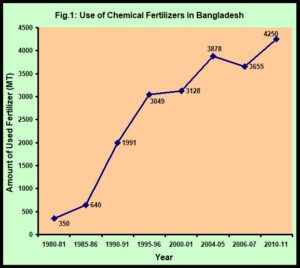
The figure shows that until the decade of 90s the use of chemical fertilizers was not so high, which was very rapidly increased about five times during the period of 1985 (640 MT) to 1995 (3049 MT), and since then it has been increasing rapidly. This repaid increase is the drastic liberalization of agricultural trade by the then military government, which implemented the structural adjustment policy of the WB in a wholesale manner. The figure also shows that the use of chemical fertilizers has increased 12 times from 350 MT to 4250 MT within only last three decades, from 1980 to 2011.
Handbook of Agricultural Statistics 2007 also shows that, next to Korea (379 kg/ha), Japan (282 kg/ha), and China (225 kg/ha), fertilizer consumption in Bangladesh is the highest among the Asian countries. Even in the neighboring country, India (102 kg/ha) it is much lower than that of Bangladesh (159 kg/ha). However, excessive use of chemical fertilizers is not only hazardous for health & environment but also a major cause of soil fertility degradation. The soil organic matter status, which is called the ‘life of a soil’ has gone below 0.5% in many soils of the country, while the optimum amount of organic matter is 5%. The assessment committee for losses of soil fertility (BARI, 2004) reported that 10-70% soil fertility has been depleted in different AEZ of Bangladesh during the period of 1967-68 to 1997-98 due mainly to intensified crop cultivation. If this situation is not properly handled, then, undoubtedly, our soil will not be able to produce sufficient food for future generations, which is a grave concern for the food security of the country.
5. Production of safe & nutritious food
Ensuring the availability of food grains may be the solution for mitigating hunger, but not for food security. Because, for food security, it is essential to ensure the availability of safe and nutritious food. But, chemical-intensive modern agriculture produces food full of poisons because huge amounts of poisonous chemicals are being used in different stages of the food supply chain, from production, processing, and preservation.
The plant protection wing of the then-Pakistani government first imported pesticides in Bangladesh in 1956. At that time, the pesticides were supplied to farmers at free of cost. The Bangladesh government, after the liberation, continued to give a 100% subsidy to pesticides until 1974, which was reduced by 50% in 1979. The government fully cut off the subsidy and invited the private sector to import pesticides in 1980 under the structural adjustment program of WB. Despite the removal of subsidies, the use of pesticides doubled (Figure 2) 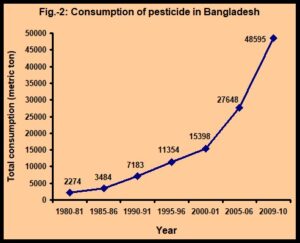 during the period of only five years, from 1985 to 1990, which indicates the dependency of farmers on pesticides that was created through providing subsidies during previous years. The figure also shows that the use of pesticides in 1980-81 was 2274 metric tons (MT), which increased to as high as 48595 MT in 2009-10. That means pesticide use increased 21 times over the period of only three decades, from 1980-81 to 2009-10, which seems to be increasing at a rapid rate in the future. This trend also indicates that all efforts of promoting integrated pest management have virtually been failed in the country. In this context, it is a big question how it is possible to ensure food security with the poisonous food produced by modern agriculture. But, it is undoubtedly true that modern agriculture has tremendously swelled the pesticide and fertilizer business of the corporations and their profit.
On the other hand, many of the modern varieties give higher yield by increasing the bulk of the food, not the nutritional status. Although the data presented in Table 1 shows that Bangladesh has been a food surplus country for the last few years but FAO data on nutrition gives us a reverse message. The FAO data says that the rates of malnutrition in Bangladesh are among the highest in the world. More than 54% of preschool-age children, equivalent to more than 9.5 million children, are stunted, 56% are underweight, and more than 17% are wasted.
The data further says that Bangladeshi children also suffer from high rates of micronutrient deficiencies, particularly vitamin A, iron, iodine, and zinc deficiency. Malnutrition among women is also extremely prevalent in Bangladesh. More than 50 percent of women suffer from chronic energy deficiency. It is also well-known to all that due to the consumption of poisonous food, the health hazards and disease occurrence are increasing at an alarming rate in the country. It is therefore crucial to rethink the production system of the country in no time to foster the production of safe and nutritious food at any cost.
6. Control over seed & genetic resources
The farmers are losing their inherited and hundreds of thousands years control over agriculture of the country day by day under the regime of the neo-liberal market economy. The market players are gradually taking the driving seat in our agriculture, where the farmers have little space. It is the seeds that led the whole process. Seed is not only a production input but also the key factor to regulate the whole agricultural production system. It is also linked to the whole lifestyle of a community, including the culture, religious beliefs, food habits, etc. Seed is the holder and carrier of the crop diversity of a country and the region, leading to a unique agricultural system. So, the question of ownership of seed resources is a vital agenda for the very existence of the traditional agricultural system of the country as well as the livelihood of the farmer community. Nowadays, after the inclusion of agriculture in the trade liberalization agreements of the WTO, the multinational corporations have identified the seed business as a thrust sector for their monopoly agribusiness. In order to achieve their target, they have been introducing hybrid and GM varieties and using terminator technology so that the farmers fail to produce & preserve their own seeds for cultivation, that are eradicating farmers’ own seeds from their hands. Introduction of such varieties is promoting the business of agrochemicals, agro-equipment, and other highly expensive technologies of the multinational corporations. As a result, the peasants are becoming fully dependent on the corporations for their crop production. This sort of dependency is a great threat for the sustainability of the poor peasants of Bangladesh in agriculture and also to the sovereignty of the country itself.
Bangladesh is very rich in biodiversity, with thousands of species of crops, plants, animals, birds, etc. The culture of the country has been developed based on this biodiversity. Bangladesh is famous for its cultural heritage, popularly known as “Thirteen festivals in twelve months,” which were based on diversified crops and the cropping seasons of the country. The Bengalese were world famous for their hospitality, which was also based on crop diversity enriched with diversified food habits. Special varieties of rice and other crops were cultivated for special types of food items. The ever-increasing monoculture of HYV rice has been destroying the invaluable biodiversity and cultural heritage of the country. The irrigation block of HYV boro rice restricts the cultivation of pulses, oilseeds, vegetables, etc., which is also a threat to the food security of the country, especially in terms of nutrition uptake. It has also massacred the socio-economic structure of the country. A large number of alien species/varieties of different crops have already been introduced in the ecosystem of the country without prior and proper scientific investigation on their possible impact on the ecosystem and native species. The National Seed Approval Committee of the government of Bangladesh approved the import of hybrid seed in 1998 without any prior assessment of the impacts of such seeds on our agriculture, environment & ecosystem. In addition, very recently, Bangladesh has entered into an agreement with Cornell University of America and USAID that will promote genetically modified crops, which are reported to be destructive to biodiversity, and that’s why GM crops are banned in many countries of the world, including Europe.
The peasants of Bangladesh are already experiencing a severe seed crisis. The problems of ever-increasing market price, businesspersons’ manipulated seed crisis, below-quality seed, lower germination rate, etc., are increasing day by day. The crisis must reach a peak when the corporations will take total control over the seed resources of the country. The corporations have already occupied about 80% of the vegetable seed market, and it is so far, 20% for rice seed market in the country. In the global context, the top 10 seed companies account for $14,785 million – or two-thirds (67%) of the global proprietary seed market (ETC Group 2007). It is not far away when the multinational corporations will capture the whole seed market of the country, and that situation must be suicidal for the farmer as well as for the freedom and sovereignty of the country.
Since the early 1970s, the pesticide industry has gone through a period of consolidation. Today, after a flurry of mergers and acquisitions, corporate domination, specifically over the agrochemical market and the food system in general, has reached a peak. The top five agrochemical companies, Syngenta (a merger of Novartis and AstraZeneca), Aventis (Rhone-Poulenc and AgroEvo), Monsanto (present name Pharmacia), BASF, and DuPont hold dominant positions in the seeds, pesticides, pharmaceuticals, and related markets. Presently, these companies account for nearly two-thirds of the commercial seed market and virtually 100 per cent of the market for GM seeds. Monsanto alone occupies 91% of genetic crop of the world (ETC Group 2007). Only three big companies, Monsanto (Pharmacia), Aventis Crop Science, and Syngenta, are controlling the major part of the world’s agriculture and the seed market. Such control is established by the monopoly ownership of world genetic resources facilitated by the patent law under TRIPS agreement of the WTO. The present trend of such monopoly control of MNCs over the genetic resources, along with mergers and acquisitions among the MNCs, apparently signals that the control of the world food chain is going into the grip of a few MNCs.
In the year 1970, the BRRI was established to develop high-yielding rice varieties that were better suited to local growing conditions and the ecosystem. So far, the institute has developed 51 HYVs and 2 hybrid varieties, BINA has developed 8 varieties, BAU has developed one variety, and BSMRAU has developed one rice variety. On the other hand, BARI has developed 21 varieties of wheat, 4 of maize (including 3 hybrid varieties), 32 of potato, 24 of pulses, 21 of oilseeds, 41 of vegetables,s and 26 of fruits. Those varieties are not patented, and on-farm conservation is possible by the farmers (except for the hybrids). If we even take the point that we have no other way but increasing the crop yield to meet up the growing demands of food for the increasing population of the country then our research institutes have already proven their capacities and potentials in this regard. Moreover, there is still a huge gap between the yield potentials of these varieties and the yield in farmers’ fields. The main reason for this gap is the lack of capacity of the farmers to manage these varieties with intensive technologies and external inputs for getting better yields. Lack of capital and the crisis of seeds, fertilizers, diesel, electricity, etc., are also very vital reasons for the yield gap. So, it is essentially a logical question that “Why should we go for importing exotic varieties in the name of increasing crop yield without solving the aforesaid problems?”.
The ownership and control of seeds concentrated in too few hands and a food supply based on too few varieties planted widely are the worst option for food security. On the other hand, it will be a disaster for the poor farmers in the least developed and developing countries like Bangladesh because traditionally they rely on farm saved seeds and only enter the market to purchase seeds about once in about once in several years. But, if they buy and plant patented seeds, companies can insist that they purchase new seeds every year. Seeds are often sold in a package with fertilizers, pesticides, which further increases farmer’s dependence on the market, while also increases the risk of indebtedness when crops fail due to adverse climatic conditions. It would also decrease farmers’ access to seeds, reduce efforts in publicly funded plant breeding, increase the loss of genetic resources, prevent seed sharing and could put poor farmers out of business.
Transformation of the agriculture of Bangladesh
In order to understand the transformation of agriculture of Bangladesh from the farmers view points ten FGDs were conducted with the farmers in ten villages of four unions under Shailkupa upazila of Jhenaidah district. It is to mention that the villages are located within the Ganges-Kobadak (G.K) irrigation project area. Mainly the aged farmers were selected as FGD participants so that they can describe the transformation from their own experience. Female were also participated in the FGDs. Several in-depth interviews of selected farmers from the FGD participants were also conducted. Moreover, data of crop production cost were also collected from the same participants. The findings of the FGDs, in-depth interview and the collected data are described below as a summary.
The Milestone of Transformation
It was very difficult for the participants to remember the exact time when the transformation towards modern agriculture was started. But, they could clearly identify that with the start of GK project the modern agriculture was initiated. Since then irrigated boro rice cultivation was started with the water of GK project. It is to note that G.K project is the first irrigation project of Bangladesh which was conceived in 1954 and came into full operation since 1961. But unfortunately, it became a failed project due mainly to Farakka barrage at upstream of the Ganges river established by India since it began operations on April 21, 1975. The GK project had totally failed to supply water during 1992-1996 due to low flow in the river Padma. The project became operational again after signing of the water sharing treaty with India in 1996 but suffered from water scarcity almost every year. So, huge number of shallow tubewells has been set up by the farmers. Now, the irrigated boro cultivation is totally depended on under ground water irrigation by shallow tubewell. At the start of GK project irrigation was very cheap, BADC supplied seeds of HYV at free of cost, DAE supplied pesticides at free of cost. The farmers had to buy only 10-15 kg of Urea fertilizer for one acre of land at very low cost. But, they got almost double (50-60 mounds/acre) yield than that of local variety (25-30 mounds/acre). The cost of production was only little higher than the traditional varieties but the yield was almost double. So, the farmers easily accepted the new varieties and technologies. Before that the farmers had their self-reliant and integrated production system. every farm family produced varieties of crops mainly for their family needs.
Impacts of the transformation from the Farmers’ Perspective
Although transformation from subsistence to commercial farming increased the yield and production of rice but the farmers by turn have been fallen into various problems. One of the root causes of the problems is that the market dependency for agricultural production is being increased day by day and the farmers are losing control over the agricultural production system to the market or market players. The source of agricultural inputs before and after green revolution is presented in the table below.
Table 2: The Sources of crop production inputs before and after the green revolution.
| Production activities | Before the green revolution | After the green revolution | ||
| Inputs | Source | Input | Source | |
| Land | Own, Local | Land | Own, Local | |
| Labour | Own, Local | Labour | Own, Local | |
| Capital | Own, Local | Capital | Own, Local, NGO, Commercial Bank | |
| Land preparation | Country plough, ladder, cow | Own, Local | Tractor, power tiller | Market |
| Seed sowing | Local Seeds | Own, Local | HYV, Hybrid seeds | Market |
| Fertilizer use | Organic fertilizer | Own, Local | Chemical fertilizers | Market |
| Pest control | Indigenous method with local materials | Own, Local | Chemical pesticides | Market |
| Weeding | Hand weeding instruments | Own, Local | Chemical weedicides | Market |
| Irrigation | Local irrigation materials | Own, Local | Deep & shallow tube well, surface irrigation pump, electric motor, diesel, etc. | Market |
| Harvesting | Cow | Own, Local | Harvester machine | Market |
From the table-2 it is observed that after the introduction of green revolution technologies, farmers have become totally depended on the market for their production inputs and technologies. As all crops have become cash crops and the whole production system has become market oriented then it is clear that the agriculture of the country is no more at subsistence level rather it has been transformed into commercial agriculture governed by the corporations. It was subsistence when farmer produced crop for their food & other family needs. They sold only the surplus of their products to the market. They selected crops based on their food culture and considering other family needs which is very rare now-a-days.
The transformation has got both positive & negative impacts on various aspects of social, economic, cultural, health and environmental life and livelihood of the farmer community which were stated by the farmers are briefly described below.
According to the farmers’ opinion both the yield and total production of food grains eg. rice and wheat and vegetables have substantially been increased. It is important to note that earlier vegetables were mainly homestead products. Most of the vegetables were produced in the homestead by the women. Now, the vegetables are mainly cultivated in the field as a cash crop. Earlier Jute, Cotton, sugarcane were mainly cash crops but now every crop has become cash crop. However, the yield of pulses (lentil, gram, mung bean etc), oilseeds (mustard & sesame) spices (onion, garlic, chili, turmeric) has also been increased substantially but total production has been decreased because the production land of these crops has been occupied by rice and wheat. As a result, monoculture of rice has drastically been increased. Now-a-days only rice is being cultivated in more than 80% of land resulting in reduced crop diversity which is very much necessary not only for food security and meeting up diversified family needs but also maintaining soil fertility status, reducing risk of crop failure and conservation of biodiversity and environment.
The production cost and profit/loss of paddy in different growing season is presented in fig.-3. 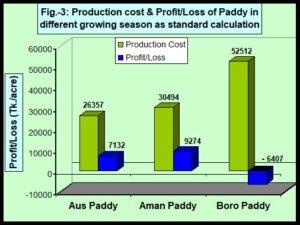 The data presented in the figure and shows that average production cost for Aus, Aman & Boro rice are 26357, 30494 and 52512 Tk./acre respectively. The cost of production for boro rice is due mainly to very high irrigation cost. The data also shows that net profit for Aus & Aman rice are 7132, 9274 Tk./acre respectively while it is a loss of 6407 Tk./acre for boro rice. The data reveals that rice cultivation is not much profitable while farmers have to count substantial loss for cultivating boro rice. Therefore, it is a big question why farmers cultivate rice when it is not much profitable or even loss. the answer will be found later on.
Comparative profitability of some other major crops of Jhenaidah district is shown in figure-4. 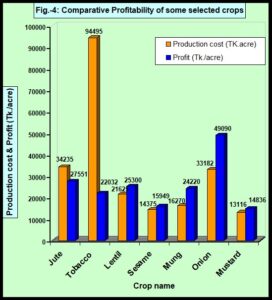 The data presented in the figure shows that Onion is the most profitable (49090 Tk./acre) followed by Jute (27551 Tk./acre), Lentil (25300 Tk./acre), Mung bean (24220 Tk./acre), Tobacco (22032 Tk./acre), Mustard (14836 Tk./acre) and Sesame (14375 Tk./acre). It is therefore, clear that all of these crops are more profitable than rice. It is important to note that though the profitability of tobacco is higher than mustard & sesame but its’ cost of production is very much high triple or more than that of the other crops. The farmers become interested in cultivating tobacco mainly because the market is ensured; they get the inputs in credit from the company; and get return at a time that seems to be big amount of cash for them.
However, it is a big question that why farmers cultivate rice as it is not profitable for them. In finding answer of this question it was found that farmers never calculate their profit/loss as a professional businessmen though agriculture is now a business for them. They just calculate yield & total production and their values. Even they don’t calculate their total investment for a crop production. It is to mention that the data presented in the previous figures were calculated by standard method where value of their own resources eg. cow dung, their own and family labour, lease value of land and the interest of their running capital were also included to the cost of production which is never calculated by the farmers. Generally, they compare the profitability of different crops just from total production and the market price. Actually, they don’t calculate the profit or loss rather they just calculate the total return from a crop. For example, from one bigha (46 decimal in local measurement) of land they get approximately 25 mounds of rice. So, if the price of per mound rice is 800 Tk. then they get the return of Tk. 20,000 from one bigha while it is 19,200Tk, 15,200Tk, 12,500Tk and 10,400Tk for Mung bean, Lentil, Mustard and Sesame respectively. Therefore, according to farmers’ perception, the most profitable crop is tobacco followed by onion, Jute, Rice, Mung bean, Lentil, Mustard and Sesame (fig.-5).
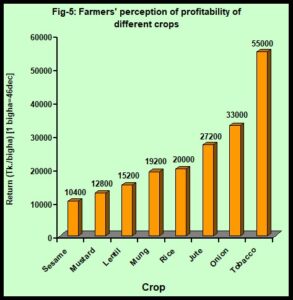
From the above discussions, it can be concluded that farmers never see agriculture as a business, though they have already entered into the commercial production system. As a result, they are being easily exploited by the market players. On the other hand, they continue their production even though it is not profitable for them because they have no other alternative. They are just serving the market players as a slave while the market players and the corporations become bigger and larger out of the agribusiness by extracting profit from the poor farmers.
Overall results of introducing green revolution technologies
The farmers identified results of the introduction of green revolution technologies as follows.
- At initial stage yield was increased very rapidly but now it is stagnant or in decreasing trend.
- Farmers have lost their self-reliant production system.
- The cost of production has drastically been increased resulting of decrease in profitability.
- Due to increased market dependency of farmers the market players are exploiting farmers in many ways. Farmers are being exploited by the market during buying inputs and selling their products and they are not getting fair prices of their products.
- The production of Pulses, oilseeds and spices has been decreased drastically. So, the farmers have to buy those from the market with very high prices.
- Farmers specially women have lost their seed resources.
- Use of local resource based inputs is decreased or eliminated.
- Use of chemical fertilizers and poisonous pesticides has been increased very much.
- The biodiversity and crop diversity has been reduced.
- Agro-ecosystem has been ruined.
- Soil fertility status has drastically been depleted.
- Insect occurrence and disease infestation has been increased manifold.
- Climate has been changed and disasters like, drought, flood, water logging, salinity, cyclone etc. have been increased.
- Ground water table has gone down resulting in scarcity of drinking & irrigation water.
- The risk in crop production has been increased manifolds. Thus the farmers’ tension for protecting their crops has been increased.
- Environment has been degraded.
- Health hazards and diseases have been increased manifold. So, the treatment cost has been increased.
- The fish resources have almost been abolished.
- Production of livestock and local chicken, duck etc. has been drastically reduced.
- Farmers have lost their indigenous knowledge of crop production. Farmers have been depended on external sources or market for their production technologies.
- Opportunity for women to participate in production system is reduced.
- Rural cultural elements have been demolished.
- Farmers’ opportunity of leisure & recreation has been reduced.
- Family bondage and social harmony is destructed. Individualism has been increased.
The list could be longer but this is enough to realize that how much we have lost by dint of single gain of increasing production of food grains.
Macro perspective of the transformation
It is clear from the previous discussion that the agriculture of Bangladesh is already transformed into a commercial form. While Dr. Hassanullah (2008) termed the present situation of Bangladesh Agriculture as a transitional phase. He said, “Agriculture in Bangladesh, as well as in many other developing countries, is passing through a transitional phase of transformation from subsistence to commercial in nature. During the last three decades from the seventies to the nineties, an enormously large investment was made for agricultural development in various sub-sectors and commodities supported by donor agencies. Some of those programs were rapid expansion of public sector input distribution systems in the sixties and the seventies, intensive crop development programs (sugarcane, jute, tobacco, wheat, maize, oilseeds, minor crops, horticulture) in the seventies, merging six organizations and introducing the Training & Visit model through Extension & Research Projects and Agricultural Research Management Projects in the eighties, Crop Diversification Projects, Agricultural Services Innovation and Reform Projects, Agro-based Industries and Technology Development Projects and Seed and Fertilizer Projects in the nineties, etc.” It is needless to mention that all of the aforesaid programs and projects paved the way for the corporation to intervene into the market of the country that led to the commercial formation of our subsistence agriculture. Most importantly the structural adjustment program imposed by the WB enhanced the commercialization process by liberalization & privatization of agriculture sector of the country.
But unfortunately, it seems that such transformation is fully recognized neither by the farmers nor by the government policy makers while government still feels the necessity of commercialization. That’s why the draft NAP 2011 has set the priority of commercialization of agriculture from its subsistence nature. On the other hand, a report entitled ‘Transformation of Agriculture for Sustainable Development and Poverty Alleviation in Bangladesh’ published by the ministry of agriculture (2006) says, “In the face of rapidly changing national, regional and global economic environment, Bangladesh agriculture is facing the challenge to reinvent itself to withstand competition and at the same time continue to provide food and employment opportunities for the vast majority of the population. To this end, the Government is in the process of articulating a new vision for the sector, realizing that the past and current visions with relatively heavy emphasis on production of food are no longer adequate. In this process, the Government is seeking ways and means to make agriculture more competitive through incentive compatible policies and measures with the view to transforming the sector for sustainable agricultural development, food security and poverty alleviation within the overall framework of the country’s Poverty Reduction Strategy Paper (PRSP)”.
The report further says, “In spite of the existence of many problems and constraints to sustainable agricultural development in Bangladesh, a quiet agricultural revolution process has been taking place in the country. This process has evolved in response to emerging macro-economic policy and sector policy reforms. These policies included market and trade liberalization and substantial reduction in public sector intervention in agriculture. Driven by the farmers themselves and the private sector, agriculture is beginning to transform itself from a largely peasant based subsistence activity to a commercial entrepreneurial activity. The initiation of the transformation process was made feasible with the help of new technology, irrigation expansion and new opportunities to commercialization due to growth of the rural non-agriculture sector and improved rural infrastructure”.
Rationale for transformation into Corporate Agriculture
The agriculture production & marketing system prevailing in the country may be termed as corporate agriculture. It is argued that large-scale corporate agriculture is more efficient than peasant farming prevalent in the country. It leads to better allocative efficiency, induces higher private investment in agriculture, and results in higher output, income and exports (Mishra, 1997). In Bangladesh the average operational size of the landless holdings is only below 0.2 hectares including homestead, for marginal holdings it is 0.2 to 0.6 ha, for small holdings 0.6 to 1.0 ha, for medium holdings 1.0 to 3.0 ha and for large holdings it is ≥ 3.0 ha. Moreover, small farms are highly fragmented. Land transactions have led to further fragmentation making them non-viable in terms of resource use as well as family sustenance. The costs of fragmentation included increased travel time between farms and hence lower labour productivity, higher transportation costs of inputs and outputs, negative externalities for land quality improvement like irrigation, loss of land on boundaries and greater potential for disputes (Mani and Pandey, 1995). It is therefore may be the fact that the expected development of our agriculture is not possible by these tinny peasants. But unfortunately, the landless, marginal and small holding constitutes about 88% of the total holdings of the country. This is the key feature to be considered for any sort of development planning of the agriculture as well as of the country as a whole.
Although so far as efficiency is concerned, there is no conclusive evidence of farm productivity rising with increasing farm size, rather small farms have been found to have higher output per hectare (Toulmin and Gueye, 2003). In fact, land reforms drew their logic from the evidence which pointed to the inverse relationship between farm size and productivity (Lipton, 1993). Also, economies of scale are important not at the production level but at the processing stage which can be availed of under contract farming or co-operative processing arrangements (Vyas, 2001). If the argument of efficiency of large holding has any logic at all, it can still be practised by increasing the size of operational holdings even under the existing land laws by way of consolidation. Ownership of land is not a necessary condition for corporate agriculture. The case of India can be mentioned here as an example. Since agricultural sector in India, quite in contrast to the industrial sector, has functioned in a competitive environment – with very large number of producers and consumers in the market – there is no evidence to suggest that under the present system of peasant farming, allocation of resources is inefficient (Rao, 1995). If a proof is needed, it should be seen in the growth rate of agricultural production and changes in the efficiency of capital use. Agricultural production has grown at an average rate of 3 –3.5% per annum since the late 1960s and the marginal efficiency of capital in Indian agriculture more than doubled, from 0.150 in the 1960s to 0.414 in the 1980s (Mishra, 1997).
Further, the experiment of corporate farming in many developed and developing country situations did not succeed largely due to many internal and external problems of the agribusiness firms. For example, in Iran, most of the firms failed, when they were given large chunks of land for cultivation, due to the mismanagement which resulted from the lack of relevant experience. The main reasons were managerial in nature, like neglect of field improvement, no contingency planning, under-capitalisation, managerial inflexibility, and poor labour relations (Strohl, 1985; Johnson and Ruttan, 1994)). The external reasons included diseconomies of scale which suggested that there were limits to farm size growth worldwide (Johnson and Ruttan, 1994). Large-scale corporate farms failed in UK, Venzuela, Ghana, Brazil, and Philippines besides Iran despite the presence of significant ‘external economies of scale’ in terms of subsidised inputs including land, low interest credit, and tax and duty benefits (Johnson and Ruttan, 1994; Toulmin and Gueye, 2003). On the other hand, there have been many cases of success when the firms worked with local farmers under the contract system or leased in their land (Johnson, 1985).
Further, export-oriented agriculture requires large investments which only big agri-business enterprises can afford (Rangswamy, 1993). It is said that corporate farming is a must for stable production and export performance (Singh, 1994). It is also said that allowing companies to buy and operate land would open the doors to their technology in horticulture, food processing, etc. Further, if there is no ceiling on the assets of a firm, why should there be such a restriction on the farm firms or agribusiness enterprises? (Johl, 1995).
The key issue is how to protect the farmers, while allowing the companies to use their land where the farmers work as labour and suffer from the monopolistic contracts with the companies? (Dash, 2004). Also, in a country where the population pressure on agricultural land is already high, it is debatable whether captive or corporate farming is the most optimal use of agricultural or even degraded land. It already evident a major adverse fall out of such corporate agriculture in many developed and developing countries were displacement of large number of peasant farmers. By allowing companies to buy land will make farmers landless since the companies would offer prices which may be too tempting for the poor farmers to resist and they may not be able to negotiate fair prices for their land and find out alternative source of their livelihood. Land owners, therefore, would run the risk of becoming landless. It is already happening in the country while huge number of landowner farmers becoming landless everyday, moving towards the township in search of their livelihoods and living very inhumane life in the slums.
Therefore, the most vital question is how the holding size will be increased to get a minimum economic scale. There is not clear policy measures to solve this crucial problem which is the question of survival of 88% farming community. Without solving this crucial problem the government inviting the corporations that indicate the attitude that these small holders should get out of farming if they are not able to move on to more export-oriented and commercial crops. Only those who have the mindset, technology, management, and financial resources to face the challenge of the Second Green Revolution should be permitted to do farming as an agribusiness.
Forms & Impacts of Corporate Agriculture in Bangladesh
Three forms of corporate agriculture are found to be existed in the country which may be termed as i. Farmers’ Independent farming, ii. Direct Corporate Farming, ii. Contract farming. These are described below.
1. Farmers’ Independent Farming
It is the traditional farming system prevailing in the country run by the farmers independently though depends on existing market chain for marketing of their products. Although in this system the farmers seem to be independent but they are not independent at all. Because, in this system a set of middlemen exists in the market chain who, in fact, controls the market and extract almost the whole profit generated from agricultural production. In this system farmers usually don’t get fair price of their products though the price become double or triple at consumer level. In this system farmers are extorted by the market player in two ways. The farmers have to pay more and more when they buy the agricultural inputs from the market in one hand and get very less prices when they go to sell their produces in the market on the other. So, the market players are exploiting farmers both input and product market and getting huge profit while the farmers counting even loss from their products. The farmers are producing by investing their own land, labour, capital and shouldering all risks but in the end handing over their products to the market players like a slave.
On the other hand, in this system corporations mainly the corporations those are processing agricultural products also remain in vulnerable condition for uninterrupted supply of their necessary raw materials in time at reasonable price. Actually, the middlemen enjoy the most advantaged position in this system. As a result, this system is neither preferred by the corporations nor it is beneficial for the farmers.
2. Direct Corporate Farming
In this system corporation directly run their own production farm and sale the products to the consumers. In Bangladesh there are a good number of public, private & NGO farms those are run directly by the corporation. The farmers generally don’t have any role to paly in this system other than working as a labour.
Although this system gives the corporation certainty of supply of their raw materials it is, in fact, not much preferred by them because it increases their volume of investment and management cost. Moreover, it needs large scale land available for them at a reasonable price which is often a big constraint in a country like Bangladesh where land is very scarce and fragmented.
3. Contract Farming
Contract farming is the most preferable for the corporation because of its comparative advantages than the other two options as stated before. So, in more recent years, contract farming has been introduced more intensively by a number of private companies and NGOs as a part of their agribusiness ventures. Their primary focus is on high value agricultural products to cater to the needs of increasing urbanization and expanding international markets. Contract farming of tobacco is very well-known form of contract farming in Bangladesh. Besides, BRAC has introduced contract growing of vegetables and fruits for export market and poultry and milk production for domestic market. PRAN has been promoting production of high value fruits and vegetables for domestic as well as export market. Aftab Bahumukhi Farm Ltd. (ABFL) is one of the commercial breeding farms that has introduced contract farming for broiler and layers production and integrated it with a supply chain to serve the urban consumers. Proshika has introduced contract farming for organic vegetable and fruit production mostly for the urban and foreign consumers. These are some few examples of contract farming in Bangladesh.
Contract farming involves contractual arrangements, written or verbal, between farmers and companies, specifying one or more conditions of production and/or marketing of an agricultural product. Contracting may be horizontal and vertical. If two or more different stages are tied together, this is ‘vertical contracting’. If two or more parts are tied into one at the same stage of operation, this is ‘horizontal contracting’. If both vertical and horizontal operations are tied together, this is ‘circular contracting’. For example, in the broiler chicken industry there are various stages of operation, such as: hatching egg flocks, hatcheries, feed mills, feed stores, broiler production, processing, wholesaling, retailing and finally, the consumer of chickens. Contracting on any one of these stages is ‘horizontal,’ while contracting between any two of these stages is ‘vertical’. Contracting involving both horizontal and vertical operations is called ‘circular’. Conceptually, contract farming envisages five elements: (i) product specification in response to national or international markets; (ii) market specification, ensuring product delivery at agreed upon prices; (iii) resource supplies, including quality inputs, capital, credit and services; (iv) technical support, relating to production, harvesting and processing; and (v) risk sharing, specifying insurance against natural and market risks (Mandal et.al. 2004).
Because of the aforesaid five elements, contract farming is considered to be more advantageous for the farmers as it gives better marketing opportunity for the farmers and link them with wider market. As contract farming is a better option compared to the aforesaid two other systems many theorists are in favour of introducing contract farming as a solution of farmers’ deprivations in the neo-liberal market system as an way of getting fair price of their products. Before going for any conclusion in this regards we can consider following two cases.
Moreover, Sarwar (2008) reported that some agricultural processing companies initiated contract farming in Bangladesh in the late 1990s. The main objection with the contract farming is that the arrangements limit the farmers access to the market and the contractors usually pay less (administered price) to the farmers and sometimes they do not buy the products in seasons when price is high in the market rather they wait for the price to fall and then buys the produce in a cheaper price. The agribusiness farms are able to exploit the system as 1) the contracted i.e. the small farmers often do not understand the contract’s terms and conditions; 2) very informal setting of contract through the selection of group leaders from the farmers who are close to the agribusiness firms, and 3) small farmers do not have bargaining power to get the contract right. Farmers are not compensated with the production loss due to externalities. In a country like Bangladesh where 82 percent farmers are small producers (less than 2.5 acre land possession) and having no bargaining power in respect to their counterparts’ i.e. corporate business, contract farming as a means to achieve the new agriculture is not a prudent choice”.
However, although the contract farming has been in practice for quite some time, there are issues that have not been adequately analyzed or understood. Some of the key questions that need to be addressed are as follows: Who are the contract growers and what are the contractual arrangements? To what extent the contract farming benefits the contract growers? Has the contract farming contributed to a reduction of price spread between the producers and the consumers? What needs to be done to improve the performance of contract farming in the changing nature of trade liberalization? How it is solution of Farmers’ Marketing problems?
On the other hand, corporations are interested for High Value crops rather then necessary food crops essential for food security. For example, at present in Bangladesh contract farming is happening in case of tobacco, Shrimp, fruits, maize, vegetables, spices etc.. The corporations either produce junk food for domestic market or export to the foreign market the products produced as contract. None of these products are essential for food security. On the contrary those are detrimental for food security because those occupy very scarce farmland of the country which is not enough to produce essential food items for food security. It is to remember that company run not for ensuring food security but for profit. If maize cultivation becomes profitable for company to produce bio-fuel certainly they will go for producing maize.
In fact, it is known from experiences of other developing countries, and of India where contract farming is now widespread, that agribusiness firms producing for export tend to undermine the local food production systems as they go in for export-oriented non-food crops by displacing area under basic food crops which is so crucial for local and national food security (Patnaik, 1996) and exploit farmers (Dash, 2004). Therefore, it is essential to become careful in time. It is obvious that company will never go for producing rice the staple food of the country because it is not high value crop for them. Such situation will be a great threat for the food security of the country.
Global Experiences of Corporate Farming
The draft NAP 2011 says “special attention will be given to post-production technologies, high value crops, value addition, agri-business management and trade. Enabling conditions will be created to expand local and overseas markets for agri-business opportunities”. It could be realized from the NAP that the government is eager to invite the large investors in agriculture who will produce high value crops like Tobacco, Shrimp Maize, Strawberry, BAUKUL, Dragon fruit, other fruits, organic vegetables mainly to feed the high value consumers living in the cities or export to the market abroad to earn raw foreign exchange. This trend is already happening in the country as discussed before. Many corporations, private entrepreneurs and corporate NGOs in the country investing in agriculture either to produce junk food or raw & processed food for the domestic or foreign market. Perhaps government is thinking to promote such high value agriculture in a large scale in the name of commercialization of our agriculture. If it happens it will, undoubtedly, be suicidal for the sake of food security of the country.
On the other hand, government is enthusiastic to promote competitiveness through commercialization of agriculture (Draft NAP 2011). It seems to be good from commercial perspective but the question is that with whom the poorest of the poor farmers of this country will compete and under what conditions? Will they have to compete with the corporate giants as well as domestic or foreign large-scale investors? Do they have that capacity? It is fact that the small, marginal and landless farmers of the country who constitute 88% of the farming community already in an unequal competition with the highly subsidized large-scale gigantic farmers of the developed and developing countries in the neo-liberal market of the country opened up by the pressure of WB, IMF and other donor agencies under the regime of WTO and its’ AoA. We should be proud that our farmers still surviving very boldly and courageously in such an unequal competition for last many years. This competition is not simply unequal, it is in fact, a competition between a bicycle with an aeroplane. Therefore, it should be clear what is the further competitiveness to be created by the government.
However, it is real fact that over the past three decades the rich countries of the north have forced poor countries to open their markets, then flooded those markets with subsidized food, with devastating results for Third World farming. But the restructuring of global agriculture to the advantage of agribusiness giants didn’t stop there. In the same period, southern countries were convinced, cajoled and bullied into adopting agricultural policies that promote export crops rather than food for domestic consumption, and favour large-scale industrial agriculture that requires single-crop (monoculture) production, heavy use of water, and massive quantities of fertilizer and pesticides. Increasingly, traditional farming, organized by and for communities and families, has been pushed aside by industrial farming organized by and for agribusinesses. The focus on export agriculture has produced the absurd and tragic result that millions of people are starving in countries that export food. In India, for example, over one-fifth of the population is chronically hungry and 48% of children under five years old are malnourished. Nevertheless, India exported US$1.5 billion worth of milled rice and $322 million worth of wheat in 2004 (FAO, 2004).
In other countries, farmland that used to grow food for domestic consumption now grows luxuries for the north. Colombia, where 13% of the population is malnourished, produces and exports 62% of all cut flowers sold in the United States. In many cases the result of switching to export crops has produced results that would be laughable if they weren’t so damaging. Kenya was self-sufficient in food until about 25 years ago. Today it imports 80% of its food and 80% of its exports are other agricultural products (Angus 2008).
The shift to industrial agriculture has driven millions of people off the land and into unemployment and poverty in the immense slums that now surround many of the world’s cities. The people who best know the land are being separated from it; their farms enclosed into gigantic outdoor factories that produce only for export. Hundreds of millions of people now must depend on food that’s grown thousands of miles away because their homeland agriculture has been transformed to meet the needs of agribusiness corporations. As recent months have shown, the entire system is fragile: India’s decision to rebuild its rice stocks made food unaffordable for millions half a world away (Angus 2008).
If the purpose of agriculture is to feed people, the changes to global agriculture in the past 30 years make no sense. Industrial farming in the Third World has produced increasing amounts of food, but at the cost of driving millions off the land and into lives of chronic hunger and at the cost of poisoning air and water, and steadily decreasing the ability of the soil to deliver the food we need for present & future generations. Contrary to the claims of agribusiness, the latest agricultural research, including more than a decade of concrete experience in Cuba, proves that small and mid-sized farms using sustainable agroecological methods are much more productive and vastly less damaging to the environment than huge industrial farms (Jahi Campbell 2008). Industrial farming continues not because it is more productive but because it has been able, until now, to deliver uniform products in predictable quantities, bred specifically to resist damage during shipment to distant markets. That’s where the profit is, and profit is what counts, no matter what the effect may be on earth, air, and water or even on hungry people (Angus 2008).
In search for alternative
It is obvious from the previous discussion that corporate agriculture may earn huge foreign exchange or make huge profit from domestic market and thus better contribute to the economic growth of a country but neither it is solution for food security nor for development of poor peasants of a country like Bangladesh. It is already mentioned that about 88% farm holdings of the country are small, marginal & landless categories who own maximum of 1 ha of land have been suffering much in the neo-liberal agricultural trading system. So, looking for any alternative, development issue of this big section of poorest population of the country must be prioritized. On the other hand, for producing safe and nutritious food for ensuring food security in the context of increasing climate change induced disasters must get equal priority. We should also remember that we can’t simply deny the regime of neoliberal market economy or agricultural trade.
However, if we first consider the survival issue of small, marginal & landless farmers then what should be alternative of corporate farming when it is necessary to increase the holding size for them is the first question. Mishra (1997) has given the answer of this question and proposed for a way to increase the holding size. He said, “If operational holdings are to be enlarged for more viable operations, that can be achieved by making the land lease market more efficient or by pooling land together under some co-operative enterprises, for collectively buying inputs and selling produce, if not for co-operative farming. If agricultural growth is to be shared in order to realise the virtuous circle of growth and distribution, only a peasant farming system using modern technology of production can achieve it, as the East-Asian experience has shown. Not only it is more competitive compared to the capitalist/corporate farming system, but also peasants do respond and adopt new technologies of production whenever opportunity arises. The experience of the Green Revolution in Punjab is an excellent example of this. Secondly, it is able to employ more labour as the peasant farmers substitute labour for capital much better, than the capitalist farming can ever do, given its normal motive to maximise profit (Mishra, 1997).
There is, however, a case for increasing the holding size at the lower end to make the holdings viable (Mani and Pandey, 1995). This can be done by provision of term credit through Land Development Banks to the small/marginal farmers below the poverty line, so that those willing could purchase land and increase the size of their ownership holdings (Rao, 1995). But, it may not help solve the problem of viability as it leaves no room for those at the lowest end who want to move out of it. The best course seems to be to have a free land market within the limits of land ceilings, with provision of land purchase credit facility for the small/marginal farmers. But, given the population pressure, family divisions, equal inheritance law, and deep-rooted attachment to land, even this policy may not wholly succeed in eliminating the unviable marginal holdings. About 15 years ago, a working group of agricultural economists under the chairmanship of late Sukhmoy Chakravarty, had come to the conclusion that introduction of a floor to the ownership holdings would be necessary to tackle the issue. The U.P. Zamindari Abolition and Land Reforms Act of 1950 accordingly has a clause fixing the floor limit at 1.26 hectare. It is another matter that this provision has never been implemented. Of course, it goes without saying that the floor limit will have to be different in different states just as the ceiling limits are different (Mani and Pandey, 1995; Mishra, 1997).
Finally, there is a need to look at contract farming alternative as it meets the needs of both corporate agribusinesses as well as small producers. The superiority of contract farming over corporate farming is evident in its more widespread and sustained practice as compared with corporate farming experiences (Winson, 1990) and in its positive impacts like producer link up with profitable markets, better farm incomes, skill upgradation due to transfer of technology, and sharing of market risk even in India (Glover and Kusterer, 1990; Benziger, 1996; Dileep et al, 2002: Deshingkar et al, 2003; Dev and Rao, 2004). It does not at least make small farmers landless unlike corporate farming. Even the environmental aspects of contracting are not as damaging as small farmers maintain control over farm operations which is good for environmental sustainability though when unregulated and not ethically practiced, it can lead to environmental degradation (Morvaridi, 1995; Singh, 2002) and exclusion of small producers (Warning et al, 2003; Singh, 2006a). Further, there is sharing of benefits in contracting as against corporate farming. Of course, this requires regulation and monitoring of contracting agencies by third parties or farmer organisations like co-operatives and farmer groups or the state. In general, contract farming has positive impact on non-contract growers and rural development in general if properly leveraged with state policy and local institutions like group contracts, though it is not a development tool (Goldsmith, 1985). It has been in practice in India for quite some time now with mixed results and more recently, there has been policy thrust on this mechanism of vertical co-ordination. Therefore, there is a need to build partnership into contract farming (Eaton and Shepherd, 2001) where companies not only offer contractual terms for working with farmers but also share their business risk and profits with producers as equity shareholders. It is being done successfully by a sugar company in Karnataka in south India.
On the other hand, for producing sufficient safe and nutritious food for ensuring food security in the context of increasing climate change induced disasters is a great concern for the country like Bangladesh. By following the prescription of the donor agencies of industrialist countries our policy makers are looking for the technological solution of the aforesaid problem while the intellectuals of the industrialist countries thinking differently.
John Ikerd (1996) an American educationist states “a lot of well-informed, educated people see a very different future — a “post-industrial” future for agriculture and the U.S. economy in general. They see a future in which “thinking,” — not just by the intellectually-gifted, highly-educated, and highly-paid few, but by people in general — is the key to success. The human mind will be the source of progress for individuals, families, farms, businesses, communities, and nations. “High-think” rather “high-tech” will be “buzz word” of the 21st century. A “post-industrial” paradigm for agriculture implies a future very different from the typical “high-tech” vision of continued agricultural industrialization”.
He further states, “American agriculture is in the midst of a great transition. Three basic factors foretell end of dominance for the industrial paradigm of agriculture. First, the logical, economic and social gains from industrialization of agriculture have already been realized. There is very little left to be gained from further specialization, mechanization, and routinization — industrialization — of agricultural production and marketing. Second, there are increasing problems — environmental, social, and economic problems — associated with continuing the industrialization process. The marginal costs of industrialization may have exceeded its marginal benefits as far back as two or three decades ago. Third, there is growing evidence the Industrial era has already ended in many sectors of the economy outside of agriculture and that agriculture will soon follow”.
“This industrialization of American agriculture resulted in the most efficient agriculture in the world, at least in terms of the dollar and cents costs of production. This in turn made it possible for this nation to build the strongest economy in world. Equally important, the farmer gets only a single penny out of that dime, while nine cents goes to the marketing and input firms. We now pay more for packaging and advertising than we pay the farmer to produce the food. Future gains from the further industrialization of agriculture must be squeezed from the farmer’s penny. There just isn’t much left in to be squeezed out to benefit either farmers or society. We just can’t make food much cheaper by putting more farmers out of business.”
“At the same time that the benefits to society of an industrial agriculture have declined, the perceived threats of agriculture — threats to the environment, threats to the natural resource base, and threats to the quality of life of farmers, of rural residents and society as a whole — have risen. The same technologies that support our large-scale, specialized system of farming — the industrial systems through which we have increased agricultural productivity — have now become the primary focus of growing public concerns. Industrial systems historically have degraded their environment and depleted their natural resource base. Commercial fertilizers and pesticides — essential elements in a specialized, industrialized agriculture — have become a primary source of growing concerns for environmental pollution. Industrial systems of crop and livestock production also degrade the human resource base. Factory farms transform independent decision makers into farm workers — people who know how to follow instructions or directions but not necessarily how to think. The early gains of appropriate specialization in agriculture lifted people out of subsistence living and made the American industrial revolution possible. But agriculture was the most ill-suited of all sectors for fully-industrialized, factory-like operations. Thus, full industrialization of agriculture occurred last, generated fewer benefits, created more environmental and social costs, and as a consequence, will likely last for a shorter period of time.”
“So, there are logical reasons to question further industrialization and to believe that the future will be very different from the past. An alternative paradigm for U.S. agriculture, a new paradigm arising under the conceptual umbrella of sustainable agriculture, represents a logical, realistic, positive alternative to industrial agriculture”. The paradigm of sustainable agriculture has emerged to solve problems created by the industrial model, primarily pollution of our environment and degradation of our natural resource base. However, this new paradigm seems capable of creating benefits the industrial model is inherently incapable of creating, such as greater individual creativity, dignity of work, and attention to issues of social equity.”
The above statements can give us very important guidelines to set the goal of our agricultural development. If we really want our agriculture to be beneficial for majority small, marginal and landless farmers for their sustainable development as well as if we want to ensure our food security then we have to realize that only technical solution is not enough for that. We must recognize that food security and sustainable development of farmer are social, cultural, economic and political issues. On the other hand, climate change is an environmental & ecological issue. So, we have to think for an agricultural production system which is economically viable, socially just, environmentally & ecologically sound and culturally appropriate that is we need to adapt sustainable agriculture.
It is a matter of hope that the government policies also addressing the issues of sustainable agriculture at least in black and white. The last objective of the draft national agricultural policy is “establishing a self-reliant and sustainable agriculture adaptive to climate change and responsive to farmers’ needs” (draft NAP 2011). On the other hand, A report entitled ‘Transformation of Agriculture for Sustainable Development and Poverty Alleviation in Bangladesh’ published by MOA (2006) says “Conservation agriculture is a vital option to face a double challenge of increasing productivity and preserving the natural resource base, simultaneously”. But unfortunately, we see the reverse actions in practice whatever may be written in the policy documents. Therefore, concrete political decisions and subsequent actions are essential to address the issues successfully.
References
- Alliance for a Green Revolution in Africa.” http://www.agra-alliance.org/about/about_more.html
- Angus, I. (2008): Capitalism, Agribusiness and the Food Sovereignty Alternative, IV Online magazine : IV400 – May 2008 Food Crisis – part 2
- Campbell, J. (2008), “Shattering Myths: Can sustainable agriculture feed the world?” and ” Editorial. Lessons from the Green Revolution.” Food First Institute. www.foodfirst.org
- Dash, M. (2004): “Political Economy of Contract Farming”, Mainstream, 42(52), December.
- FAO: Key Statistics Of Food And Agriculture External Trade. http://www.fao.org/es/ess/toptrade/trade.asp?lang=EN&dir=exp&country=100
- FAO: http://www.fao.org/ag/AGN/nutrition/BGD_en.stm
- Hassanullah, M. (2008): Rescuing endangered agriculture: the case of Bangladesh, website published by INSAM, International Society for Agricultural Meteorology, available at www. AgroMeteorology.org
- Hattingh S. (2008): “Liberalizing Food Trade to Death.” MRzine, 2008. http://mrzine.monthlyreview.org/ hattingh060508.html
- IRRI (2008): Press Release, April 4, 2008. http://www.irri.org/media/press/press.asp?id=171
- Islam, S. (2010): Tobacco farming Impact From Peoples’ Perspective, Fact Sheet, Published by Unnayan Dhara, Jhenaidah, Bangladesh.
- Islam, S. (2010): Corporate Globalization and Agriculture of Bangladesh, Published by Unnayan Dhara, Jhenaidah, Bangladesh.
- Johl, S.S (1995):”Agricultural Sector and New Economic Policy”, Indian Journal of Agricultural Economics, 50(3), 473-487.
- John Ikerd (1996): SUSTAINABLE AGRICULTURE: A POSITIVE ALTERNATIVE TO INDUSTRIAL AGRICULTURE, Presented at the Heartland Roundup in Manhattan, KS — a conference sponsored by the Heartland Network, Lawrence, KS and the Kansas Rural Center, Whiting, KS, December 7, 1996.
- Johnson, D. A (1985):”Sabritas’ backward integration into agricultural production”, in J Freivalds (ed.): Successful Agribusiness Management, Gower, Vermont, 108-115.
- Johnson, N. L and V. W Ruttan (1994): “Why Are Farms So Small?”, World Development, 22(5), 691-706.
- Lipton, M (1993):”Land Reform as Commenced Business -The Evidence Against Stopping”, World Development, 21 (4), 641-657.
- Magdoff F. et.al. (2000): Hungry for Profit: The Agribusiness Threat to Farmers, Food, and the Environment. Monthly Review Press, New York, 2000. p. 11
- Mandal M.A.S.et.al 2004: Vertical Integration in Bangladesh Agriculture:The Case of Contract Farming for High Value Food Products. Bangladesh Journal of Political Economy Vol. 22, No. 1 & 2
- Mani G and V K Pandey (1995): “Agrarian Structure under the New Economic Policy”, Indian Journal of Agricultural Economics, 50(3), 524-530.
- Ministry Of Agriculture (2006): Main Report, Transformation Of Agriculture For Sustainable Development And Poverty Alleviation In Bangladesh, Ministry Of Agriculture, Government Of Bangladesh Dhaka, July 2006.
- Mishra, S N (1997):”Agricultural Liberalisation and Development Strategy in Ninth Plan”, Economic and Political Weekly, 32 (13), March 29, A19-A25.
- Mousseau F. (2005): Food Aid or Food Sovereignty? Ending World Hunger in Our Time. Oakland Institute, 2005. http://www.oaklandinstitute.org/pdfs/fasr.pdf. International Assessment of Agricultural Knowledge, Science and Technology for Development. Global Summary for Decision Makers.
- Rangswamy, G (1993):”Corporate Agriculture: The key to poverty eradication”, Guide on Food Products (GFP) Year Book, 114-116.
- Rao, C.H.H (1995):”Liberalisation of Agriculture in India – Some Major Issues” Indian Journal of Agricultural Economics, 50 (3), 468-472.
- Sarwar, M.G (2008): Apprehending Agriculture: Cease the implementation of WDR 2008 in Bangladesh, The Innovators, Dhaka.
- Singh, S. (1994): “Corporate farming: Risky step?” Financial Express, February 16, Mumbai.
- Singh, S. (2006): Corporate Farming in India: Is it Must for Agricultural Development? INDIAN INSTITUTE OF MANAGEMENT AHMEDABAD-380 015 INDIA, W.P. No.2006-11-06.
- Strohl, R. J (1985):”Farming failures: the fate of large-scale agribusiness in Iran”, in J Freivalds (ed.): Successful Agribusiness Management, Gower, Vermont, 133-146.
- Toulmin, C. and B. Gueye (2003): Transformations in West African agriculture and the role of family farms, IIED Issue paper No. 123, IIED, London, December.
- Vyas, V. S (2001):”Agriculture: Second Round of Economic Reforms”, Economic and Political Weekly, 36 (10), 829-836.
- World Bank (2008): President Calls for Plan to Fight Hunger in Pre-Spring Meetings Address.” News Release, April 2, 2008.
| List of Acronyms | ||
| ADB | : | Asian Development Bank |
| AoA | : | Agreement on Agriculture |
| AGRA | Alliance for a Green Revolution in Africa | |
| BARC | : | Bangladesh Agricultural Research Council |
| BARI | : | Bangladesh Agricultural Research Institute |
| BAU | : | Bangladesh Agricultural University |
| BER | : | Bangladesh Economic Review |
| BINA | : | Bangladesh Institute of Nuclear Agriculture |
| BRRI | : | Bangladesh Rich Research Institute |
| DAE | : | Department of Agricultural Extension |
| FAO | : | Food and Agriculture Organization of the United Nations |
| GDP | : | Gross Domestic Products |
| GM | : | Genetically Modified |
| HYV | : | High Yielding Variety |
| IMF | : | International Monetary Fund |
| IPM | : | Integrated Pest Management |
| MOA | : | Ministry of Agriculture |
| BSMAU | : | Bangabandhu Sheikh Mojib Agricultural University |
| NAP | : | National Agriculture Policy |
| NGO | : | Non Governmental Organisation |
| PRSP | : | Poverty Reduction Strategy Paper |
| TRIPS | : | Trade Relates Aspects of Intellectual Property Rights |
| WB | : | World Bank |
| WTO | : | World Trade Organization |
pdf version: Corporate Agr in BD & Alternative_compressed
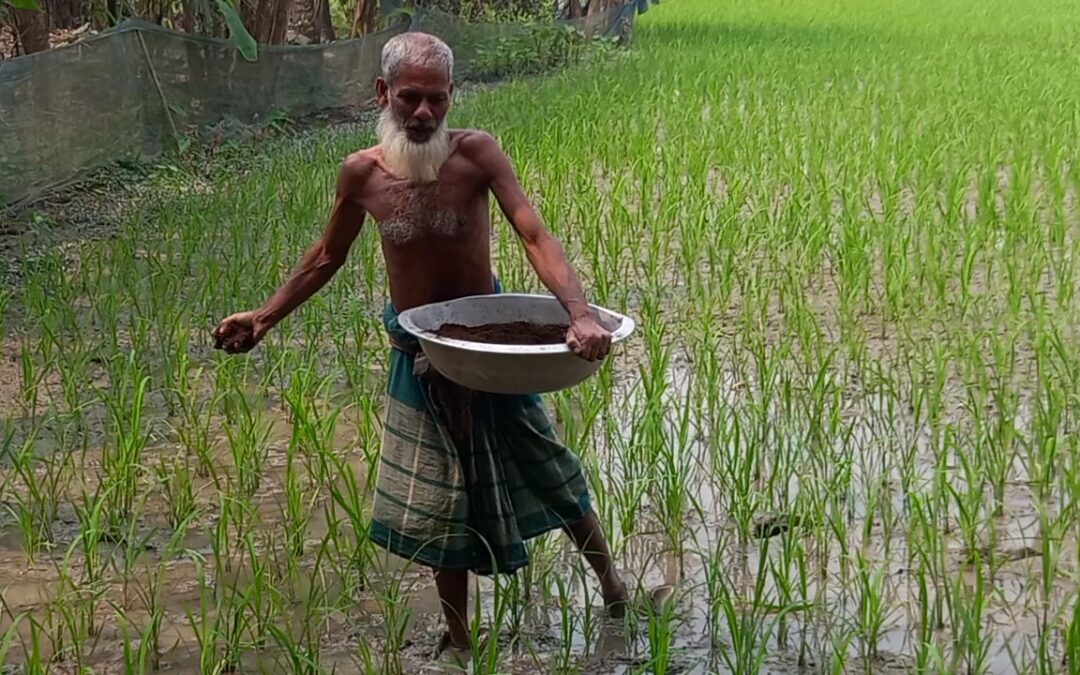
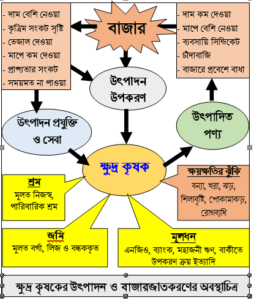
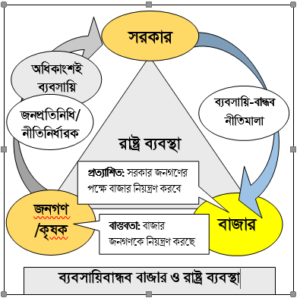 কাজেই এসব পণ্য উৎপাদন করে লোকসান গুনার কোন কারণ নেই। বাস্তবে লোকসান হয়ওনা। বাজারে চাল, ডাল, তেল, মসলা, তরিতরকারীর দাম দেখলেই এর সত্যতা মেলে। অথচ, অত্যন্ত দুঃখজনক হলেও সত্য যে, কৃষককে প্রতিনিয়ত লোকসান গুনে যেতে হচ্ছে। বর্তমান বাজার ব্যবস্থাই এ অবস্থার জন্য দায়ী। আর এই বাজার ব্যবস্থাকেই পৃষ্ঠপোষকতা দিয়ে যাচ্ছে আমাদের রাস্ট্র ব্যবস্থা। এর কারণ খুবই সুস্পষ্ট যা পাশের চিত্রে তুলে ধরার চেষ্টা করা হয়েছে।
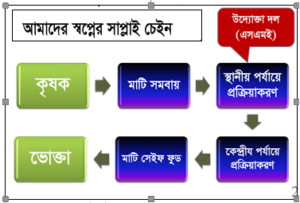 এজন্য প্রয়োজন কৃষক জনগোষ্ঠীকে সমবায়ে সংগঠিত করে সেই সমবায়ের নেতৃত্বে ক্ষুদ্র ও মাঝারী উদ্যোগ গড়ে তোলার মাধ্যমে কৃষক ও ভোক্তার মধ্যে সরাসরি সংযোগ স্থাপনরে মাধ্যমে একটি খাদ্য-ভ্যাল্যুচেইন গড়ে তোলা সম্ভব হলেই এই অত্যন্ত জটিল ও কাঠামোগত সমস্যার সমাধান সম্ভব বলে আমারা বিশ্বাস করি। সে লক্ষ্য নিয়েই মাটি একটি ছোট আকারের মডেল গড়ে তুলতে কাজ করছে। একাজে সংশ্লিষ্ট সরকারি বেসরকারি প্রতিষ্ঠানসহ সংশ্লিষ্ট সকল মহলের সার্বিক সহযোগিতা একান্ত কাম্য।